Custom AI vs ChatGPT vs Claude: Which Fits Your Team?
Custom AI gives you control over data and rules, while ChatGPT and Claude give you speed. Compare the three options on fit, cost and control before you choose.
On this page
Short answer
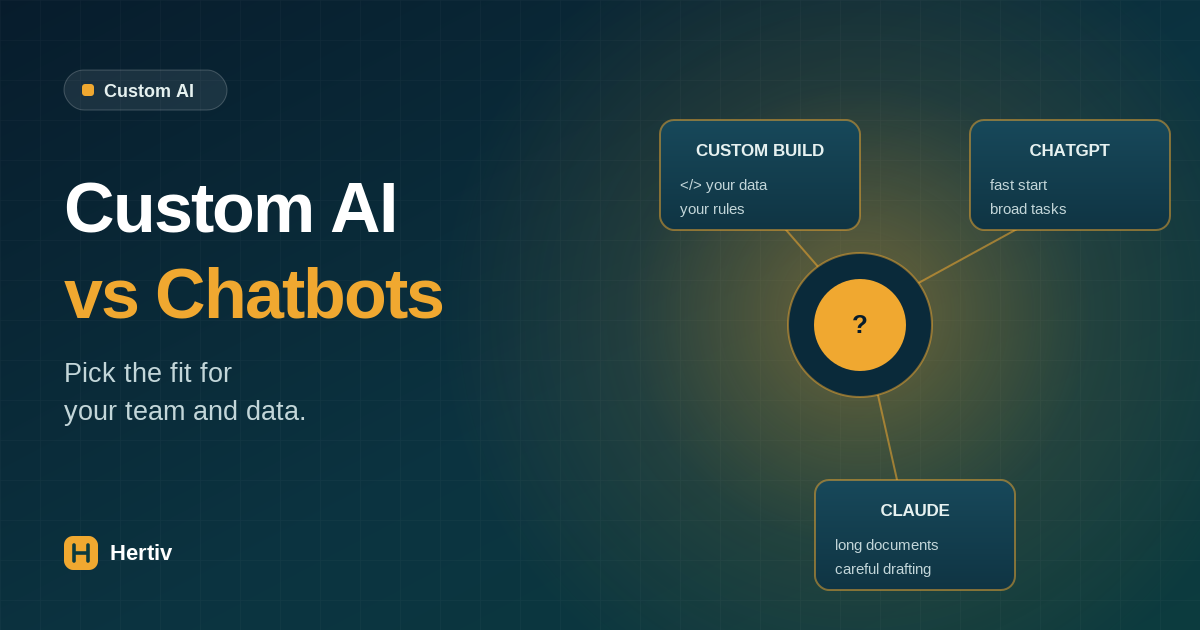
Custom AI is software built for your own workflow and data, while ChatGPT and Claude are ready-made products you use as they are. Choose custom AI for high-volume, rule-bound or sensitive work, and choose ChatGPT or Claude when you need to start fast on varied tasks.
What is the difference between custom AI, ChatGPT and Claude?
Custom AI is software built for one team and one workflow, while ChatGPT and Claude are ready-made AI products you use as they are. The difference is control: with custom AI you own the data flow, the prompts and the integrations, while with ChatGPT or Claude you rent a capable general model and shape it with prompts and settings.
ChatGPT, from OpenAI, and Claude, from Anthropic, are both general-purpose chat models that can write, summarise, code and answer questions. They are strong starting points, and many teams use one of them directly before deciding whether a custom build is worth it.
| Option | What you get | Best for | Main trade-off |
|---|---|---|---|
| Custom AI | Software built around your data and rules | Regulated or repeatable workflows | Higher upfront cost and build time |
| ChatGPT | Ready-made chat and API from OpenAI | Fast start, broad tasks | Less control over data and behaviour |
| Claude | Ready-made chat and API from Anthropic | Long documents, careful drafting | Less control over data and behaviour |
The choice is rarely about which model is smartest. It is about where your data lives, how repeatable the task is, and how much control you need over what the system does.
When does a custom AI build make sense?
A custom AI build makes sense when the same task runs hundreds of times a day, follows your own rules, and touches data you cannot send to a third party. In that case, the cost of building is spread across a large volume of work, and the control is worth paying for.
Regulated work is a common trigger. If your team handles health, legal or financial records, a custom build lets you keep data inside your own systems, log every action and apply your own approval steps. A ready-made chat product may not offer that level of control.
Repeatable workflows are the second trigger. If the task is always the same shape, such as triaging tickets, extracting fields from contracts or drafting replies from a fixed template, a custom system can be tuned to that shape and measured against it. General chat tools can do the same job, but they need careful prompting every time.
Build when the task is high-volume, rule-bound or sensitive. If none of those apply, a ready-made product is usually the faster and cheaper path.
When is ChatGPT the better fit?
ChatGPT is the better fit when you need to start quickly, the task varies from day to day, and your team is comfortable working inside a ready-made product. It is a strong generalist, and its API makes it easy to add AI to an existing tool without building a whole system.
Teams use ChatGPT for drafting, brainstorming, code help, summarising and answering questions over documents. The breadth is the point: one product covers many small tasks, and the team learns what AI is good at before committing to a build.
The trade-off is control. Your prompts and data pass through OpenAI's systems, and the model's behaviour is set by OpenAI, not by you. For internal drafting and low-risk work that trade-off is usually fine, but for sensitive data or strict rules it needs a closer look.
Start with ChatGPT when speed matters more than control, and when the task is varied enough that a custom build would be guessing at the requirements. You can move to a custom build later, once you know which tasks are worth automating.
When is Claude the better fit?
Claude is the better fit when the work involves long documents, careful writing or multi-step reasoning, and you want a model that is cautious about what it claims. It handles long contracts, reports and codebases well, and it is a good choice for drafting that a human will review.
Teams use Claude for reviewing documents, drafting policies, writing code and working through complex problems step by step. Its strength is sustained, careful work on a single piece of material rather than quick, varied answers.
Like ChatGPT, Claude is a ready-made product, so the same control trade-off applies: your data passes through Anthropic's systems and the model's behaviour is set by the provider. For a direct comparison of the two chat products, see Claude vs ChatGPT.
Choose Claude when the work is document-heavy and accuracy matters more than speed. If your team mostly needs short answers and broad coverage, either product can work, and the choice comes down to which interface and pricing your team prefers.
How do the costs compare?
Costs compare on three axes: what you pay to start, what you pay per use, and what you pay to keep the system running. Ready-made products are cheap to start and charge per use, while a custom build is expensive to start and cheaper per use once it is running.
| Cost | Custom AI | ChatGPT or Claude |
|---|---|---|
| Starting cost | High: design, build and testing | Low: sign up and start |
| Per-use cost | Low once built, mostly hosting | Per message or per token |
| Running cost | Monitoring, updates, support | Subscription or API bill |
| Switching cost | High: the system is yours | Low: change product any time |
The break-even point depends on volume. A team that runs a few hundred AI tasks a month will almost always spend less on a ready-made product, while a team that runs hundreds of thousands may find a custom build cheaper over two or three years.
Do not forget the hidden costs. A custom build needs someone to monitor it, update it and fix it when the model changes. A ready-made product needs someone to manage prompts, access and usage. Either way, budget for a person, not just the software.
Example: choosing for a support team
Example (hypothetical): a software company receives 20,000 support tickets a month and wants AI to draft replies. The team compares three options using made-up rates to see how the numbers behave, not as real prices.
Option one is a ready-made chat product at a hypothetical $0.02 per ticket, which is 20,000 x $0.02 = $400 a month, or $4,800 over a year. Option two is a custom build costing $60,000 to build plus $4,000 a month to run, which is $60,000 + 12 x $4,000 = $108,000 in the first year.
The custom build is far more expensive in year one, but it keeps ticket data inside the company's systems and applies the company's own reply rules. The team decides to start with the ready-made product, measure which ticket types the AI handles well, and revisit the custom build once the volume and the rules are clear.
That sequence is the usual one: rent first, learn the shape of the work, then build only if the numbers and the control justify it.
What are the common mistakes?
The most common mistakes when choosing between custom AI, ChatGPT and Claude are building before the task is clear, picking a model on brand alone, and ignoring where the data goes.
- Building too early. A custom build locks in a design before you know which tasks are worth automating. Use a ready-made product first and learn.
- Choosing on reputation. The best model for your task is the one that performs best on your own examples, not the one with the most press. Test both on real work.
- Ignoring data rules. Sending customer or regulated data to a third-party model without checking the terms is a compliance risk, not a shortcut.
- No human review. All three options make mistakes. A workflow without a review step will let bad answers reach customers.
- No exit plan. If your prompts, history and integrations live in one product, switching later is painful. Keep your data and your evaluation set portable.
Key takeaways
- Custom AI means control over data, prompts and rules; ChatGPT and Claude mean speed and low starting cost
- ChatGPT is a strong generalist for varied daily tasks, while Claude suits long documents and careful drafting
- Ready-made products are cheap to start and charge per use; custom builds cost more upfront and less per use
- Test both chat products on your own real tasks before choosing
- Rent first, learn the shape of the work, and build custom only when volume and control justify it
Frequently asked questions
Can I use ChatGPT or Claude for customer data?
You can, but check the provider terms and your own data rules first. Some plans offer stronger data handling than others, and regulated data often needs a custom setup where data stays inside your own systems.
Is custom AI always better than ChatGPT?
No. Custom AI is better when the task is high-volume, rule-bound or sensitive. For varied, low-risk work, a ready-made product is faster and cheaper, and it lets you learn what AI is good at before you build.
What is the main difference between ChatGPT and Claude?
Both are general-purpose chat models, but they differ in how they handle long documents, drafting and multi-step reasoning. The best way to choose is to run the same real tasks through both and score the results.
How do I know if I need custom AI?
You likely need it when the same task runs at high volume, follows strict rules, or touches data you cannot send to a third party. If none of those apply, a ready-made product is usually enough.
Can I switch from ChatGPT to Claude later?
Yes, but switching is easier if you keep your prompts, test cases and data portable. A custom layer that sits above the model makes it simpler to change providers without rebuilding the workflow.
Does custom AI mean training my own model?
Not usually. Most custom AI projects use an existing model and add your data, prompts, rules and integrations around it. Training a model from scratch is rare and only fits very specific needs.


