Cultural Asset Tokenization: Real Use Cases That Work Today
Cultural asset tokenization turns art, collectibles and heritage rights into digital tokens. The use cases that hold up are provenance, fractional ownership and licensing.
On this page
Short answer
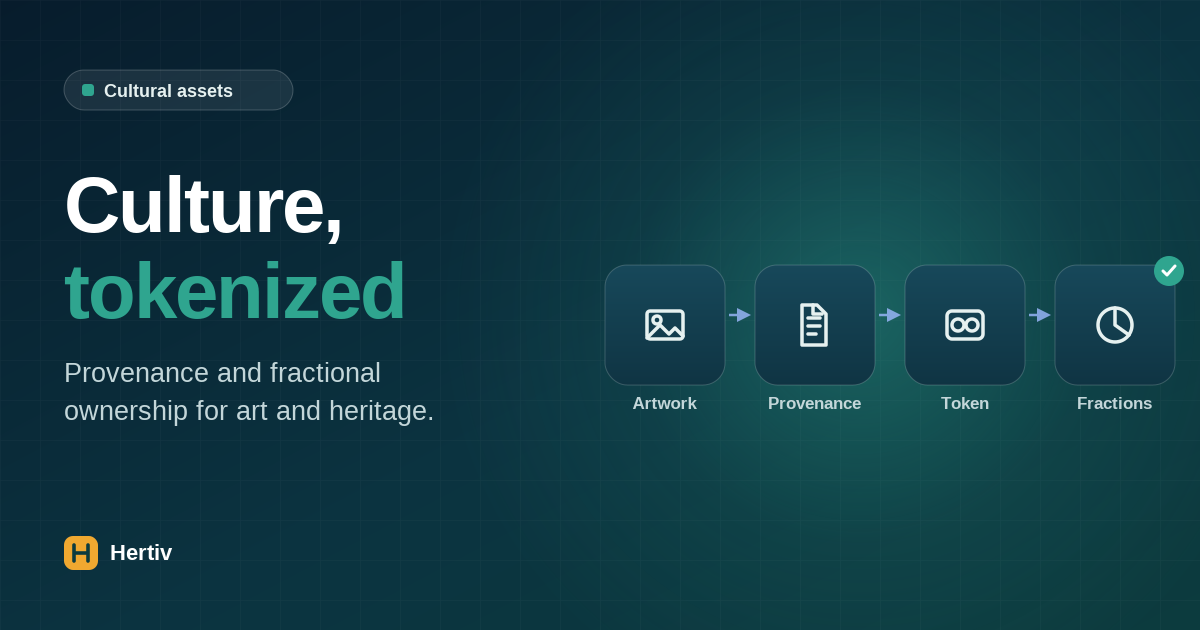
Cultural asset tokenization is the representation of artwork, collectibles, heritage objects or intellectual property rights as blockchain tokens. Practical use cases today are provenance tracking, fractional ownership of high-value pieces, and rights and royalty management for creative works.
What is cultural asset tokenization?
Cultural asset tokenization is the process of issuing a blockchain token that represents a claim, right or record tied to a cultural object such as a painting, a sculpture, a rare book, a photograph or a heritage site. The token is not the object. It is a digital instrument that points to the object, to a legal agreement, or to a registry entry.
This distinction matters for every design decision. A token can prove that a specific wallet held a record at a specific time. It cannot by itself prove that a physical painting is genuine. That still requires an appraiser, a conservator or a trusted institution. The token adds a shared, tamper-evident log around that human verification.
Teams often mix three layers and then argue about the wrong one:
- The physical or legal asset: the object, the copyright, the loan agreement.
- The off-chain record: custody documents, condition reports, insurance, rights metadata.
- The on-chain token: ownership register, transfer rules, royalty logic.
A workable project defines all three before writing a contract. If your legal team cannot describe who holds the asset and under which jurisdiction, tokenization will not fix that gap. Hertiv's blockchain consulting engagements usually start with this mapping step rather than with chain selection.
Which use cases actually work today?
The use cases that work are the ones where a token replaces a slow, paper-based or disputed record. Speculative trading of art fractions is the weakest case; provenance, rights management and controlled fractional ownership are stronger.
| Use case | What the token does | Data needed | Effort |
|---|---|---|---|
| Provenance record | Logs ownership and condition events | Custody docs, appraisals, condition reports | Low to medium |
| Fractional ownership | Splits a high-value piece into units | Legal opinion, custody agreement, valuation | High |
| Rights and royalties | Tracks licences and splits payments | Rights metadata, contracts, payout rules | Medium |
| Museum membership | Grants access or supporter status | Membership terms, identity checks | Low |
| Archive licensing | Issues time-limited usage rights | Catalogue metadata, licence templates | Medium |
| Heritage fundraising | Records donations and milestones | Project plan, donor terms | Low to medium |
| Authenticity certificate | Anchors a certificate hash on-chain | Certificate issuer, hash, revocation plan | Low |
The pattern is clear. Low-effort cases change how records are kept. High-effort cases change who can own the asset, and that is a legal and regulatory problem as much as a technical one. Pick the record-keeping layer first, prove it with one collection, then decide whether ownership changes are worth the legal work.
How does provenance tracking work in practice?
Provenance tracking anchors a hash of each custody or condition document on-chain so that later changes are visible. The document stays off-chain with the institution or the owner; the chain holds a fingerprint and a timestamp.
The flow is straightforward:
- The issuer registers the object with a stable identifier and a metadata record.
- Each document, such as a sale note, loan agreement or condition report, is hashed.
- The hash and a reference to the off-chain location are written to the ledger.
- Any later change creates a new entry rather than overwriting the old one.
This does not stop fraud at the point of entry. A false document can be hashed as easily as a true one. What it does provide is a clear audit trail: who added what, when, and whether a record was edited. For insurers, auction houses and lenders, that trail is often enough to reduce friction.
A small museum or private collection can run this with a single registry contract and an internal admin tool. The harder work is cataloguing, not coding.
When does fractional ownership make sense?
Fractional ownership makes sense when a single cultural asset is too expensive for one buyer, has reliable custody, and can be sold under a clear legal structure. It is the most regulated use case in this list, and the one most often attempted too early.
Before designing tokens, answer four questions:
- Who legally owns the object, and through which entity?
- Is the token a security, a fund unit or a pure collectible under the target jurisdiction?
- Who holds and insures the physical piece, and at what standard?
- How can a holder exit, and who sets the price?
If the answer to the second question is unclear, pause. Issuing fractional units without a legal opinion exposes the issuer and confuses buyers. Regulated structures usually look more like a fund or a special-purpose vehicle than like a simple NFT drop.
Example (hypothetical): a gallery places a work valued at 500,000 in a holding entity and issues 5,000 units at 100 each. It reserves 20 percent of units for the entity and sells the rest. The numbers are illustrative only; real structuring costs and fees vary by scope and jurisdiction.
The technical work here overlaps with broader real-world asset tokenization, including transfer restrictions, investor checks and payout logic. A cultural asset adds custody and conservation requirements on top.
How do rights, licensing and royalties fit in?
Rights and royalty management is often the most valuable cultural tokenization case, because the underlying rights are already documented and the pain is administration rather than ownership. Photographers, estates, music catalogues and image archives all deal with split payments and usage tracking.
A typical design:
- Each work has a rights record listing contributors and their shares.
- Licences are issued as time-limited, scoped permissions.
- Payments are split automatically according to the recorded shares.
- Licence events are logged so that usage can be audited.
The token does not create the copyright. It records an agreement about the copyright that already exists. That keeps the project inside existing contract law while improving speed and transparency.
Estates and small archives often benefit most, because they lack the back-office systems that large labels already run. The build is moderate: a registry, a licence contract and a reporting view for finance. Teams comparing scope and budget can read Hertiv's guide to tokenization platform costs before committing.
What about museums, heritage sites and public collections?
Museums and heritage bodies rarely need to sell ownership. Their useful cases are membership, supporter records, fundraising and licensed digital access. A token can represent a membership tier, a donation milestone or a time-limited right to use digitised material.
Three patterns come up repeatedly:
- Supporter tokens that record donations and grant access to events or previews.
- Licensing tokens for digitised archives used by researchers, publishers or educators.
- Provenance participation where a museum co-signs records for objects it has examined.
Public institutions face procurement rules, accessibility requirements and reputational risk. A failed experiment is more costly for them than for a private gallery. That argues for a narrow pilot with a defined end date and a clear statement that no national heritage is being sold.
Hertiv's enterprise blockchain work covers permissioned networks, which suit institutions that need controlled participation rather than open trading.
How to choose your first cultural tokenization project
Choose the project with the clearest records, the fewest regulatory questions and a single accountable owner. That usually means provenance or licensing before fractional ownership.
- Map the asset and the rights. List what is owned, by whom, under which contracts, and where the documents live.
- Pick the narrowest use case. One collection, one rights catalogue or one membership programme.
- Get a legal opinion. Confirm how the token is classified in each target market before design is fixed.
- Choose infrastructure that fits participants. A permissioned network for institutions; a public chain only when open participation is the point.
- Define success in operational terms. Fewer disputes, faster licensing or cleaner audits, not token volume.
Teams that need extra engineering capacity for a pilot often use hire blockchain developers rather than building a permanent team before the model is proven. Whichever route you take, keep the first release small enough to shut down cleanly if the assumptions fail.
Common mistakes
Most failures come from legal and operational assumptions, not from smart contract bugs. These are the patterns worth avoiding.
- Treating the token as proof of authenticity rather than as a record of a claim.
- Issuing fractional units before confirming securities treatment.
- Storing personal data or large files on a public chain.
- Designing royalty splits that do not match the signed contracts.
- Skipping custody and insurance planning for the physical object.
- Building a marketplace before proving that anyone wants the underlying rights.
A short discovery phase catches most of these. If you are weighing whether the project is worth starting, Hertiv's use-case library and blockchain development pages give a practical baseline for scoping.
Key takeaways
- Tokenizing a cultural asset does not move the physical object; it records claims or rights on a ledger.
- Provenance and authenticity records are the lowest-risk starting point because they need no securities analysis.
- Fractional ownership works best for high-value pieces with clear legal custody and a regulated issuance path.
- Licensing and royalty splits suit photography, music and archive collections where rights are already documented.
- Museum and heritage projects succeed when the institution keeps custody and the token represents a membership or access right.
- Start with one collection and a written legal opinion before choosing a chain or a token standard.
Frequently asked questions
Does tokenizing a painting mean the buyer owns the physical artwork?
Not automatically. A token can represent a record, a fractional interest, a licence or a membership. Physical ownership depends on the legal agreement behind the token. Most projects keep the object with a custodian and define the token holder's rights in a separate contract.
Is fractional ownership of art legal?
It depends on the jurisdiction and how the token is structured. In many markets a fractional interest can be treated as a security, which brings registration and disclosure duties. Get a written legal opinion for each market before issuing units.
Which blockchain should a museum or gallery use?
Institutions usually do better with a permissioned network where participation is controlled. Public chains suit projects that need open transfer and broad access. The choice should follow the legal structure and the participants, not the other way round.
What data should stay off-chain?
Personal data, high-resolution images, condition reports and contract text should stay off-chain in systems you control. Put hashes, identifiers and timestamps on-chain. This keeps the audit trail useful while limiting privacy and storage problems.
How long does a first cultural tokenization pilot take?
A narrow provenance or licensing pilot typically takes a few months once records are catalogued and the legal position is clear. Fractional ownership projects take longer because they need structuring, investor checks and custody arrangements. Scope varies widely.
Can cultural tokenization help with provenance disputes?
It can make the history of records visible and hard to edit quietly. It cannot prove that an input document was honest. Provenance tokens work best alongside appraisers, conservators and established registries rather than replacing them.


