Crypto Narrative Clusters: How Market Themes Form and Rotate
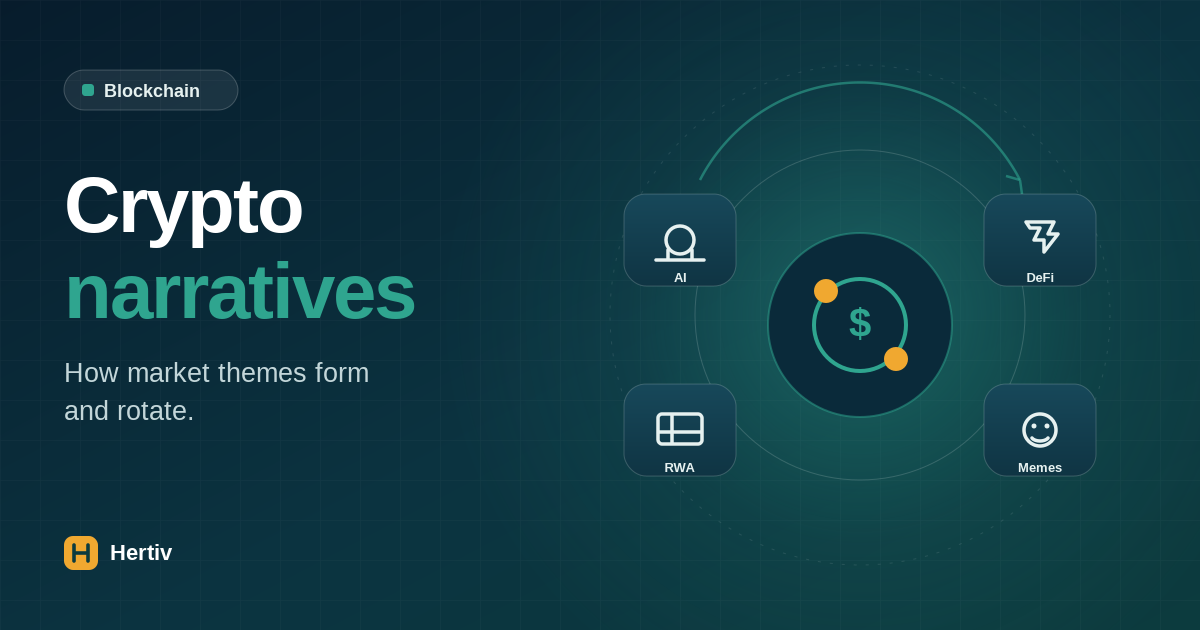
A crypto narrative cluster groups tokens by the story they share, such as AI, DeFi or real-world assets. Tracking them shows where the market's attention is going.
On this page
Short answer
A crypto narrative cluster is a group of tokens that traders and commentators link to the same story, such as artificial intelligence, decentralised finance or real-world assets. The tokens in a cluster tend to move together more often than the wider market, because the same buyers, news and arguments drive them.
What are crypto narrative clusters?
A crypto narrative cluster is a group of tokens that traders and commentators link to the same story, such as artificial intelligence, decentralised finance, or real-world assets. The tokens in a cluster move together more often than the wider market, because the same buyers, news and arguments drive them.
Clusters form around ideas, not technology alone. A token joins the AI cluster because its project uses machine learning, or because the market believes it does. The story is the grouping rule, and it can change: a token can leave one cluster and join another when its project changes direction.
Trackers group tokens this way so readers can see which themes attract money. When the AI cluster rises while the rest of the market falls, that tells you where attention is going, even if it says nothing about which project will last. For the basics of the market these clusters sit in, see what DeFi is.
Which narrative clusters exist today?
Clusters change with the market, but the same broad themes return in each cycle. The table lists the clusters that trackers follow most often.
| Cluster | What it covers | What usually drives it |
|---|---|---|
| AI | Tokens tied to machine learning and agents | Model releases, agent demos, AI funding news |
| DeFi | Lending, trading and yield protocols | New products, fee income, protocol upgrades |
| Memes | Community coins with no product claim | Social buzz, celebrity mentions, jokes |
| Real-world assets | Tokens backed by bonds, property or credit | Interest rates, tokenised fund launches |
| Layer 1 | Base chains such as Bitcoin and Ethereum | Upgrades, ETF flows, network activity |
| DePIN | Tokens for physical networks and hardware | Device growth, partnership announcements |
| Gaming and NFTs | Game tokens and digital collectibles | Game launches, marketplace activity |
| Perpetual DEXs | Decentralised exchanges for margin trades | Trading volume, fee income, new listings |
New clusters appear when a new idea catches on: a new chain, a new kind of app, or a new use for tokens. Old clusters shrink when the idea fades, but they rarely vanish entirely; they wait for the next catalyst. Most of the activity in these clusters runs through protocols built with DeFi development.
How does money rotate between narrative clusters?
Money rotates when attention moves. A catalyst, such as a product launch, a rule change, or a well-known investor talking about a theme, pulls buyers into one cluster. Prices rise, more buyers notice, and the move feeds itself until the story runs out of new buyers.
Then the rotation starts. Early buyers take profits and look for the next theme that has not moved yet. The money does not leave crypto; it moves sideways, from the hot cluster to the next one in line. That is why clusters take turns: one leads for a few weeks, then another does.
Rotation is driven by attention, not by fundamentals alone. A cluster can lead while its projects are still early, and a strong project can sit in a cold cluster for months. The cluster tells you where the crowd is looking, not which project is best.
How do you track a narrative cluster?
Tracking a cluster is mostly a matter of watching the right numbers in the right order.
- Pick a tracker. Use a site that groups tokens by theme and shows each cluster's total value and price change.
- Watch relative strength. Compare each cluster with bitcoin, not with the dollar: a cluster that rises against bitcoin is pulling money from the rest of the market.
- Follow the news, not the price alone. A cluster moves on catalysts, such as launches, listings and rule changes, so note what changed, not just that the price moved.
- Check the breadth. A healthy cluster move lifts most of its tokens; a move driven by one token is a single-coin story, not a cluster story.
- Set a review rhythm. Check weekly, not hourly: clusters move over weeks, and hourly checks turn noise into decisions.
Keep a short log of what you see each week: which cluster led, what the catalyst was, and whether the move was broad or narrow. After a few months, the log shows you the rotation pattern far better than memory does.
Example (hypothetical): tracking a rotation
Example (hypothetical): a reader follows three clusters, AI, real-world assets and memes, on a tracker. In one month, the AI cluster rises 12% against bitcoin, real-world assets fall 4% and memes fall 9%. The reader does not buy on that alone.
Instead, they check the breadth: 8 of the 10 largest AI tokens rose, while only 2 of the 10 largest real-world-asset tokens did. The move is broad, so the reader reads the AI news: two projects shipped products that week. The reader notes the cluster, waits for the next weekly check, and only then decides whether to look closer.
The point of the exercise is discipline. The numbers tell you where attention is, the news tells you why, and the weekly rhythm stops you from reacting to every hourly move. For a wider view of market themes, see crypto trends reshaping global finance.
What are the common mistakes?
The most common narrative cluster mistakes come from treating attention as proof, and from watching prices too often.
- Chasing the hottest cluster. By the time a cluster leads every headline, the early buyers are often selling.
- Treating a cluster as one bet. Tokens in a cluster differ wildly in quality; the cluster label hides that.
- Confusing a story with a business. A good narrative does not mean a project earns money or has users.
- Checking prices every hour. Clusters move over weeks; hourly checks produce trades, not insight.
- Forgetting bitcoin. A cluster can rise in dollars while falling against bitcoin, which means it is lagging the market, not leading it.
What narrative clusters cannot tell you
A cluster cannot tell you whether a project will survive. It measures attention, and attention is fickle: a theme can dominate for a month and vanish for a year. A cluster that led the last cycle can sit quiet through the next one, and a new theme can appear from nowhere when a product or a rule change gives it a reason to exist.
It also cannot tell you what a token is worth. Clusters have no price target, no earnings and no floor. They describe where money has gone, not where it should go.
Use clusters as a map of attention, not as a buy list. They are useful for understanding the market's mood and for spotting themes early, and dangerous the moment they are treated as advice. Nothing in this article is investment advice.
Key takeaways
- A crypto narrative cluster groups tokens by the story they share, not by their technology alone
- Money rotates between clusters as attention moves, and the rotation runs over weeks, not hours
- Track relative strength against bitcoin, check the breadth of the move, and follow the catalyst behind it
- A cluster measures attention, not value: a hot theme does not mean a project earns money
- Use clusters as a map of the market's mood, never as a buy list
Frequently asked questions
What is a crypto narrative?
A crypto narrative is the story the market tells about a group of tokens, such as AI, DeFi or real-world assets. A narrative cluster is the group of tokens attached to that story, tracked together so you can see how the theme is doing as a whole.
How are narrative clusters different from sectors?
Sectors group tokens by what they do, such as exchanges or lending. Narrative clusters group them by the story driving attention right now. The two often overlap, but a narrative can pull in tokens from several sectors at once.
Why do crypto narratives rotate?
Attention is limited. When one theme has absorbed the available buyers, early holders take profits and look for the next theme that has not moved yet. Catalysts such as launches and rule changes decide which theme gets picked next.
Can you trade based on narrative clusters?
Some traders do, but it is risky. Clusters measure attention, which can reverse fast, and they say nothing about whether a project is sound. Anyone trading on narratives should treat it as speculation and size positions accordingly.
Where can you track narrative clusters?
Several analytics sites group tokens by theme and show each cluster's total value, price change and performance against bitcoin. Pick one tracker, check it weekly, and keep a short log of which cluster led and why.
Do narrative clusters apply outside crypto?
The same pattern shows up in stocks and other markets, where themes such as AI or clean energy take turns leading. Crypto moves faster and the clusters are easier to track, which is why the idea is most visible there.


