Is the Crypto Industry Doomed After the FTX Collapse?
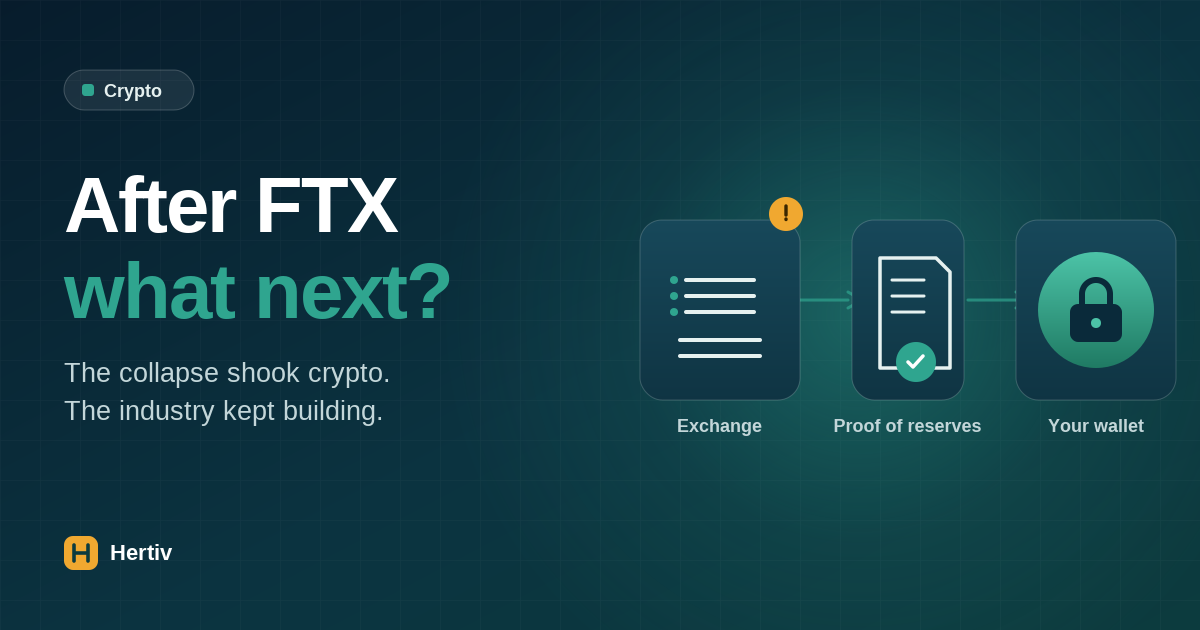
After the FTX collapse shook trust in crypto, the industry kept going: exchanges tightened custody, proof of reserves became standard, and building continued.
On this page
Short answer
FTX collapsed in November 2022, but the crypto industry was not doomed with it. Trading continued on other exchanges, developers kept building, and the failure pushed exchanges, regulators and users toward stricter custody, proof of reserves and clearer rules.
What happened when FTX collapsed?
The FTX collapse was the failure of one of the largest crypto exchanges in November 2022, after it became clear that customer funds had been used in ways customers had not agreed to. Withdrawals were halted, the exchange filed for bankruptcy protection, and customers were left waiting to learn whether they would get their money back.
The failure mattered because FTX was not a small exchange. It was one of the most visible names in crypto, with heavy advertising and a large user base. When it fell, it took trust in the whole industry down with it, at least for a while.
For many users, the shock was not that an exchange could fail, but that one this large could fail this fast. That gap between the public image and the reality is what turned a single company failure into an industry-wide crisis of confidence.
The collapse also changed the conversation around crypto. Before it, the debate was mostly about prices and new products. After it, the questions were about custody, audits and regulation: the boring parts of finance that decide whether customers get their money back.
Why did one exchange failure shake the whole industry?
One exchange shook the industry because crypto firms were more connected than they looked. Lenders had lent to each other, trading firms held funds on the same exchanges, and many businesses kept their operating cash in one place. When FTX stopped withdrawals, the firms that depended on it faced their own shortfalls, and several of them failed in turn.
The second reason was trust. Most users could not see how an exchange handled their funds, so they had to take its word for it. When that word turned out to be wrong, users asked the same question of every other exchange, and many moved their funds out at once.
- Other lenders and trading firms failed in the months that followed.
- Regulators in several countries opened investigations and proposed new rules.
- Users moved funds to self-custody wallets and to exchanges that published proof of reserves.
The speed of the fall made it worse. In a traditional bank failure, deposit insurance and a slow resolution process give customers time. In crypto, there was no equivalent backstop, so the loss of confidence spread in days rather than months, and prices across the market fell with it.
What changed after FTX?
The collapse changed how exchanges are expected to behave. The table below shows the main shifts, and what each one means for users.
| Area | Before FTX | After FTX |
|---|---|---|
| Custody | Customer funds often held and used by the exchange | Segregation expected; self-custody grew |
| Proof of reserves | Rarely published | Many exchanges publish reserve checks |
| Audits | Light or absent for many firms | Audits and attestations requested more often |
| Regulation | Patchy, with gaps between countries | New rules proposed in several major markets |
| Lending | Easy credit between crypto firms | Lending tightened; collateral checked harder |
None of these changes happened overnight, and none of them is finished. But the direction is clear: exchanges are now expected to show, not just say, that customer funds are safe.
Proof of reserves is the most visible change, but it is not a full audit. It shows that an exchange holds a snapshot of assets at one moment, not that it is solvent over time or that its internal controls are sound. Users who treat it as a guarantee are reading too much into it.
Did the crypto industry recover?
The crypto industry did not end with FTX. Trading continued on other exchanges, developers kept building, and new products, from tokenised funds to payment stablecoins, kept reaching users. The market went through a long quiet period, then activity returned as new rules and products took shape.
Recovery does not mean the risks are gone. Exchanges still fail, prices still swing sharply, and regulation still differs by country. What changed is that the failure taught users and builders to check custody, reserves and audits before trusting a platform, and that lesson has stayed.
Choosing where to trade now starts with custody and transparency: see which crypto exchange model to choose before opening an account.
The building that continued was also different in character. Teams spent more time on custody design, audit trails and compliance than on new trading features, and the products that gained users were the ones that could show their reserves and explain their controls in plain terms.
Example (hypothetical): splitting holdings after FTX
Example (hypothetical): a user holds $6,000 in crypto. After the collapse, they split it: $2,000 stays on exchange A, $2,000 moves to exchange B, and $2,000 goes to a self-custody wallet that only they control.
If exchange A halts withdrawals, $4,000 of the $6,000 is still reachable: the funds on exchange B and in the wallet. The split does not remove the risk of prices falling, but it removes the risk of one company holding everything.
Self-custody needs care too: crypto wallet development covers how wallets handle keys and recovery, which is the part most new self-custody users get wrong.
What are the common mistakes?
The most common mistakes after a collapse come from reacting to the last failure instead of checking the next platform properly.
- Keeping everything on one exchange because it feels convenient.
- Trusting marketing and sponsorships instead of checking custody and reserves.
- Panic selling at the bottom of a crash, then buying back higher.
- Ignoring the fine print on how an exchange lends or uses deposits.
- Assuming a new exchange is safe because it is new and well funded.
What to check before trusting an exchange
Before trusting an exchange with your funds, check four things: custody, reserves, regulation and track record. If any answer is unclear, keep the amount small or use self-custody.
- Custody. Are customer funds kept separate from the company's own funds?
- Reserves. Does the exchange publish proof of reserves, and how recent is it?
- Regulation. Is it licensed or registered where it operates, and under which rules?
- Track record. Has it survived a market crash, and how did it treat users then?
- Exit. Can you withdraw at any time, and have users reported delays?
If you are building an exchange or wallet rather than choosing one, crypto exchange development covers the custody and audit patterns that matter.
Key takeaways
- FTX failed in November 2022, but trading and building continued on other platforms
- The collapse spread because firms were connected and users could not see how funds were handled
- Custody segregation, proof of reserves and audits are now expected, not optional
- Splitting holdings across exchanges and self-custody removes single-company risk
- Check custody, reserves, regulation and withdrawal history before trusting any exchange
Frequently asked questions
Is the crypto industry doomed after FTX?
No. The industry went through a long quiet period after the collapse, but trading continued, developers kept building, and new products reached users. The failure changed how exchanges are expected to behave, rather than ending the industry.
What actually caused the FTX collapse?
FTX failed after it became clear that customer funds had been used in ways customers had not agreed to. Withdrawals were halted and the exchange filed for bankruptcy protection, leaving customers waiting to learn whether they would get their money back.
Did other crypto companies fail because of FTX?
Yes. Several lenders and trading firms that depended on FTX, or on firms that depended on it, failed in the months that followed. The failures showed how connected crypto firms were, even when they looked independent.
What is proof of reserves?
Proof of reserves is a check an exchange publishes to show it holds the funds it owes customers. It became standard after FTX, when users wanted evidence rather than promises. It is a useful signal, but it does not prove the exchange is well run in every way.
Is crypto safe to use now?
Crypto still carries real risks: exchanges can fail, prices swing sharply, and rules differ by country. The safer approach is to keep amounts small on any one platform, check custody and reserves, and hold the rest in self-custody.
What should I check before using an exchange?
Check four things: whether customer funds are kept separate from company funds, whether the exchange publishes proof of reserves, whether it is licensed where it operates, and whether users can withdraw without delays. If any answer is unclear, keep the amount small.


