Crypto Exchange Platform Trends That Will Continue
Crypto exchange platforms are adding AI risk checks, tokenized assets, cross-chain liquidity and simpler onboarding. These are the trends shaping the next builds.
On this page
Short answer
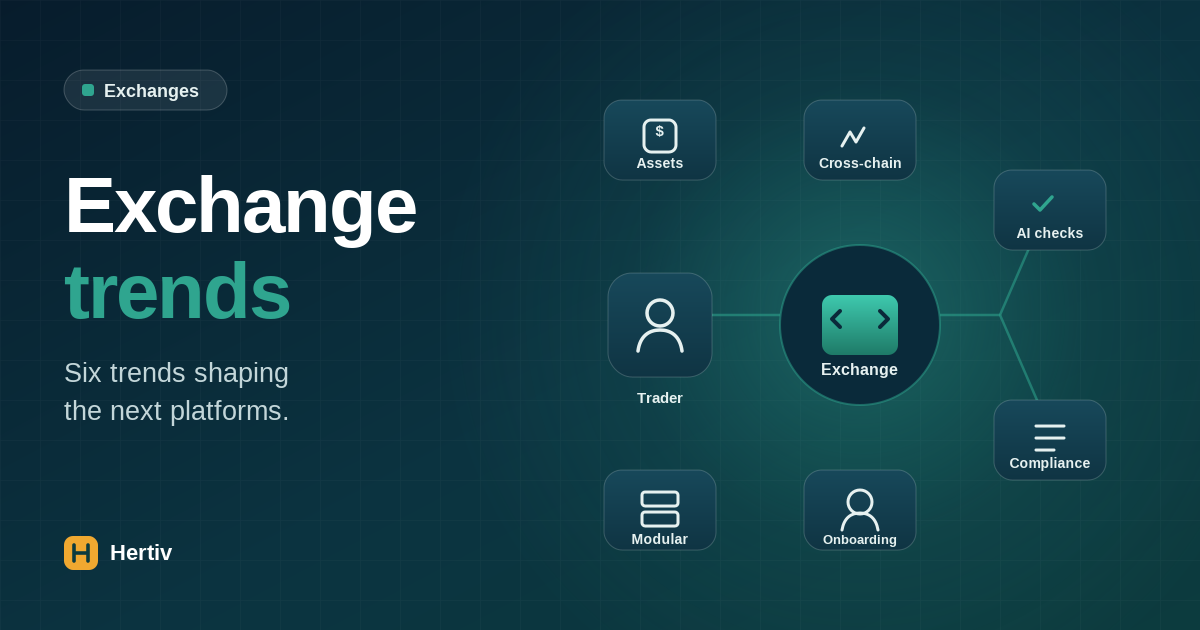
The crypto exchange platform trends that will continue are AI-powered risk checks, support for tokenized real-world assets, cross-chain liquidity, account abstraction for simpler onboarding, stronger compliance tooling, and modular infrastructure. Each trend answers a real problem: safer trading, more assets to list, easier movement between chains, and onboarding that does not scare new users away.
Which exchange platform trends will continue?
Crypto exchange platforms are changing fast, but not every trend lasts. The ones that continue are the ones that fix a real problem for traders, builders or regulators.
The six trends below are already visible in live platforms, and each one is driven by demand rather than fashion. If you are planning an exchange, they are the features your users will expect next.
| Trend | Problem it solves | Who it helps | Stage |
|---|---|---|---|
| AI risk checks | Fraud and bad trades | Traders and operators | Live on major platforms |
| Tokenized assets | Too few assets to trade | Traders and issuers | Growing fast |
| Cross-chain liquidity | Funds stuck on one chain | Traders | Live, still improving |
| Account abstraction | Hard wallet onboarding | New users | Rolling out |
| Compliance tooling | Regulatory risk | Operators | Required in many markets |
| Modular infrastructure | Slow, costly builds | Development teams | Becoming standard |
1. AI-powered risk checks: best for safer trading
1. AI-powered risk checks: best for safer trading
Exchanges are using AI models to watch trades, deposits and withdrawals for signs of fraud, market abuse and account takeover. The models flag unusual patterns far faster than a human team can.
For operators, this cuts losses and speeds up reviews. For traders, it means fewer frozen accounts caused by slow manual checks, because the system can clear normal activity in seconds.
Pros:
- Flags fraud and abuse in real time
- Reduces manual review work
- Improves account security
Cons:
- Needs clean data to work well
- False flags still need human review
2. Tokenized real-world assets: best for new markets
2. Tokenized real-world assets: best for new markets
Exchanges are listing tokenized versions of real-world assets, such as treasury bills, funds and property shares. These tokens let traders buy fractions of assets that were once out of reach.
This trend will continue because it brings new users and new trading volume to exchanges. The hard part is not the token but the legal and custody work behind it, which is why platforms with strong compliance teams are moving first.
Pros:
- Opens new asset classes to traders
- Brings new users to the platform
- Creates fresh fee income
Cons:
- Needs licences and custody partners
- Listing rules vary by market
3. Cross-chain liquidity: best for moving funds
3. Cross-chain liquidity: best for moving funds
Traders hold assets on many chains, and they want to trade without moving funds through slow manual steps. Cross-chain liquidity pools and bridges let an exchange serve orders across chains from one balance.
The trend will continue because users will not accept being locked to one chain. The risk is bridge security, so platforms are choosing audited routes and limiting how much value moves through any single bridge.
Pros:
- One balance works across chains
- Faster trading for users
- More pairs to offer
Cons:
- Bridges remain a security risk
- Liquidity can split across chains
4. Account abstraction: best for easy onboarding
4. Account abstraction: best for easy onboarding
Account abstraction lets users open a wallet with an email or a social login instead of guarding a seed phrase, and it lets the exchange pay gas fees on their behalf. The wallet still belongs to the user, but the hard parts are hidden.
This trend will continue because onboarding is the biggest barrier for new traders. Every extra step in sign-up loses users, and the platforms that remove those steps grow faster.
Pros:
- Sign-up takes minutes, not hours
- Gas fees can be sponsored
- Lost keys can be recovered
Cons:
- Needs careful key management
- Support costs rise with new users
5. Compliance tooling: best for staying licensed
5. Compliance tooling: best for staying licensed
Regulators in most markets now expect exchanges to check identities, screen transactions and report suspicious activity. Modern platforms build these checks into the product instead of adding them later.
Compliance tooling will keep growing because the rules are tightening, not loosening. Platforms that treat it as a core feature avoid the fines and shutdowns that hit teams who added it as an afterthought.
Pros:
- Keeps the platform licensed
- Builds trust with banks and users
- Automates routine checks
Cons:
- Adds cost and build time
- Rules differ by country
6. Modular infrastructure: best for faster builds
6. Modular infrastructure: best for faster builds
Exchange teams are moving away from one large system toward modules: a matching engine, a wallet service, a risk service and a compliance service that can each be built, tested and replaced on their own.
This trend will continue because it makes builds faster and failures smaller. When one module has a problem, the rest of the platform keeps running, and a team can swap a module without rebuilding the whole exchange.
Pros:
- Faster to build and change
- Failures stay contained
- Teams can work in parallel
Cons:
- More services to run and watch
- Needs strong testing between modules
How to choose which trends to build first
Not every trend deserves a place in your first release. Work through them in this order and build the ones your users will feel first.
- Start with compliance tooling. Without it, you cannot operate in most markets, so it is not optional.
- Fix onboarding next. Account abstraction brings users in, and users are what the rest of the trends serve.
- Add cross-chain liquidity. Traders with assets on several chains will leave a platform that cannot serve them.
- Build AI risk checks. They protect the platform as volume grows, and they are cheaper than a fraud loss.
- Plan tokenized assets last. They need licences and partners, so start the legal work early even if the feature ships later.
Modular infrastructure underpins all of this, so choose it from day one rather than rebuilding later. See our guide to crypto wallet development trends for the wallet side of the same story.
Common mistakes
The most common mistake is chasing every trend at once. A team that tries to ship six new features in a first release ships none of them well, and users meet a half-finished product.
The second mistake is treating compliance as a later task. Adding identity checks and screening after launch means rebuilding flows that users already rely on.
The third mistake is trusting a bridge without checking its audit history. Cross-chain features are only as safe as the weakest link in the route.
The fourth mistake is copying a large exchange's feature list. A startup serves a smaller market, and its first release should solve that market's problems, not match a rival's marketing page.
Key takeaways
- AI risk checks, tokenized assets and cross-chain liquidity are the trends to watch.
- Account abstraction removes the hardest steps from wallet onboarding.
- Compliance tooling is now a core feature, not an afterthought.
- Modular infrastructure makes exchange builds faster and failures smaller.
- Build compliance and onboarding first; plan tokenized assets last.
- Never trust a bridge route without checking its audit history.
Frequently asked questions
What is the biggest trend in crypto exchange development?
Account abstraction and cross-chain liquidity are the most visible trends, because they remove the two biggest barriers for users: hard wallet onboarding and funds that are stuck on one chain.
Will AI replace human compliance teams on exchanges?
No. AI flags unusual activity quickly, but people still review the flags, handle appeals and decide what counts as suspicious in each market, because rules and context differ by country.
What are tokenized real-world assets?
They are blockchain tokens that represent ownership in real assets such as treasury bills or property shares. They let traders buy small fractions of assets that were once hard to access, which opens markets that used to need large sums.
Is cross-chain trading safe?
It is safer than it was, but bridges remain a risk. Platforms reduce the risk by using audited routes, limiting the value that moves through any single bridge, and watching bridge activity in real time.
How long does it take to build a crypto exchange?
A basic exchange can take three to six months, while a platform with cross-chain features, compliance tooling and audits takes longer. Licensing alone can add months in some markets, so start that work early.
Do small exchanges need modular infrastructure?
Yes, even small teams benefit. Modules let a small team build and test one part at a time, and they make it easier to replace a part that does not work.


