How Much Does Crypto Development Cost to Build?
Crypto development cost depends on what you build, which chain you use and how much security review you need. Learn the cost parts and how to budget a first build.
On this page
Short answer
Crypto development cost is the total spend to design, build, test, audit and launch a crypto product such as a wallet, token, exchange or payment flow. The figure varies widely because a simple token and a full exchange are very different builds, and security review adds a large share of the work.
What is crypto development?
Crypto development is the work of building software that moves, stores or manages digital assets on a blockchain. It covers wallets, tokens, exchanges, payment gateways, lending apps and the smart contracts behind them.
A crypto build is not one product. It is a combination of an on-chain part, usually smart contracts, and an off-chain part, usually an app, a server and a database. The on-chain part needs careful review because a mistake there can move real funds and cannot always be fixed after launch.
The main product types differ sharply in scope:
| Product | What it involves | Main cost driver |
|---|---|---|
| Token | Smart contract, minting rules, distribution | Contract design and audit |
| Wallet | Key storage, signing, balances, fiat on-ramp | Security and platform support |
| Exchange | Order matching, liquidity, custody, compliance | Scope and regulation |
| Payment gateway | Checkout flow, settlement, refunds | Integrations and testing |
| DeFi app | Pools, lending logic, oracles, rewards | Contract complexity |
Because the scope varies this much, a single price for 'crypto development' means very little. A useful budget starts from the product type, then adds the cost parts below. Teams that need a trading product usually start with crypto exchange development to understand the full scope before pricing anything.
What are the main cost parts of a crypto build?
The main cost parts of a crypto build are product design, smart contract work, app and server work, security review, infrastructure and launch support. Each part scales with scope, and skipping one usually moves the cost into fixes later.
Product design covers user flows, screens and the rules for how assets move. This is where decisions about custody, fees and limits get made, and changing them after contracts are written is expensive.
Smart contract work covers writing, testing and reviewing the on-chain code. Contracts need more test coverage than ordinary server code because they handle funds directly and often cannot be changed once deployed.
App and server work covers the wallet interface, account handling, notifications and the admin tools your team uses. This is usually the largest share of hours on a product with a real user interface.
Security review covers an external audit, penetration testing and a review of key handling. Audits are priced by the size and complexity of the code, so keeping contracts small and simple also keeps this part down.
Infrastructure covers nodes or node providers, indexing, monitoring and backups. These are running costs rather than a one-off build cost, and they grow with the number of users and transactions. A crypto wallet development plan should list these running costs next to the build cost so the first year is visible.
How does the blockchain choice change the cost?
The blockchain choice changes the cost through developer availability, tooling, fees and the amount of custom code you need. A chain with mature tooling and a large developer pool is usually cheaper to build on than a chain where everything must be written from scratch.
Ethereum and other EVM-compatible chains share the same language and many of the same libraries, so a team can reuse tested code and hire from a wide pool. That keeps the build faster and the audit simpler, because auditors already know the common patterns.
Chains with their own languages, such as Solana or Aptos, need specialists and separate tooling. The build can still be the right choice when the product needs high throughput or low fees, but you should budget for a smaller hiring pool and longer testing.
Running your own chain or a private chain is the most expensive option. It adds node operations, consensus setup and tooling that a public chain gives you for free, and it only makes sense when the product needs control that a public chain cannot offer.
The chain choice also affects the user experience. Fees, confirmation times and wallet support all differ, and those differences shape how much support work the product needs after launch. A blockchain development partner can compare two or three chains against your product requirements before you commit.
Example (hypothetical): budgeting a first crypto wallet
Example (hypothetical): a startup wants to build a simple non-custodial wallet with token swaps and a fiat on-ramp. The team plans a six-month first version with four people working on it.
The budget is built from the parts above. Product design and planning takes one month of one designer, app and server work takes four months of two developers, and smart contract work for the swap takes two months of one developer. Security review is booked as a fixed block of time near the end.
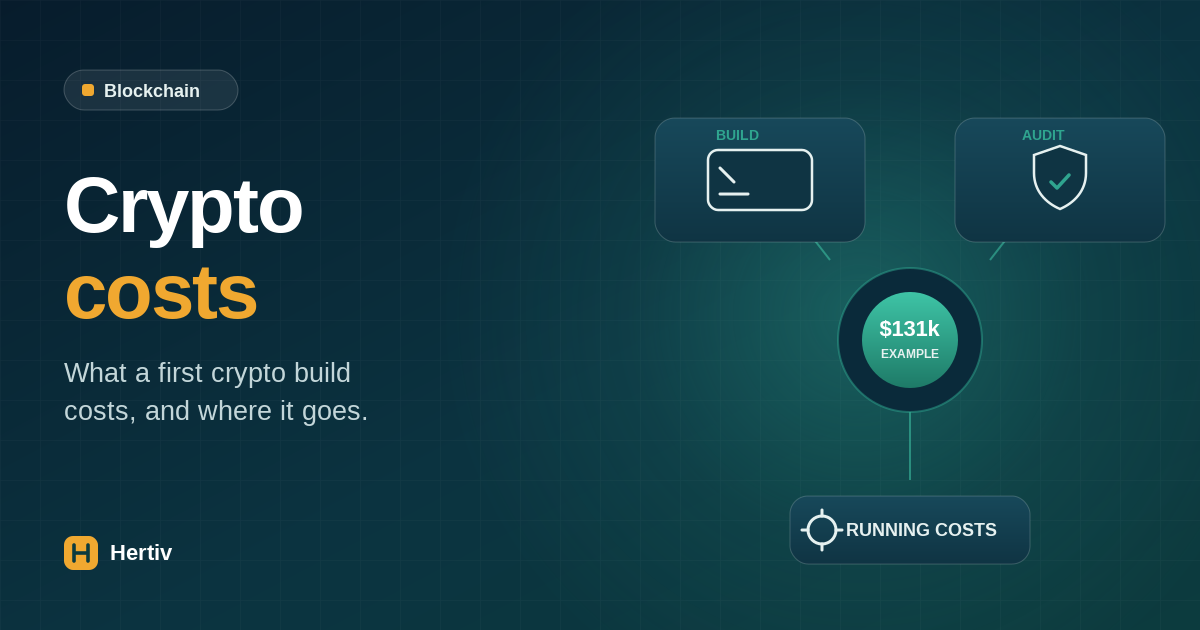
The arithmetic is straightforward. Design at $8,000 a month for one month is $8,000. App and server work at $9,000 a month per developer for two developers over four months is $72,000. Smart contract work at $10,000 a month for two months is $20,000. An audit block of $25,000 and infrastructure and tooling of $1,000 a month for six months, $6,000, bring the total to $131,000.
That total is a planning figure for this example only, not a market price. Real quotes depend on the team, the region and the exact scope, so treat any vendor figure as 'see vendor site' and compare like with like. The value of the exercise is that each part is visible, so cutting scope in one place shows up as a lower number in that part.
What adds cost after launch?
What adds cost after launch is maintenance, chain upgrades, security monitoring, support and compliance work. These running costs are easy to miss in a build budget, and they decide whether the product stays healthy.
Smart contracts need monitoring for unusual activity, and any upgrade path must be tested before it is used. A contract with no upgrade path is cheaper to build but riskier to run, because a bug found later may have no safe fix.
Chain upgrades and hard forks can break integrations. Node providers, indexers and wallets all need to be checked when the underlying chain changes, and that work is rarely zero.
Support grows with the user base. Wallet recovery, failed transactions and fee questions are the most common tickets, and each one needs a clear answer and a process. A product that hides fees or shows confusing errors pays for it in support hours.
Compliance work also continues. Reporting, record keeping and any licensing duties depend on where the product operates, and those duties change as rules change. Budget a regular review rather than treating compliance as a one-off task. A smart contract development team should hand over monitoring and upgrade runbooks, not just code.
How do you keep a crypto budget under control?
You keep a crypto budget under control by cutting scope before you cut security, and by making the cost of each feature visible before you commit to it.
- Start with one product, not a platform. A wallet with swaps is a build. A wallet with swaps, staking, lending and a card is four builds.
- Freeze the contract design early. Every change to a contract after audit starts costs a re-review, so agree the rules before the audit begins.
- Use tested libraries for standard parts. Token standards, access control and upgrade patterns exist as reviewed code. Writing them from scratch adds risk and cost.
- Budget the audit as a share of the build. If the audit is not in the plan, it will still need to happen, and late audits find problems when they are most expensive to fix.
- Price running costs for the first year. Nodes, monitoring, support and compliance should appear next to the build figure, not as a surprise later.
- Ship in small releases. A limited first release with real users tests the product before the full scope is built, and the lessons are cheaper at that stage.
These steps do not make a build cheap. They make the spend predictable, which is what a budget is for. A smart contract audit booked early also protects the schedule, because audit slots are limited and late booking delays launch.
What are the common mistakes?
The most common crypto budgeting mistakes are pricing the build and forgetting the audit, underestimating security work, and choosing a chain for its price rather than its fit.
- No audit in the budget. A product that moves funds without an external review is a risk the team carries alone, and the cost of an incident is far higher than the audit.
- Treating contracts like server code. Contracts need more testing and slower changes, because a deployed bug can move money and may not be reversible.
- Copying a competitor's feature list. Every feature adds build, test, audit and support cost. A feature your users do not need is spend with no return.
- Ignoring key management. How keys are created, stored and recovered is a core design decision, not a detail to settle at the end.
- Forgetting running costs. Nodes, monitoring, support and compliance continue after launch, and a product that cannot pay for them will degrade.
Key takeaways
- Crypto development cost is driven by product type, chain choice and security review, not by a single market price
- A token is a much smaller build than an exchange, so budget from the product type first
- Smart contract audit, monitoring and first-year running costs belong in the budget from the start
- Using tested libraries and freezing contract design early keeps both build and audit costs down
- Ship one product in small releases rather than building a full platform at once
- Compare vendor quotes like with like, and treat any figure as see vendor site unless it is your own quote
Frequently asked questions
How much does a simple token cost to develop?
A simple token is usually the smallest crypto build, because it is one contract with minting and transfer rules. The main costs are contract design, testing and an audit, plus the app or page that lets people interact with it. The total depends on the chain, the rules in the contract and the size of the audit, so get a quote for your exact scope.
Do I need an audit for a small crypto product?
Yes, if the product moves funds or holds user assets. An audit reviews the contract for logic errors and known attack patterns before real money is involved. Small products can use a smaller audit scope, but skipping review entirely leaves the team carrying the full risk of a bug.
Which blockchain is cheapest to build on?
There is no single cheapest chain, because the cost depends on the language, the tooling and the developers you can hire. EVM-compatible chains usually have the widest pool of developers and the most reused code, which tends to keep builds faster. Compare two or three chains against your product needs rather than choosing on fees alone.
What are the running costs of a crypto product?
Running costs include node access or node providers, indexing, monitoring, support and compliance work. They grow with users and transactions, so a product with more activity costs more to run. Budget them for the first year alongside the build, and review them each quarter as the product grows.
Can I build a crypto product without writing smart contracts?
Sometimes. A product that only reads prices or shows balances may not need its own contracts. But any product that moves, locks or distributes funds needs contracts, and those contracts need testing and review. A custodial product can also use an existing provider instead of building its own contracts.
How long does a first crypto product take to build?
A simple wallet or token can take a few months, while an exchange or DeFi app usually takes longer because of matching, liquidity, custody and compliance work. The audit alone can take several weeks, and its findings may need more build time. Plan the schedule around the audit, not just the coding.


