Cross-Chain P2P Exchanges: How Traders Swap Across Chains
Cross-chain P2P exchanges let two traders swap crypto across different blockchains without a central exchange. How atomic swaps and escrow settle the trade.
On this page
Short answer
A cross-chain P2P exchange is a marketplace where two people trade crypto directly across different blockchains, without a central exchange holding the funds. Trades settle with atomic swaps or escrow contracts that release each side only when both sides have paid, so neither trader has to trust the other or a middleman.
What is a cross-chain P2P exchange?
A cross-chain P2P exchange is a marketplace where two traders swap crypto held on different blockchains, peer to peer, without a central exchange taking custody. One trader might hold USDT on BNB Chain while the other holds ETH on Ethereum, and the exchange matches them and settles the swap across both chains.
It differs from a normal P2P exchange, where both sides trade on the same chain and a single escrow contract holds the funds. A cross-chain trade has to coordinate two chains that cannot see each other, so the settlement mechanism is the whole point of the design.
| Settlement method | How it works | Needs | Main risk |
|---|---|---|---|
| Atomic swap | Both sides lock funds; both release or both refund | Time-locked contracts on both chains | One side times out and funds sit locked |
| Escrow with relayer | A relayer watches both chains and releases escrow | Trusted relayer or validator set | Relayer failure or collusion |
| Bridge-routed swap | One side is bridged, then swapped on one chain | A bridge and a swap pool | Bridge smart contract risk |
| Wrapped token swap | One asset is wrapped so both sides sit on one chain | A custodian or minting contract | Wrapped token loses its backing |
Atomic swaps are the purest form: either the whole trade happens or nothing happens. The other methods add a middleman of some kind, which is faster to build but adds a party you must trust.
How does a cross-chain P2P trade work?
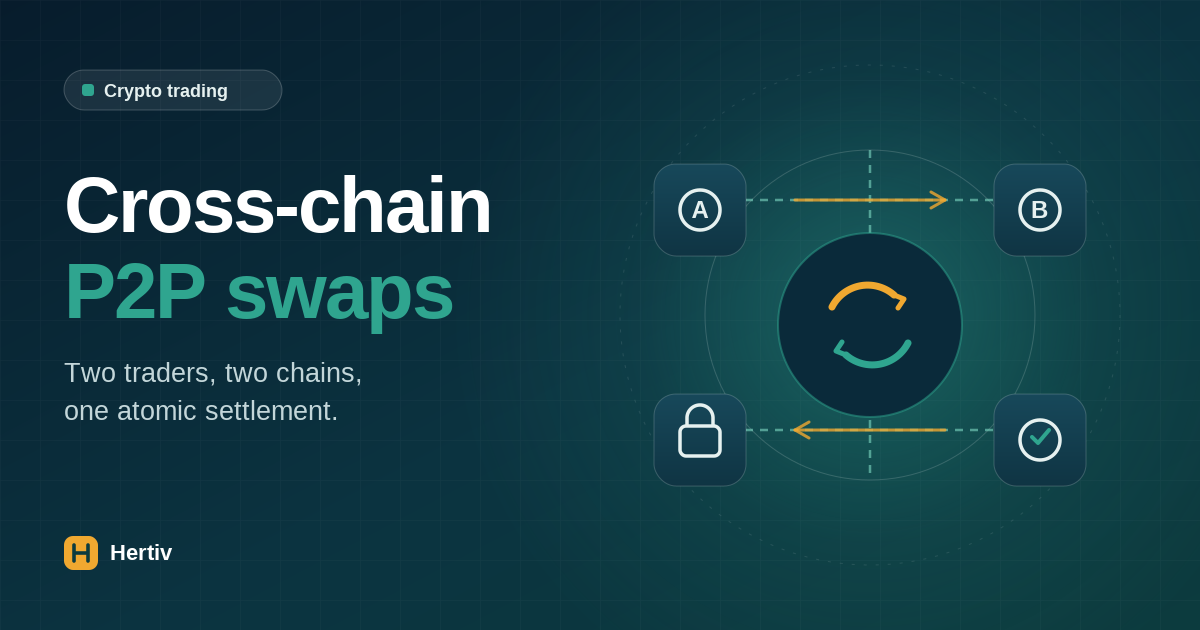
A cross-chain P2P trade follows the same shape as any peer trade, with an extra settlement step that spans two chains. The buyer and seller agree a rate, lock their funds, and the trade either completes on both chains or refunds on both.
- Match. The buyer posts an offer with the pair, the rate and the chains involved, and the seller accepts it.
- Lock. Both sides lock their funds in time-locked contracts, one on each chain, using the same secret hash.
- Reveal. The buyer reveals the secret to claim the seller's funds, which makes the secret visible on chain.
- Claim. The seller uses the revealed secret to claim the buyer's funds on the other chain before the time lock ends.
- Refund. If either step fails, the time locks expire and both sides get their funds back.
The time lock is what makes the swap atomic: the seller can only claim after the buyer has claimed, and if nobody claims, the refund path returns the funds. That is the core idea behind how cross-chain bridges move assets, applied to a trade between two people.
What are the main types of cross-chain P2P exchange?
The main types differ in who holds the funds during the trade and how the two chains are linked. Each type trades off trust, speed and the range of pairs it can support.
- Atomic-swap exchanges. Trades settle with hash time-locked contracts on both chains and no custodian. They are the most trust-free option, but they only work for chains that support the same contract logic.
- Escrow marketplaces. A marketplace holds one side in escrow and a relayer or validator set confirms payment on the other chain. They support more pairs, but you trust the escrow operator.
- Bridge-routed exchanges. One asset is bridged to the other chain, then the trade settles as a normal swap. This is simple for users, but bridge risk becomes part of the trade.
- OTC desks with cross-chain settlement. A desk quotes a rate for large trades and settles across chains on your behalf. This suits large orders that would move the price on a public marketplace.
For small trades between well-known chains, atomic-swap and escrow marketplaces are the usual choices. For large or unusual pairs, an OTC desk is often the practical route.
How do escrow and settlement work across chains?
Escrow across chains works by locking each side separately and linking the two locks with a shared secret or a trusted watcher. Neither side can take the other's funds without giving up their own, and a time limit returns the funds if the trade stalls.
In an atomic swap, the link is a hash: the buyer locks funds behind a secret only they know, the seller locks funds behind the same hash, and revealing the secret to claim one side exposes it so the other side can be claimed. In a relayer model, the link is a watcher: validators confirm that payment arrived on one chain, then release the escrow on the other.
Disputes are harder across chains than on one chain, because no single contract can see both sides. Good marketplaces keep a record of both transactions, set clear time limits, and offer a human review path when a trade is stuck. Before trading, compare the marketplace with a P2P crypto exchange comparison to see how each platform handles disputes.
What are the risks of trading across chains?
The risks of cross-chain P2P trading come from the extra moving parts: two chains, two contracts, a time limit and a counterparty you have never met. Most losses come from one of these parts failing, not from the idea itself.
- Time-lock expiry. If a claim is not made before the lock ends, funds return, but a slow chain or a missed step can leave money locked for hours.
- Chain reorganisation. A short reorganisation on one chain can make a confirmed payment look unconfirmed to the other side.
- Smart contract bugs. Bridge and escrow contracts are a target, and a bug in either side can drain funds.
- Price moves during settlement. A trade that takes minutes to settle can drift from the agreed rate if the market moves fast.
- Counterparty fraud. Fake payment proofs and social engineering still work when traders skip the platform's escrow.
- Wrong network or address. Sending funds to the right address on the wrong chain is one of the most common and least recoverable mistakes.
Trade small first, use the platform's escrow every time, and never move a trade off the platform to save a fee. Decentralized P2P exchanges explain the same risks for single-chain trades, and most of them apply here too.
Example (hypothetical): swapping tokens across two chains
Example (hypothetical): Maya wants to swap 2,000 USDT held on BNB Chain for 1 ETH held on Ethereum. The agreed rate is 1 ETH for 2,000 USDT, so the trade is worth 2,000 USDT on each side before fees.
Both sides lock their funds in time-locked contracts. Maya pays a network fee of 10 USDT to lock her side, and the seller pays a network fee of 0.001 ETH to lock his. At 2,000 USDT per ETH, that fee is worth 2 USDT, so the total fees are 12 USDT.
Maya reveals the secret and claims 1 ETH. The seller uses the revealed secret to claim 2,000 USDT. After fees, Maya holds 1 ETH and has spent 2,010 USDT in total, while the seller holds 2,000 USDT and has spent 0.001 ETH in fees. If either side had failed to claim in time, both locks would have expired and both would have been refunded.
What are the common mistakes?
The most common mistakes in cross-chain P2P trading are skipping escrow, rushing the time lock, and sending funds on the wrong network.
- Trading outside escrow. Direct payment to a stranger removes the only protection the trade has.
- Ignoring the time lock. A lock that is too short can expire before a slow chain confirms the claim.
- Wrong chain, right address. Check the network name on every send, not just the address.
- Accepting a rate that moved. Re-check the rate at the moment of locking, not when the offer was posted.
- Using an untested pair. New chain pairs have less liquidity and fewer working escrow paths.
- No record of both transactions. Save both transaction hashes so a dispute can be reviewed on both chains.
Key takeaways
- A cross-chain P2P trade swaps crypto across two blockchains without a central exchange
- Atomic swaps settle all-or-nothing with time-locked contracts on both chains
- Escrow, bridge-routed and OTC models trade trust for speed and pair coverage
- Time-lock expiry, chain reorganisations and price drift are the main settlement risks
- Always trade inside escrow, check the network on every send, and save both transaction hashes
Frequently asked questions
What is a cross-chain P2P exchange?
It is a marketplace where two traders swap crypto held on different blockchains, peer to peer, without a central exchange holding the funds. Settlement uses atomic swaps or escrow contracts so the trade either completes on both chains or refunds on both.
How is a cross-chain P2P exchange different from a normal P2P exchange?
A normal P2P exchange settles both sides on one chain with a single escrow contract. A cross-chain exchange must coordinate two chains that cannot see each other, so it uses time-locked contracts or a relayer to link the two sides of the trade.
Are cross-chain P2P exchanges safe?
They are safer than trading directly with a stranger, because escrow and time locks protect both sides. They are riskier than single-chain P2P trading, because two chains, two contracts and a time limit all have to work. Trade small first and use escrow every time.
What is an atomic swap?
An atomic swap is a trade where both sides lock funds in time-locked contracts linked by the same secret. Either both sides complete, or both are refunded when the time locks expire. It needs no custodian, but both chains must support the contract logic.
Which chains support cross-chain P2P trading?
Support depends on the marketplace. The most common pairs involve large chains with smart contract support, such as Ethereum, BNB Chain and Solana. Check the platform's supported pairs before posting an offer, because not every chain combination works.
What fees do cross-chain P2P trades have?
You usually pay a network fee on each chain to lock and claim funds, plus any marketplace fee. Fees vary with network congestion, so check the fee on both chains before locking, and see vendor site for the marketplace's current fee schedule.


