What Does It Cost to Hire AI Engineers?
Hiring AI engineers costs more than salary alone: recruiting fees, onboarding, tooling and interview time all add up. Here is how to budget the full amount.
On this page
Short answer
Hiring AI engineers costs the engineer's pay plus recruiting fees, onboarding time, tools and the hours your team spends on interviews. The first-year cost of one hire is usually well above the salary on the offer letter, because fees and lost time are easy to miss. Budget the full first year, not just the monthly pay, and compare hiring against contracting or buying a finished product.
What does it cost to hire an AI engineer?
The cost of hiring an AI engineer is the full first-year cost of bringing that person onto your team, not just the salary. Salary is the largest part, but recruiting fees, onboarding, tooling and interview time add a large amount on top.
Most teams under-budget because they only count pay. A realistic budget adds each of these parts separately, so the total is visible before the offer goes out.
| Cost part | What it covers | When you pay it |
|---|---|---|
| Pay | Salary and benefits for the engineer | Every month |
| Recruiting fee | Agency fee or job-board and sourcing spend | At hire |
| Interview time | Hours your team spends screening and interviewing | Before hire |
| Onboarding | Weeks before the new hire works at full speed | First months |
| Tools and compute | Model access, data tools and cloud spend | Every month |
| Management | Reviews, mentoring and planning time | Every month |
Start from this table and fill in your own numbers. Rates differ widely by region, seniority and whether the role is remote, so treat any single figure you read online as a rough guide, not a quote. For the hiring process itself, see how to hire AI developers.
What makes the cost go up or down?
Seniority moves the cost most. A senior engineer who can design a system and ship it alone costs more than a junior who needs close guidance, but the senior often delivers working software sooner and with less rework. Match the level to the job, not to the budget line.
Region and remote work matter too. Pay bands differ between markets, and a remote hire can widen your options, but it can also add coordination cost if time zones barely overlap. Decide the working hours you need before you open the role.
Scarcity is the third driver. Engineers with experience in a niche, such as retrieval systems or model fine-tuning, are harder to find, so the search takes longer and the fee is higher. If the niche is only a small part of the job, hire a strong generalist and buy specialist help for the rest.
Should you hire, contract or buy?
Hiring fits work that lasts. If the AI feature is central to your product and will need changes for years, an employee who learns your data and your users is worth the cost. The hire builds knowledge that stays in the company.
Contracting fits work with a clear end. A contractor can build the first version, set up the data pipeline and hand it over, which is often faster and cheaper than a permanent hire for a one-off project. The risk is knowledge leaving with the contractor, so insist on documentation and a handover.
Buying fits work that is not your edge. If a vendor product already does the job well, paying for it is usually cheaper than hiring a team to rebuild it. Compare the vendor's yearly price with the full first-year cost of a hire before you decide. If you are weighing building against buying, the numbers in what it costs to build an AI agent are a useful starting point.
How do you budget a hire in five steps?
Budget in five steps, and write each number down so the team can check it. A budget built from parts is easier to defend than a single round number.
- Set the pay band. Pick a range for the role and level, and add benefits and taxes on top of the base figure.
- Add the recruiting cost. Use the agency fee or your own sourcing spend, and add the interview hours valued at your team's hourly cost.
- Add onboarding. Plan for reduced output in the first months, and count the mentoring hours from senior staff.
- Add tools and compute. Include model access, data tooling and the cloud spend the engineer will use.
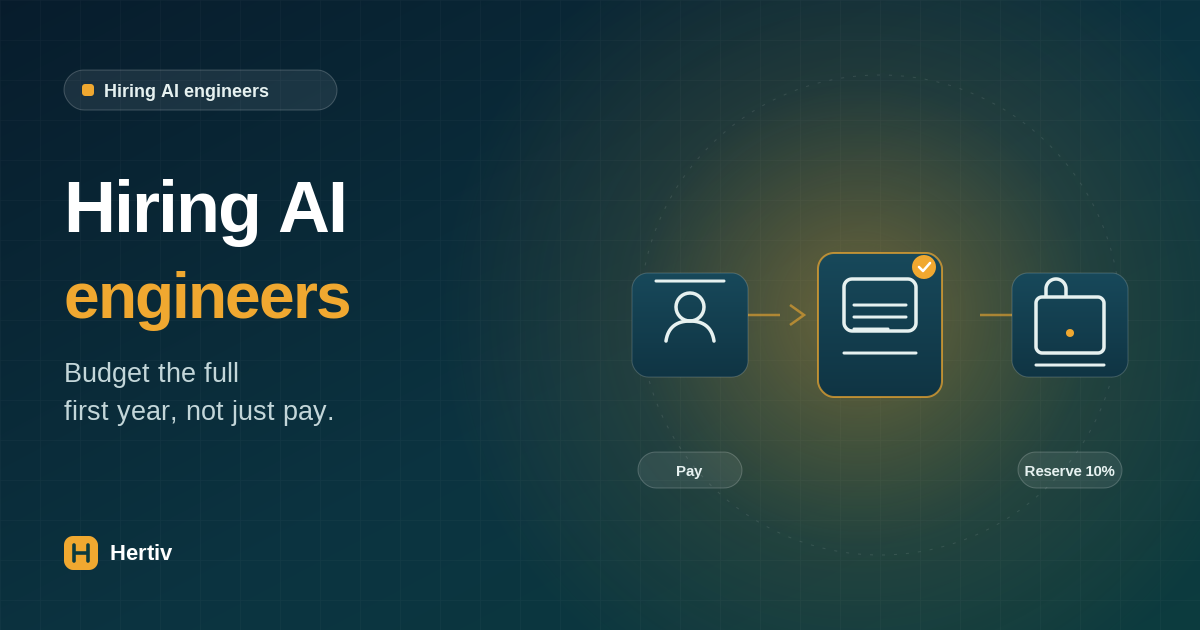
- Add a reserve. Keep 10 percent aside for the search running longer than planned or for a counter-offer.
Review the budget after the first hire. The real numbers from that hire are the best guide for the next one, and they are far more useful than any salary report.
Example (hypothetical): budgeting two AI engineers
Example (hypothetical): a startup plans to hire two AI engineers for a six-month project. It sets a hypothetical pay figure of $8,000 a month per engineer, a hiring fee of $12,000 in total, and tooling of $3,000 for the six months.
The pay for both engineers is 2 times $8,000 times 6 months, which is $96,000. Adding the hiring fee of $12,000 and tooling of $3,000 gives $111,000. A 10 percent reserve on that total is $11,100, so the full budget is $122,100.
The reserve matters because the search often runs long. If hiring takes two extra months, the project slips, and the reserve covers the extra sourcing spend and the contractor hours needed to keep the work moving. Always check the arithmetic before the budget goes to the founders: 2 times 8,000 times 6 is 96,000, plus 12,000 plus 3,000 is 111,000, plus 11,100 is 122,100.
What are the common mistakes?
Budgeting only the salary is the most common mistake. The fee, the interview hours and the slow first months are real costs, and leaving them out makes the hire look cheaper than it is. Add every part from the table above.
Hiring before the job is clear is the second mistake. If the role description is vague, the interviews drift, the wrong person gets hired, and the team spends months fixing the mismatch. Write down the one job the engineer must deliver in the first three months before you post the role.
The third mistake is skipping a small paid work trial. A short, paid task that mirrors the real work shows how the candidate thinks and communicates far better than a whiteboard puzzle. Keep it short, pay for the time, and judge the work, not the polish.
The last mistake is forgetting the tools budget. Model access and cloud spend can grow fast once a new engineer starts testing ideas. Set a monthly limit and review it in the first month, so there are no surprises.
How do you know the hire is working?
Judge the hire on delivered work, not on activity. A good sign is a small feature in production within the first month, even if it is simple. A bad sign is months of research with nothing a user can touch.
Check the basics at the end of month one: the engineer can run the system locally, can explain the data it uses, and has shipped one small change. At month three, look for ownership of a real piece of the product and fewer questions about how things work.
If progress is slow, look at the setup first. Missing data access, no clear priorities and no reviewer are common causes, and they are the manager's job to fix. Before you expand the team, make sure the first hire has what they need. A small proof of concept is a good test of the setup; see how to build an AI proof of concept for a plan that works in weeks.
Key takeaways
- The full cost of a hire is pay plus fees, interview time, onboarding and tools.
- Seniority, region and niche skills move the cost most.
- Hire for lasting work, contract for a clear one-off, buy when a vendor already does it.
- Budget in parts and keep a 10 percent reserve for a longer search.
- Judge a hire on shipped work in the first month, not on activity.
Frequently asked questions
How long does it take to hire an AI engineer?
A typical search takes six to twelve weeks from posting the role to a signed offer, and longer for niche skills. The time grows if the role is vague or the interview loop is slow, so keep the loop short and decide quickly after the final round.
Is it cheaper to hire a junior AI engineer?
A junior costs less in pay but needs more guidance, so the total cost depends on how much senior time is available. A junior is a good hire when a senior can mentor them and the work is well defined.
What does a recruiter charge for an AI engineer?
Agency fees vary by market and by the terms you agree, so ask for the fee in writing before the search starts. Some agencies charge a share of first-year pay, others a flat fee, and the terms differ.
Should a startup hire AI engineers or use contractors?
Hire when the AI work is central to the product and will keep changing. Use contractors when the work has a clear end and a handover. Many startups do both: contractors build the first version and hires take it over.
Do AI engineers need expensive tools?
They need model access, data tooling and cloud spend, and the bill grows with testing. Set a monthly limit, give the engineer a dashboard to watch it, and review the spend in the first month.
How do you keep an AI engineer after hiring them?
Give them real problems, clear priorities and time to learn. Engineers leave when the work is vague, the data is a mess or every decision needs approval, so fix the setup before you worry about perks.


