How Much Does It Cost to Develop a Meme Coin?
A meme coin can cost almost nothing on a launchpad or tens of thousands through an agency. The real budget is liquidity and marketing, not the token.
On this page
Short answer
Developing a meme coin costs from almost nothing to tens of thousands of dollars, depending on the route: a launchpad token on Solana or BNB Chain costs only network fees, a template token costs a few hundred to a few thousand dollars, and a custom contract with an audit and a marketing push costs $10,000 to $50,000 or more. Liquidity and promotion, not the contract, decide most of the budget.
How much does it cost to develop a meme coin?
A meme coin costs almost nothing to create on a launchpad and tens of thousands of dollars through an agency, because the token itself is the cheapest part of the launch. What you pay for is the contract work, the branding, the liquidity pool, the listings and the marketing that gets people to notice.
Use the table to see the three routes side by side, then read the sections below for what each line actually buys. The ranges below are planning figures from published 2026 guides, and they move with the chain, the contract and the size of the launch.
| Route | What you get | Typical cost | Best for |
|---|---|---|---|
| Launchpad | Token from a form | Free to a few dollars | Testing an idea |
| Template token | Standard token plus branding | $500 to $5,000 | Small community coin |
| Custom contract | Bespoke features and audit | $10,000 to $50,000+ | Serious launch |
| Full launch | Custom token plus marketing | $50,000 to $100,000+ | Funded team |
The token is pocket change; the pool and the promotion are the budget. A coin with no liquidity and no audience costs little to make and goes nowhere.
What does each route cost?
Each route costs a different amount because each one buys a different level of work. The launchpad route is nearly free, the template route adds branding and setup, and the custom route adds contract engineering and an audit.
On a launchpad such as Pump.fun, creating the coin costs nothing beyond network fees, and the first buy puts the token on-chain. A basic token on Solana can cost under a dollar in fees, and a similar token on BNB Chain costs a few cents. That is the whole technical cost for a test launch.
A template token uses a standard contract, often ERC-20 or BEP-20, with your name, ticker, supply and branding added. Published 2026 guides put this at roughly $500 to $5,000, covering the deployment, the artwork and a simple website. A custom contract with special mechanics, such as taxes, burns or staking, runs roughly $10,000 to $50,000 before an audit, and an audit adds more on top.
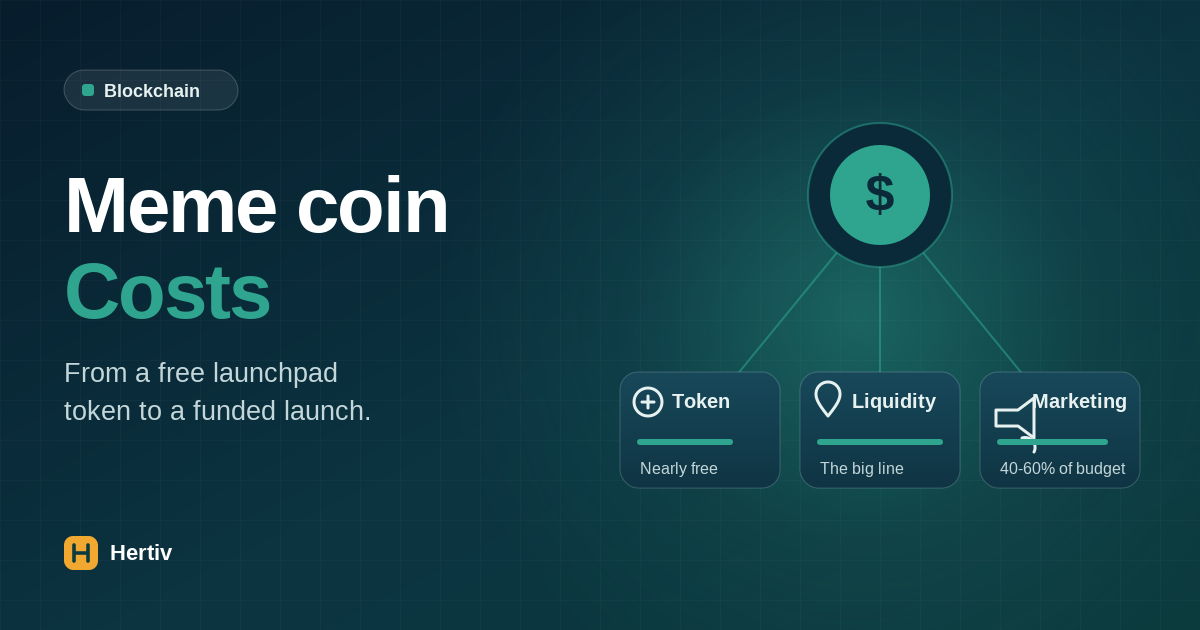
The full launch adds the expensive lines: liquidity, exchange listings and marketing. Guides put a funded launch at $50,000 to $100,000 or more, with marketing and community often taking 40% to 60% of the total. If you want the contract side handled by specialists, smart contract development is the service to compare.
What drives the cost up?
The cost drivers are the chain, the contract, the audit, the branding, the liquidity, the listings and the marketing. Each one can be small or large, and the total follows the choices you make on all of them.
| Cost driver | Low end | High end | What changes it |
|---|---|---|---|
| Token deployment | Free | $5,000 | Launchpad vs template vs custom |
| Smart contract audit | $0 | $20,000+ | Contract size and auditor |
| Branding and website | $200 | $5,000+ | Freelancer vs studio |
| Liquidity pool | A few dollars | $50,000+ | How deep the pool is |
| Listings and data sites | $0 | $10,000+ | DEX Screener, exchanges |
| Marketing and influencers | $0 | $50,000+ | Reach and duration |
Liquidity deserves a closer look. The pool is not a fee, it is money you put in so people can trade, and it is the largest single line for most serious launches. A shallow pool means a small buy moves the price a lot, which scares traders away.
Listings also add up. A DEX Screener enhanced token page costs $299, and centralised exchange listings cost far more and are usually out of reach for a first launch. Legal advice is a separate line that many teams skip and later regret.
How do you launch a meme coin, step by step?
You launch a meme coin by picking the chain and the route, deploying the token, adding liquidity, and then promoting it, with checks at each step so a mistake does not cost the whole budget.
- Pick the chain. Solana suits fast, low-fee launches; BNB Chain suits low fees with EVM tooling; Ethereum suits deep liquidity with higher gas. Match the chain to where your audience already trades.
- Choose the route. A launchpad for a test, a template token for a community coin, or a custom contract with an audit for a funded launch.
- Design the tokenomics. Fix the total supply, the split between the pool, the team, the community and the treasury, and whether any tax or burn applies.
- Deploy and check the contract. Deploy on a testnet first, verify the supply and the owner permissions, and read the contract before mainnet.
- Add liquidity and lock it. Seed the pool, then lock the liquidity tokens so buyers can see the pool cannot be pulled.
- Publish the pages. Set up the website, the social accounts and the data-site listings so buyers can find the contract address and the token details.
- Promote and monitor. Announce the launch, watch the pool and the holders, and answer questions in public so the community can check what is happening.
Do the cheap steps first. A test launch on a launchpad costs almost nothing and shows you whether the idea has any pull before you spend on branding or marketing.
Example: three budgets for the same coin
Example (hypothetical): a team plans the same meme coin at three sizes, so the numbers show where the money actually goes.
The lean launch uses a launchpad: $0 to create the token, about $2 in network fees, 2 SOL of liquidity worth about $150, and a $12 domain, for a total of about $164. Everything else is the team own time.
The mid launch uses a template token: $2,000 for the contract and deployment, $800 for branding, $299 for a DEX Screener page, $1,500 of liquidity, and $1,000 for community promotion, for a total of $5,599. The token is a small part of that total.
The full launch uses a custom contract: $15,000 for development, $8,000 for an audit, $3,000 for branding and a website, $10,000 of liquidity, $5,000 for listings and $20,000 for marketing, for a total of $61,000. At this size, marketing is the largest single line, which matches what published guides report.
The pattern is clear in all three: the token gets cheaper as a share of the budget while liquidity and promotion take over. Budget for the launch you can afford to run for months, not the launch you can afford to start.
What are the hidden costs?
The hidden costs are the ones that do not appear on the token quote: legal advice, liquidity that gets stuck, listing fees, and the time it takes to run a community. Teams that budget only for the contract run out of money at the point where spending matters most.
Legal advice is the most skipped line. A meme coin can fall under securities or promotion rules depending on how it is sold and described, and the rules differ by country. A short review before launch costs far less than a problem after launch.
Liquidity is a hidden cost in a different way: it is your money sitting in the pool, and if the price falls, that money falls with it. Locking liquidity protects buyers, but it also means you cannot take it back quickly.
Then there is the running cost. A community needs answers every day, the social accounts need posts, and the price needs watching. A team that launches and goes quiet usually watches the coin fade within weeks. For the trading side, crypto exchange development covers how venues handle listings and liquidity.
What are the common mistakes?
The most common mistakes are spending on the token and nothing else, hiding the team allocation, and promising returns the coin cannot deliver.
- All budget on the token, none on liquidity. A coin nobody can trade is a dead coin, however good the contract is.
- Hidden team wallets. Buyers check holder lists. A large undisclosed team allocation destroys trust fast.
- Promising price gains. A meme coin is a volatile token with no guaranteed return. Promises attract regulators and angry holders.
- Skipping the audit on a custom contract. A bug in a tax or burn function can drain the pool or freeze trading.
- Liquidity left open. If the team can pull the pool, buyers assume it will, and many will not buy at all.
- Launching without a community. A coin with no audience on day one has no buyers on day two.
Key takeaways
- The token is the cheapest part; liquidity and marketing are the budget
- A launchpad token costs almost nothing; a custom launch costs $10,000+
- Lock the liquidity so buyers can trust the pool
- Budget for months of community work, not just the launch day
- Get legal advice before you sell, not after
- Most meme coins lose most of their value
Frequently asked questions
Is it free to create a meme coin?
Nearly. Creating a coin on a launchpad such as Pump.fun costs nothing beyond network fees, and a basic token on Solana or BNB Chain can cost under a dollar. The costs start after creation, with liquidity, listings, branding and promotion.
How much liquidity should a meme coin start with?
There is no fixed number, but the pool should be deep enough that a normal buy does not move the price sharply. Small community coins often start with a few hundred dollars of liquidity, while serious launches start with thousands. Deeper pools attract more traders.
Do meme coins need a smart contract audit?
A launchpad token does not, because it uses a standard template that has been used thousands of times. A custom contract with taxes, burns or staking should be audited, because a bug in those functions can drain the pool or freeze trading.
Can I launch a meme coin without a team?
Yes, a solo launch on a launchpad is common, but running the community, the social accounts and the support alone is a full-time job for weeks. Most solo launches fade because the creator runs out of time, not because the token failed.
Are meme coins legal?
It depends on the country and how the coin is sold and promoted. Some jurisdictions treat tokens sold to the public as securities, and promotion rules apply to claims about returns. Get legal advice for your country before launch rather than after.
What is the difference between a meme coin and a utility token?
A meme coin is mainly a community and trading token with little or no function, while a utility token gives access to a product or service. The line blurs when a meme coin adds staking or governance, but the core difference is whether the token does something beyond trading.


