How Much Does a Healthcare App Like myAster Cost to Build?
A healthcare app like myAster, Aster DM Healthcare's UAE patient app, typically costs $80,000 to $500,000 to build, depending on features and integrations.
On this page
Short answer
A healthcare app like myAster is a patient app that books doctor appointments, shows lab results and prescriptions, and offers video consultations and pharmacy delivery. Building one typically costs between $80,000 and $500,000, depending on how many services it covers, which hospital systems it connects to, and how strict the local health data rules are.
What is myAster, and what does a myAster-like app do?
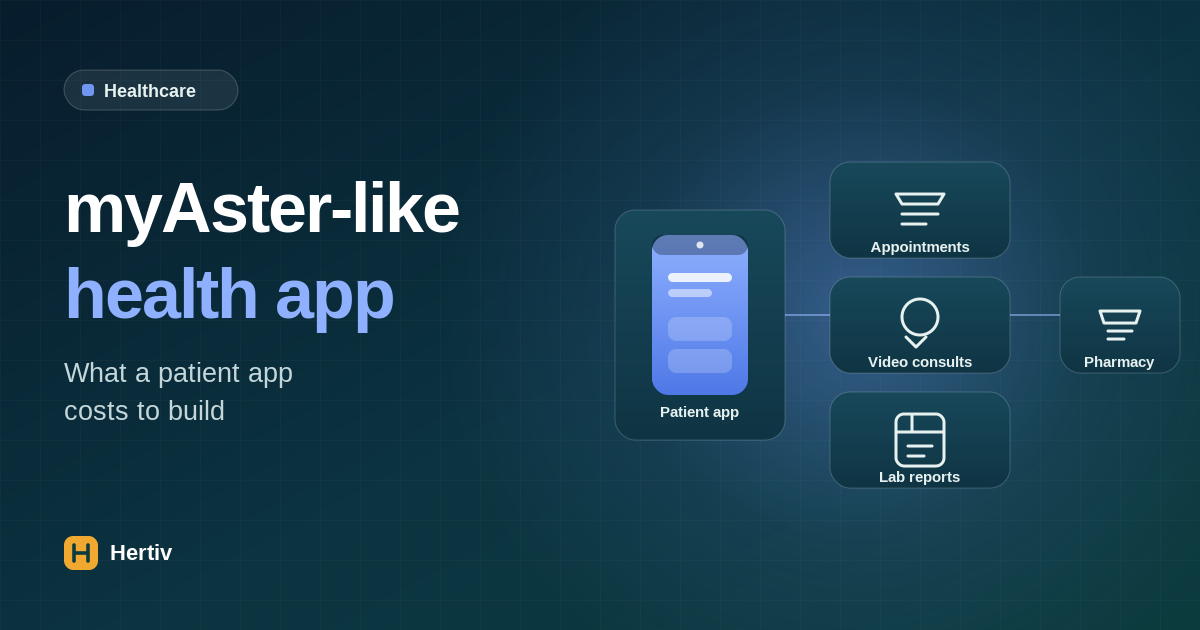
myAster is the patient app of Aster DM Healthcare, a healthcare provider in the UAE. It lets patients book in-clinic and video consultations, search doctors by specialty, location, gender and language, view lab results and scan reports, manage family health profiles, order medicines from an integrated online pharmacy, and link insurance profiles for payment.
A myAster-like app is a healthcare app with the same job: one place where patients manage their care. The core is appointment booking and reminders, a personal health record, electronic prescriptions, lab results and a way to talk to a doctor without visiting a clinic. Some versions add family profiles, so a parent can manage appointments for children and dependents.
The difference from a simple booking app is the data behind it. myAster connects to the provider's hospitals, clinics, labs and pharmacies, so a lab result ordered in a clinic shows up in the app. A clone that only books appointments is a different, much smaller product than one that also shows a patient's full health record.
If you are costing a healthcare product in general, start with healthcare app development cost to see the baseline before adding provider integrations.
What does a healthcare app like myAster cost?
A healthcare app like myAster costs between $80,000 and $500,000 to build, depending on scope. The table below shows indicative ranges for the usual versions.
| Version | What it includes | Indicative cost |
|---|---|---|
| First version | Appointments, patient profiles, reminders, basic health record view | $80,000-$200,000 |
| Full app | Video consultations, e-prescriptions, lab results, pharmacy delivery, family profiles | $200,000-$500,000 |
| Multi-provider platform | Connections to hospital systems, labs, pharmacies and insurance | $500,000-$1,200,000 |
| White-label base | A ready-made health app rebranded and configured for one provider | $30,000-$80,000 |
These are indicative ranges, not quotes. The first version is the usual starting point for a private clinic network, while the multi-provider version is a multi-year programme, not a single build. Running costs are separate: hosting, support, compliance reviews and updates.
What drives the cost up or down?
The cost of a healthcare app like myAster depends on four things: how many services it covers, how many systems it connects to, how strict the health data rules are, and how much of the work is custom.
Integrations are the biggest driver. Each connection to a hospital system, lab, pharmacy or insurer needs mapping, testing and ongoing support. A lab result feed that works in one clinic may need rework for a second clinic on a different system.
Compliance is the second driver. Health data needs encryption, access controls, audit logs and consent handling, and the rules differ by country. A video consultation feature also needs reliable call quality and a fallback when the connection drops. For a closer comparison, see the cost of a healthcare app like Sehhaty, which adds national-system connections.
Team size is the third driver. A small team builds the first version in months; a large team with separate mobile, backend and compliance work costs more each month but ships faster. The cheapest team is not always the cheapest project: a slow build pays for more months of salaries. Ask for a fixed scope with a clear list of features, rather than an open-ended hourly estimate.
Which features come first?
A sensible build order starts with the features patients use every week, then adds the ones that need deeper integrations.
- Appointments and reminders. Book, reschedule and cancel, with SMS and push reminders.
- Doctor search. Filter by specialty, location, gender and language, with earliest-available booking.
- Health records. Lab results, scan reports and prescriptions the patient can view and download.
- Video consultations. In-app calls with a doctor, plus follow-up bookings.
- Pharmacy and delivery. Order medicines, track delivery, and pay inside the app.
- Family profiles and insurance. Manage dependents and link insurance for payment.
Build the first three before the rest. If appointments and records work well, patients return; pharmacy and family profiles can follow in later releases.
Should you build, buy or white-label?
There are three ways to get a myAster-like app, and the right one depends on how different your service is from the standard.
| Route | When it fits | Trade-off |
|---|---|---|
| Build from scratch | Unique workflows or deep integrations | Full control, highest cost and longest build |
| White-label base | Standard clinic or hospital services | Faster and cheaper, limited customisation |
| Buy and integrate | One missing piece, such as pharmacy | Fast for one feature, integration work remains |
Most providers start with a white-label base and customise the branding, doctor search and payment flow. Building from scratch makes sense only when the workflows are genuinely different. If you are planning the product itself, read how to build a healthcare app for the full planning steps.
Example (hypothetical): a 25-clinic network builds a myAster-like app
Example (hypothetical): a 25-clinic network plans a patient app with appointments, doctor search, health records and video consultations, but no pharmacy in the first version.
The build uses 3 developers for 16 weeks at $2,000 a week, which is $96,000, plus $15,000 for design and $20,000 for a compliance review, giving $131,000 for the first version. Yearly running costs are $36,000 for hosting, support and updates.
The app handles 2,000 appointments a month. Each online booking saves reception staff 10 minutes, so 2,000 bookings save 20,000 minutes, or about 333 hours a month. At $25 an hour that is about $8,333 a month, or $100,000 a year. Against a $150,000 build, the app pays for itself in about 18 months, before counting the video consultations it also enables.
What are the common mistakes?
The most common healthcare app mistakes are underestimating integrations, treating compliance as an afterthought, and launching with too many features at once.
- Underestimating integrations. Each hospital or lab system is a separate project, not a checkbox.
- Compliance as an afterthought. Consent, audit logs and access controls are cheaper to build in than to add later.
- Too many features at launch. A wide, shallow app frustrates patients; a narrow, reliable one earns trust.
- No offline fallback. Patients lose signal in lifts and car parks; the app should still show records and appointments.
- Ignoring older patients. Large text, simple flows and family profiles matter more than new features.
Key takeaways
- myAster is Aster DM Healthcare's UAE patient app for bookings, records and pharmacy
- A myAster-like app typically costs $80,000 to $500,000 to build
- Integrations and health data rules drive most of the cost
- Build appointments, doctor search and records first
- A 25-clinic example pays back in about 18 months
Frequently asked questions
What is myAster?
myAster is the patient app of Aster DM Healthcare in the UAE. It books in-clinic and video consultations, shows lab results and prescriptions, manages family health profiles, and orders medicines from an integrated online pharmacy.
How much does a healthcare app like myAster cost?
A first version typically costs $80,000 to $200,000, and a full app with video consultations, pharmacy and family profiles costs $200,000 to $500,000. Multi-provider platforms with many integrations cost more.
Do I need a white-label app or a custom build?
A white-label base fits standard clinic services and is faster and cheaper. A custom build fits providers with unique workflows or deep integrations into hospital and lab systems.
What features matter most in a healthcare app?
Appointments, doctor search and health records matter most, because patients use them every week. Video consultations, pharmacy delivery and family profiles follow once the core works well.
How long does a healthcare app take to build?
A first version usually takes three to five months, and a full app takes six to twelve months. Integrations with hospital, lab and insurance systems add the most time.
Is patient data safe in a healthcare app?
It can be, with encryption, access controls, audit logs and consent handling built in from the start. The exact rules depend on the country, so get a compliance review before launch.


