How Much Does a Healthcare App Like Sehhaty Cost to Build?
A healthcare app like Sehhaty, Saudi Arabia's national health app, typically costs $80,000 to $500,000 to build, depending on features and integrations.
On this page
Short answer
A healthcare app like Sehhaty is a patient-facing app that books appointments, shows health records and prescriptions, and offers remote consultations, built for a national health system. Building one typically costs between $80,000 and $500,000, depending on how many services it covers, which health systems it connects to, and how strict the local health data rules are.
What is Sehhaty, and what does a Sehhaty-like app do?
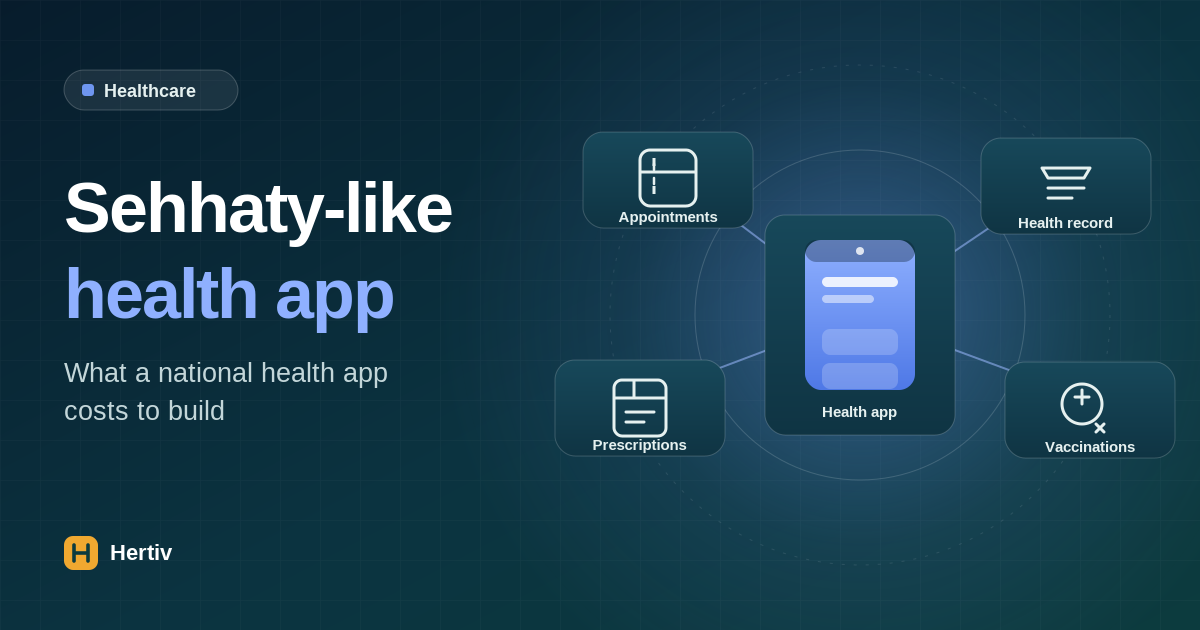
Sehhaty is the unified digital health platform of Saudi Arabia's Ministry of Health. It lets citizens and residents book appointments at public health centres and hospitals, request remote consultations, view prescriptions and search for medicines, check vaccination records and sick-leave reports, and see their health records in one place.
A Sehhaty-like app is a healthcare app with the same job: one place where patients manage their care. The core is appointment booking and reminders, a personal health record, electronic prescriptions, lab results, vaccination history and a way to talk to a doctor without visiting a clinic. Some versions also add family profiles, so a parent can manage appointments and vaccinations for children and dependents.
The difference from a simple booking app is the data behind it. Sehhaty connects to national health systems: the appointment network, vaccination registries, pharmacy systems and the national identity system used to verify each user. A clone that only books appointments is a different, much smaller product than one that also shows a patient's full health record.
If you are costing a healthcare product in general, start with healthcare app development cost to see the baseline before adding national-system integrations.
What does a healthcare app like Sehhaty cost?
A healthcare app like Sehhaty costs between $80,000 and $500,000 to build, depending on scope. The table below shows indicative ranges for the usual versions.
| Version | What it includes | Indicative cost |
|---|---|---|
| First version | Appointments, patient profiles, reminders, basic health record view | $80,000-$200,000 |
| Full app | Teleconsultations, e-prescriptions, lab results, vaccinations, sick leave, family profiles | $200,000-$500,000 |
| National-scale platform | Connections to hospital systems, vaccination registries, pharmacies and national identity | $500,000-$1,200,000 |
| White-label base | A ready-made health app rebranded and configured for one provider | $30,000-$80,000 |
These are indicative ranges, not quotes. The first version is the usual starting point for a private clinic network, while the national-scale version is a multi-year programme, not a single build. Running costs are separate: hosting, support, compliance reviews and app-store maintenance typically add $3,000 to $8,000 a month once the app is live.
What drives the cost up or down?
The cost of a healthcare app like Sehhaty is driven by integrations, compliance and the number of user roles. Each one adds weeks of work.
- Health-system integrations. Connecting to hospital records, lab systems, pharmacy networks and vaccination registries is the largest cost. Each system has its own data format and its own approval process.
- Identity verification. A national health app verifies users against a government identity system. That integration is complex and must be tested with the authority that runs it.
- Teleconsultations. Video and chat consultations need reliable calls, a queue, and a way to record the visit. They also need a fallback when a call drops.
- Compliance and security. Health data is sensitive, so the app needs encryption, audit logs, consent handling and access controls. A security review by an outside firm is a separate cost.
- User roles. Patients, doctors, pharmacists and administrators each need different screens. Every extra role adds design and testing time.
The cheapest way to cut cost is to cut integrations. An app that books appointments and shows a simple record is far cheaper than one that also pulls lab results and prescriptions from five different systems.
What features does a Sehhaty-like app need?
A Sehhaty-like app needs appointment booking, a health record, prescriptions and consultations at minimum. The table below lists the feature groups in the order most teams build them.
| Feature group | What it covers | Build order |
|---|---|---|
| Appointments | Search, book, reschedule, cancel, reminders | First |
| Patient profile | Identity, dependents, contact details, language | First |
| Health record | Visits, diagnoses, lab results, vaccination history | Second |
| E-prescriptions | View prescriptions, refill requests, pharmacy search | Second |
| Teleconsultations | Video, audio and text visits, doctor notes | Third |
| Documents | Sick-leave reports, referrals, certificates | Third |
Two features deserve care early. Reminders matter more than they look: missed appointments waste clinic time, so push and message reminders pay for themselves. And the health record view must be simple, because patients open it to check one result, not to browse a database. A record screen that takes three taps to reach a lab result will frustrate the people the app is built for.
How do you build it: in-house, agency or white-label?
You build a healthcare app like Sehhaty in-house, with an agency, or from a white-label base. The right choice depends on how much control you need over the data and the integrations.
- Define the data first. List the systems the app must read from and write to, and confirm each one has an interface you can use. An integration without an interface is a project of its own.
- Pick the build model. In-house gives the most control and the slowest start. An agency is faster to start but costs more per month. A white-label base is the cheapest start, but you inherit its data model and its limits.
- Build the record and booking first. These two features are used every day, so they should be solid before consultations and documents are added.
- Test with real clinics. A pilot with two or three clinics finds the workflow problems that a design review misses, such as double-booking and mismatched patient records.
- Pass a security review. Before launch, an outside review should check encryption, access control and audit logging. Fixing these after launch costs far more.
- Plan the rollout. A national health app rolls out region by region, because support teams need time to learn the new workflows. Plan for training and a helpdesk from day one.
For a private clinic network, the agency or white-label route is usually the sensible one. For a government health system, the work is large enough that an in-house team plus specialist contractors is the normal shape. If you need help scoping the build, a partner for custom software development can estimate the integrations before you commit.
Example (hypothetical): a one-city clinic network app
Example (hypothetical): a network of 40 clinics in one city wants a Sehhaty-like app for its patients. It needs appointment booking, patient profiles, a basic health record, e-prescription viewing and reminders, but no teleconsultations yet and no national-system connections.
The build uses 3 developers for 16 weeks at $2,000 a week, which is $96,000. Design costs $15,000, and a security and compliance review costs $20,000. The total build cost is $96,000 plus $15,000 plus $20,000, which is $131,000.
Running costs are $3,000 a month, or $36,000 a year, for hosting, support and app-store maintenance. The network charges each clinic $250 a month for the app, so 40 clinics pay $10,000 a month, or $120,000 a year.
The app brings in $120,000 a year and costs $36,000 a year to run, leaving $84,000 a year. The $131,000 build is paid back in about 19 months, since $131,000 divided by $84,000 is 1.6 years. The network also saves appointment-desk time, but that saving is not counted here.
What are the common mistakes?
The most common mistakes with a healthcare app like Sehhaty are underestimating integrations, skipping the security review, and copying the feature list without the data behind it.
- Underestimating integrations. Each health system connection takes weeks of testing and approval. A plan that treats integrations as plug-and-play will run late.
- Skipping the security review. Health data breaches are expensive and damage trust. A review before launch is cheaper than a fix after one.
- Copying the feature list. Sehhaty's features work because national systems feed them data. The same screens without those feeds are empty boxes.
- Forgetting older patients. A health app used by every age group needs large text, simple steps and phone support. An app only young patients can use will miss its audience.
- No plan for records. Patient records need a clear owner, a retention rule and a way to correct errors. Without that, the record view becomes a source of complaints.
Key takeaways
- A Sehhaty-like app books appointments, shows health records and prescriptions, and offers remote consultations in one place
- Building one typically costs $80,000 to $500,000, with integrations and compliance as the largest costs
- Build appointments and the health record first, then add consultations and documents
- Health-system integrations take the most time, so confirm each interface exists before you plan
- A security review before launch is cheaper than fixing health-data problems after one
Frequently asked questions
What is the Sehhaty app?
Sehhaty is the unified digital health platform of Saudi Arabia's Ministry of Health. It lets citizens and residents book appointments, request remote consultations, view prescriptions and vaccination records, and see their health records in one app.
How much does a healthcare app like Sehhaty cost?
A first version with appointments and a basic health record typically costs $80,000 to $200,000. A full app with teleconsultations, e-prescriptions and family profiles costs $200,000 to $500,000, and a national-scale platform with hospital and registry connections costs more.
What features does a Sehhaty-like app need?
At minimum it needs appointment booking, patient profiles, a health record view, e-prescription viewing and reminders. Teleconsultations, lab results, vaccination history and documents such as sick-leave reports are usually added in later phases.
How long does it take to build?
A first version for a clinic network usually takes three to five months with a small team. A full app with consultations and integrations takes six to twelve months, and a national-scale platform is a multi-year programme.
Is a white-label health app cheaper?
Yes, a white-label base typically costs $30,000 to $80,000 to configure and brand, against $80,000 or more for a custom build. The trade-off is less control over the data model and the integrations it supports.
What is the biggest cost risk?
Integrations. Connecting to hospital records, lab systems, pharmacies and identity systems takes the most time and carries the most approval steps, so each connection should be confirmed and priced before the build starts.


