How Much Does an App Like eToro Cost to Build?
An app like eToro costs roughly $150,000 to $300,000 for a first version and $300,000 to $600,000 for a full product. Copy trading adds the most cost.
On this page
Short answer
An app like eToro is a trading app that lets users buy and sell stocks, ETFs and crypto, follow other traders in a social feed, and copy the trades of experienced investors automatically. Building one costs roughly $150,000 to $300,000 for a first version and $300,000 to $600,000 for a full product, with the social and copy trading parts adding the most to the bill.
What does an eToro-style trading app include?
An eToro-style trading app is a mobile and web app for buying and selling financial assets, built around social trading. Users trade stocks, ETFs, crypto and other assets, follow other traders in a feed, and copy the trades of traders they trust. eToro itself launched in 2007 in Israel and built its name on this social approach, with its CopyTrader feature arriving in 2010.
The app has three layers. The trading layer handles accounts, orders, prices and portfolios. The social layer handles profiles, feeds, comments and trader rankings. The money layer handles deposits, withdrawals, identity checks and the rules of each country where the app operates.
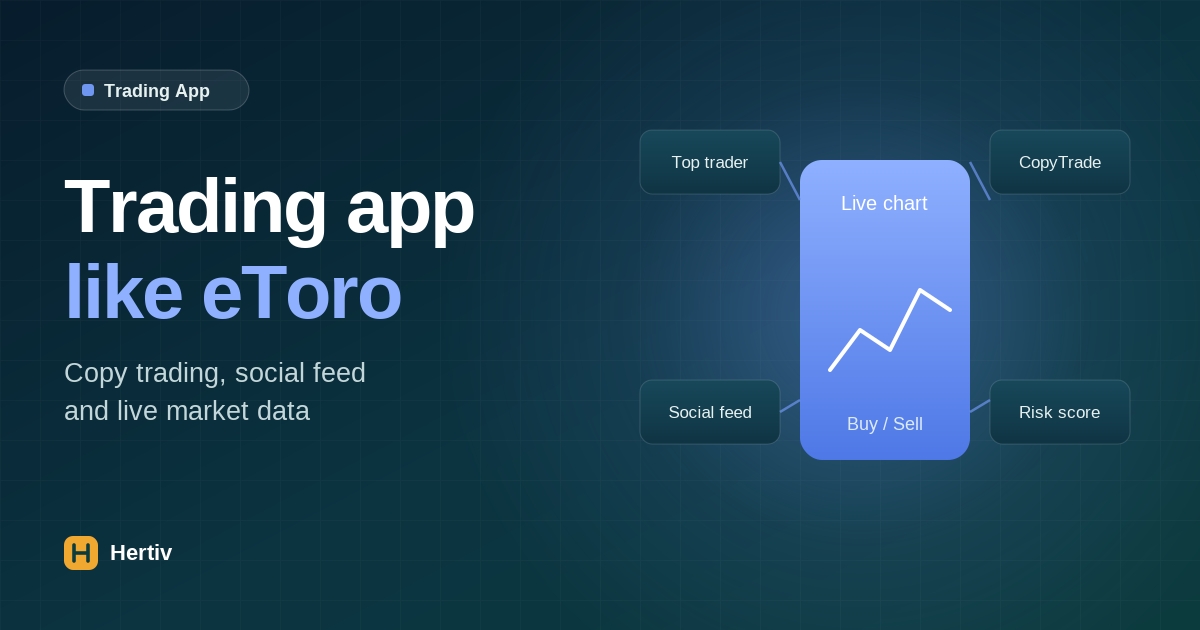
Copy trading is what sets this kind of app apart from a plain broker app. A user picks a trader, sets an amount, and the app mirrors that trader's positions in proportion. That needs live position tracking, risk scores and clear warnings, because copying a trader also copies their losses. For the generic cost picture, see stock trading app development cost.
Which features drive the cost?
The features that drive the cost are the ones that touch real money: order execution, live prices, payments and identity checks. Social features add a second layer of cost, because feeds, rankings and copy trading each need their own data and rules.
| Feature | What it does | Cost driver |
|---|---|---|
| Trading and orders | Buy, sell, watchlists, portfolios | Broker and market data links |
| Live prices and charts | Quotes, charts, alerts | Data feed licences |
| Copy trading | Mirror another trader's positions | Position tracking and risk rules |
| Social feed | Profiles, posts, comments, rankings | Feeds, moderation, ranking |
| Practice account | Trade with virtual money | Separate paper-trading ledger |
| Payments and identity | Deposits, withdrawals, ID checks | Payment and KYC providers |
Market data is a running cost, not a one-off build cost. Live quotes for stocks, ETFs and crypto come from licensed data providers, and the price depends on how many users see the data and how fast it must update. A demo with delayed prices is far cheaper than live prices for every user.
How much does each version cost?
A first version with trading, watchlists, deposits and a simple social feed costs roughly $150,000 to $300,000. A full product with copy trading, Smart Portfolios, practice accounts and apps for iOS, Android and web costs roughly $300,000 to $600,000. A large-scale product with several countries, many asset types and heavy trading volume costs $600,000 to $1,200,000 or more. All figures are indicative ranges, not quotes.
| Version | What is included | Indicative cost |
|---|---|---|
| First version | Trading, watchlists, deposits, basic feed | $150,000–$300,000 |
| Full product | Copy trading, portfolios, practice account | $300,000–$600,000 |
| Large scale | Multi-country, many assets, high volume | $600,000–$1,200,000+ |
The licence and legal work sits outside these ranges. A trading app must work with a licensed broker or become one, and the rules differ by country. Budget for legal advice and compliance from the start, because it shapes what the app can offer in each market. See how much an app like Grab costs to build for how a different kind of marketplace app is priced.
What makes the social and copy trading parts expensive?
Copy trading is expensive to build because every copied position must be tracked in real time. When the trader being copied opens or closes a position, the app must open or close the same position for every copier, in proportion to their amount, and show the result at once. If the link breaks, copiers hold positions the trader no longer holds.
The social feed adds moderation and ranking work. Trader profiles need risk scores, past performance and drawdown charts, and the app must show those numbers honestly, with warnings that past results do not predict future results. Posts and comments need moderation, because a trading feed attracts scams and false tips.
Risk controls are the third cost. The app must limit how much a user can copy, stop copying when a trader's risk changes, and let users set stop-loss limits. These controls protect users and the business, and regulators in many countries expect them. A plain trading app without social features skips most of this work.
How to build it in seven steps
Build an eToro-style app in seven steps, starting with the legal model and the broker link, not with the design. The trading and money parts come first; the social parts come after the core works.
- Settle the legal model. Decide whether to partner with a licensed broker or seek a licence, and which countries to serve first.
- Pick the asset list. Start with stocks and ETFs in one market, then add crypto and other assets once trading works.
- Build trading and accounts. Orders, portfolios, watchlists, deposits and withdrawals come before any social feature.
- Add live prices and charts. Connect a market data provider and test quotes, charts and alerts under load.
- Add the social feed. Profiles, posts, comments and trader rankings, with moderation from day one.
- Add copy trading. Position mirroring, risk scores, limits and stop-loss controls, tested with small amounts first.
- Test with real users. Run a closed test with a practice account, then open trading in one country before expanding.
Keep the practice account in every version. It lets users learn the app with virtual money, and it gives the team a safe way to test copy trading without real funds at risk. For a related build, see how much an app like Airbnb costs to develop.
Example (hypothetical): a one-market launch
Example (hypothetical): a team launches an eToro-style app in one country with 5,000 active users in the first year. Each user brings in $8 a month on average from spreads and fees, so monthly revenue is 5,000 x $8 = $40,000.
Running costs are $25,000 a month, covering market data, servers, support and compliance. That leaves $40,000 - $25,000 = $15,000 a month in net income. A first version that cost $180,000 to build pays for itself in $180,000 / $15,000 = 12 months, if user numbers and revenue hold steady.
The numbers change fast if copy trading takes off or stalls. If half the users copy traders, trading volume rises and so does revenue, but support and compliance work rise too. Plan the budget around the slow case, and treat extra volume as a bonus, not as the plan.
What are the common mistakes?
The most common mistakes with eToro-style apps are starting with copy trading before core trading works, showing trader performance without risk warnings, and underestimating compliance.
- Copy trading first. If orders, prices and portfolios are not solid, copying multiplies every error.
- No risk warnings. Trader rankings without drawdown and risk scores mislead users and draw regulator attention.
- Skipping compliance. Trading rules differ by country, and a feature that is fine in one market may be banned in another.
- Cheap market data. Delayed or unreliable quotes break trust, and users leave after one bad trade.
- No moderation. A trading feed without moderation fills with scams and false tips within weeks.
- Ignoring the practice account. Users who cannot practise first make costly mistakes and blame the app.
Key takeaways
- Copy trading is the feature that sets an eToro-style app apart
- A first version costs roughly $150,000 to $300,000; a full product $300,000 to $600,000
- Market data, broker links and compliance are running costs, not one-off build costs
- Trader rankings need risk scores and warnings, not just past returns
- Build trading and accounts first, then the social feed, then copy trading
Frequently asked questions
How much does an app like eToro cost to build?
A first version costs roughly $150,000 to $300,000, a full product roughly $300,000 to $600,000, and a large multi-country product $600,000 to $1,200,000 or more. These are indicative ranges. The licence, broker link and market data fees sit outside them, so get a quote for your market before you budget.
What is copy trading?
Copy trading lets a user mirror the trades of another trader automatically. The user picks a trader and an amount, and the app opens and closes the same positions in proportion. If the trader gains, the copier gains in proportion; if the trader loses, the copier loses too.
Does an eToro-style app need a licence?
Yes, in most countries. Trading apps must work with a licensed broker or hold a licence themselves, and the rules differ by market. Legal advice should come before design work, because the licence model decides which assets and features the app can offer.
What assets can an eToro-style app offer?
Most offer stocks, ETFs and crypto, with some adding forex, commodities and CFDs. Start with one or two asset types in one market, then expand once trading, payments and compliance work well. Each new asset type adds data, rules and testing.
How long does it take to build?
A first version usually takes four to seven months, and a full product with copy trading takes eight to fourteen months. The licence and broker work often takes longer than the software, so start it early and do not plan the launch around a best-case legal timeline.
Why is market data so expensive?
Live prices come from licensed data providers who charge by user and by update speed. Delayed prices are far cheaper, but users expect live quotes in a trading app. Budget for data as a monthly cost that grows with users, not as a one-off build cost.


