What Drives Stock Trading App Development Cost
Stock trading app development cost is driven by brokerage integration, real-time market data licences, compliance, and platform scope, not by UI work. Here is what moves the number.
On this page
Short answer
Stock trading app development cost is driven mainly by brokerage and market-data integrations, regulatory compliance, real-time infrastructure and the number of platforms. A basic app with one broker and delayed data is far cheaper than a multi-broker, real-time, regulated platform with order management.
What is included in a stock trading app?
A stock trading app is a client that shows market data, lets users place and manage orders, and reports positions and history, backed by services that connect to brokers, data vendors and compliance systems.
The build usually splits into four layers:
- Client apps: iOS, Android and often web, with watchlists, charts, order tickets and portfolio views.
- Backend services: accounts, authentication, order management, portfolio calculation and notifications.
- Integrations: broker or exchange APIs, market data feeds, payment and funding rails, KYC and identity checks.
- Operations and compliance: audit logs, reporting, monitoring, incident response and security controls.
Cost estimates that only count screens miss the second half of the list. The integrations and compliance layer is where most of the engineering time sits, and where scope decisions have the biggest price effect. A team that has built order flows and broker connections before will estimate this far more accurately than one that has not.
If you are comparing quotes, ask each vendor to break their number down by these four layers.
Which factors move the cost the most?
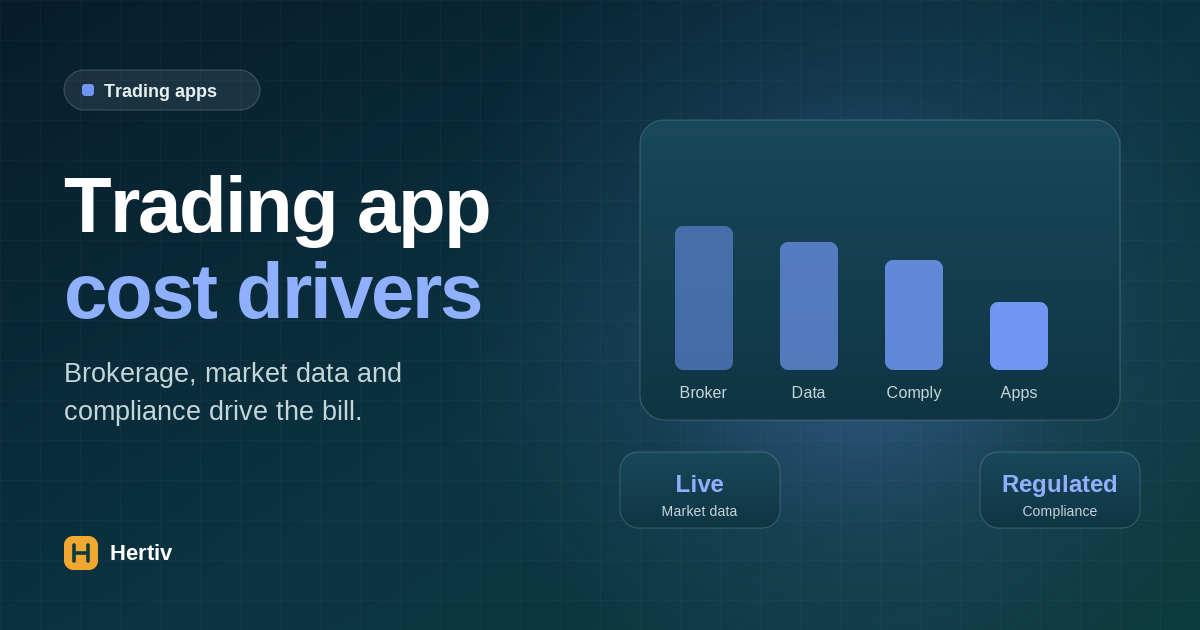
The biggest cost drivers are the number of brokers and markets, whether data is real-time or delayed, how much regulation applies to you, and how many platforms you ship.
| Factor | Low end | High end |
|---|---|---|
| Broker connections | One broker, one API | Many brokers, order routing, failover |
| Market data | Delayed or reference data | Real-time licensed feeds, multiple venues |
| Regulation | Informational app, no order handling | Licensed brokerage, KYC, audit trails, reporting |
| Platforms | One mobile platform | iOS, Android and web with shared logic |
| Accounts | Single currency, single region | Multi-currency, multi-region, tax handling |
| Settlement | Display only, manual handling | Automated reconciliation and corporate actions |
| Security | Standard auth | Hardware-backed keys, step-up auth, pen testing |
Each step up the table adds backend work, not just interface work. Moving from delayed to real-time data, for example, changes how you cache, reconnect, store history and handle market hours across time zones. Multi-broker support means an abstraction layer, per-broker quirks and testing against sandbox environments that rarely match production behaviour.
A practical way to read your own scope: list every row and mark where you sit. The distance between your position and the low end is roughly your added cost relative to a basic app.
What does market data really cost?
Market data is usually a licensing cost rather than an engineering one, and it scales with usage and redistribution rights rather than with your codebase.
Vendors typically charge for the feed itself, for the right to display it to end users, and sometimes for non-display use such as order checks or analytics. Real-time data from major venues costs more than delayed data, and redistribution to a public app costs more than internal use. Exchanges may also require you to report user numbers or pay per-user fees.
Budget for these items:
- Feed subscription and any per-user display fees.
- Exchange or venue fees where redistribution applies.
- Engineering time to normalise, cache and store the data.
- Failover to a second provider where outages are unacceptable.
Ask vendors directly about display and non-display rights, minimum contract terms and what happens if your user base grows. Those answers shape your long-term cost more than the initial connection work.
How do compliance and security affect the budget?
Compliance and security add engineering scope that is hard to see in a demo, but it is often the difference between a prototype and a product you can operate.
If your app handles orders or client money, expect obligations such as identity verification, suitability or appropriateness checks, order and communication records, audit trails, and reporting to a regulator. Even apps that only display data usually need strong authentication, privacy controls and clear disclosures.
Engineering work that follows from this:
- Identity and KYC integration, including document capture and sanctions screening providers.
- Immutable audit logging for orders, changes and access.
- Role-based access for staff, support and operations.
- Encryption in transit and at rest, key management, and regular penetration testing.
- Retention and deletion rules that match the jurisdictions you serve.
Security deserves its own line in the budget. Trading apps are a visible target, and a single weak point in authentication or session handling undermines the rest. Review flows for step-up authentication on orders and withdrawals, and plan for periodic third-party testing.
What is a realistic build sequence?
A staged build keeps early spending small and defers the expensive integrations until you know the product works.
- Define the regulated scope. Confirm with counsel which activities require a licence in your target markets. This decides almost everything downstream.
- Build a display-only MVP. Watchlists, charts with delayed data, portfolio views for manually entered or imported positions. No order placement.
- Add one broker in sandbox. Implement order placement, cancellation and status against a single broker API, with clear failure states.
- Harden operations. Add audit logs, alerting, reconciliation and support tooling before real users can transact.
- Go live in one market. One currency, one broker, one platform. Measure where support requests come from.
- Expand deliberately. Add brokers, markets, real-time data and additional platforms only when the first market is stable.
This order matters because each step validates a risk before you pay for the next. Teams that build multi-broker, multi-region apps first often spend heavily on abstractions before confirming that users actually place orders. If you are funding this from scratch, a cost guide for how much an MVP costs helps set the first-stage budget.
How to choose a development partner
Choose a partner on evidence of order-flow and integration work, not on interface mockups.
- Ask for integration experience. Broker APIs, market data feeds and KYC providers have specific failure modes; prior work shortens the learning curve.
- Request a layer-by-layer estimate. A quote broken into client, backend, integrations, compliance and operations is easier to sanity-check than one number.
- Agree who owns licences. Data feed contracts and broker agreements should usually sit with you, not the vendor.
- Check the security process. Ask how testing, secrets management and incident response are handled during and after the build.
- Plan the handover. You need documentation, infrastructure access and a clear maintenance arrangement from the start.
A firm that builds custom software for regulated environments will raise compliance questions early, which is a good sign. Expect a typical build for a single-market, single-broker app to sit at the lower end of the range, with real-time, multi-broker and licensed brokerage features pushing it considerably higher; the spread depends on scope and vendors should justify it in writing.
What are common mistakes in budgeting?
Most budget overruns in trading apps come from scope that was understood but not priced.
- Counting only the mobile client and forgetting backend, operations and support tooling.
- Assuming market data is free or one fee; display and redistribution rights usually cost more.
- Planning for real-time prices before confirming that users need them.
- Leaving audit logging, reconciliation and support tools until after launch.
- Skipping a sandbox phase with the broker, then discovering production differences during a live incident.
- Underestimating post-launch work: security reviews, compliance changes and OS updates recur every year.
Fix this by writing a scope document that lists every integration, every regulatory obligation you have confirmed, and every platform. Then price each item separately. That single change makes competing quotes comparable and gives you a basis for change control later.
The same discipline applies to any regulated fintech build, including mobile app development where store review and device security add their own steps.
Key takeaways
- Market data licensing and broker connectivity are usually the largest recurring costs, not the app code
- Regulatory obligations (KYC, order records, audit trails) add engineering scope in most jurisdictions
- Real-time pricing, order routing and portfolio sync need durable backend infrastructure
- Starting with one broker, one region and delayed data keeps an MVP affordable
- Ongoing costs include data feeds, hosting, security reviews and compliance maintenance
Frequently asked questions
How long does it take to build a stock trading app?
A display-only MVP can take a few months. A version with one broker, order placement and compliance features typically takes longer, and multi-broker, multi-market platforms run well beyond that. The regulated scope and broker integration timelines usually set the schedule more than the client app does.
Can I launch without a brokerage licence?
In many jurisdictions you can launch a data and analysis app without a licence, but once you route or execute orders for users, licensing and regulatory obligations usually apply. Confirm your position with local counsel before committing to a build plan.
Is it cheaper to white-label an existing trading platform?
Often yes for launch speed, because integrations and compliance features already exist. The trade-off is customisation limits, per-user or revenue-based fees, and less control over the roadmap. Compare total cost over several years, including licence fees, rather than build cost alone.
What ongoing costs should I plan for?
Expect recurring market data and broker fees, cloud hosting, security testing, app store fees, monitoring and support staff. Compliance work also recurs as rules change. These operating costs often exceed the original build cost over a multi-year horizon, so budget them from the start.
Which platform should we build first?
Start with the platform your target users actually trade on, often mobile, and keep the backend API-first so other clients can follow. Building iOS, Android and web at once multiplies testing and review work before you have validated demand.
Do we need real-time data for launch?
Not always. Delayed data is cheaper and simpler to operate, and many early users mainly need watchlists, history and portfolio views. Add real-time feeds once usage patterns justify the licensing cost and the engineering work around reconnects, caching and market hours.


