How Much Does It Cost to Build a dApp?
A simple dApp takes a small team a few weeks, while a large one with audits and complex contracts costs far more. Scope, chain and security work decide the price.
On this page
Short answer
The cost of building a dApp depends on what it does, which blockchain it runs on, and how much security work it needs. A simple dApp with one contract and a basic front end costs far less than a trading or lending app with several contracts, an audit and ongoing monitoring.
What is a dApp, and what does it cost to build?
A dApp is an application whose core logic runs on a blockchain through smart contracts, while the user interface usually runs as a normal web or mobile app. The cost covers the contracts, the interface, the wallet connection, testing and, for anything holding real value, a security audit.
There is no single price. A small team can build a simple dApp in a few weeks, while a DeFi app with several contracts, oracles and an audit can take months and a much larger budget. The range below is a planning guide, not a quote, and the real figure comes from a scoped estimate for the specific idea. For the basics, what a dApp is explains the pieces before any cost is discussed.
The biggest cost driver is usually security. A contract that holds user funds must be reviewed by specialists, and that review is priced by the size and complexity of the code. Skipping it is the most expensive mistake a dApp team can make, since a bug in a live contract can drain the funds it holds.
What are the parts of a dApp budget?
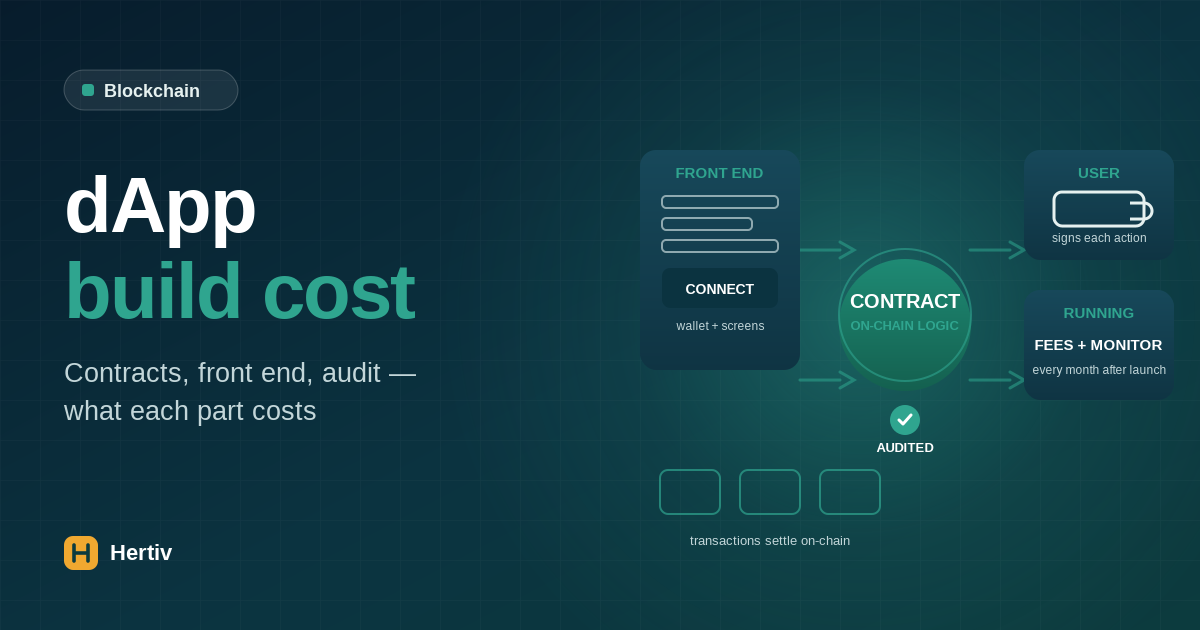
A dApp budget has five parts: the smart contracts, the front end, the wallet and data connections, testing and audit, and launch and running costs.
| Part | What it covers | What changes the cost |
|---|---|---|
| Smart contracts | Token, logic and state on-chain | Number and complexity of contracts |
| Front end | Web or mobile interface | Screens, design and wallet flows |
| Connections | Wallets, oracles, indexers, storage | Which services and chains are used |
| Testing and audit | Unit tests, review, audit report | Value at risk and code size |
| Launch and running | Deployment, gas, monitoring, support | Traffic, chain fees and updates |
Contracts are usually the smallest part of the code by line count and the largest part of the risk. A front end can be fixed after launch with a normal deploy; a contract bug may need a migration, a pause mechanism or a new contract, each of which costs time and trust.
Running costs are easy to miss. Indexing services, RPC providers, monitoring and support all carry monthly fees, and transaction fees on the chosen chain apply to every user action the contract performs. Those fees are paid by users, the team or both, and the choice should be made before launch.
What drives the cost up or down?
Five factors drive the cost: the number of contracts, the chain chosen, the value at risk, the design of the front end, and whether the team is in-house or external.
- Contract count and complexity. One token contract is simple; a lending app with interest, collateral and liquidation logic is not. Each extra contract adds design, tests and audit time.
- Chain choice. Different chains have different tools, fees and audit costs. A chain with mature tooling and many auditors is usually cheaper to build on.
- Value at risk. The more value the contracts hold, the more testing and audit the team should buy. An audit for a contract holding real funds is not optional.
- Front-end scope. A simple wallet-connected page is cheap; a full trading interface with charts, history and settings is a separate product.
- Team model. An in-house team costs salary and time, while an external team costs a project fee. The cheaper option depends on how much the team will build after launch.
Reusing audited building blocks can cut the contract cost. Standard token contracts and well-known libraries have been reviewed many times, so a team that builds on them spends its audit budget on its own logic rather than on reinventing the basics. The guide to dApp development covers the common building blocks teams start from.
What are the build phases?
A dApp is usually built in six phases: scope, contract design, front end, testing, audit and launch.
- Scope the idea. Write down exactly what the dApp does, who uses it and what value the contracts hold. Cut anything that is not needed for the first version.
- Design the contracts. Decide what lives on-chain and what stays off-chain, and draw the flows for deposits, trades and withdrawals.
- Build the front end. Build the screens, the wallet connection and the transaction flows, with clear states for pending and failed transactions.
- Test on a testnet. Run the full flows on a test network, including edge cases such as failed transactions and rejected wallet prompts.
- Audit the contracts. Send the frozen code to an auditor, fix the findings and re-test. Do not add features after the audit without a review.
- Launch in stages. Start with limits on deposits or users, watch the contracts and the front end, then raise the limits once the system holds up.
Staged launch matters because a dApp cannot be patched the way a web app can. A limit on early deposits bounds the damage if something was missed, and it gives the team time to watch real behaviour before the stakes rise.
Example: a simple token swap dApp
Example (hypothetical): a small team wants a dApp that lets users swap one token for another, with a simple web page and a wallet connection.
The team budgets 6 weeks for one smart contract developer, 4 weeks for one front-end developer and 2 weeks for design and testing, which is 12 weeks of work in total across the team. At an illustrative rate of 5,000 dollars a week per person, the build costs 60,000 dollars: 30,000 for the contract work, 20,000 for the front end and 10,000 for design and testing.
The audit adds 15,000 dollars for the single contract, and launch costs of 5,000 dollars cover deployment, monitoring and a month of support. The total first version therefore costs 80,000 dollars, since 60,000 plus 15,000 plus 5,000 is 80,000. The arithmetic adds up: the audit is the second-largest line, which is normal for a contract that will hold user funds.
If the team added a lending feature with three more contracts, the contract work and the audit would roughly double, while the front end would grow by only a few weeks. That is why scope decisions change the budget more than any other choice.
What does a dApp cost to run?
A dApp costs money to run through infrastructure, monitoring, support and updates, even when no new features are built.
Infrastructure covers the RPC provider that connects the app to the chain, the indexer that reads on-chain data quickly, and hosting for the front end. Monitoring covers alerts for failed transactions, unusual contract activity and front-end errors. Support covers users who cannot connect a wallet or whose transaction fails, which is common in the first weeks after launch.
Updates are the part teams forget. Contracts cannot be changed once deployed unless an upgrade mechanism was built in, so any fix needs a new deployment and sometimes a migration of funds. The front end can be updated normally, but every change to a contract flow needs testing against the live contracts. A realistic running budget sets aside time each month for these tasks, not just for new features.
Transaction fees deserve their own line. On some chains the team pays the deployment and admin transactions, while users pay their own. On others the team may sponsor user transactions to make the app easier to use. Either way, the fee model should be decided before launch, because changing it later affects every user flow. A partner for dApp development can help model these running costs for a specific chain and design.
What are the common mistakes?
The most common mistakes are skipping the audit, building too much for the first version, and treating the front end as the whole product.
- Skipping the audit. A contract that holds user funds without an independent review is a risk the team cannot price. Audit before launch, not after.
- Building too much first. Every extra contract adds design, tests and audit time. Ship one working flow, then add the next.
- Ignoring the front end. Users meet the dApp through the interface, not the contract. Wallet errors, pending states and failed transactions need clear handling.
- No upgrade plan. Decide before launch how a contract bug would be fixed, including who can pause the contract and how funds would move.
- Forgetting running costs. Infrastructure, monitoring and support continue after launch. Budget for them or the app will degrade quietly.
Key takeaways
- A dApp's cost is set by contract scope, chain choice and security work, not by the front end
- Budget for contracts, front end, connections, testing and audit, plus launch and running costs
- Security review is the second-largest cost for any dApp holding real value
- Launch in stages with deposit limits, and plan how a contract bug would be fixed
- Running costs — infrastructure, monitoring, support and updates — continue after launch
Frequently asked questions
How much does a simple dApp cost to build?
A simple dApp with one contract and a basic front end can be built by a small team in a few weeks, while a DeFi app with several contracts, oracles and an audit takes months. The scope, the chain and the security work decide the figure, so get a scoped estimate for the specific idea.
Do I need a security audit for my dApp?
Yes, if the contracts hold user funds or real value. An audit is an independent review of the contract code for bugs and logic flaws, and it is the main protection against a loss that cannot be undone. The cost depends on the size and complexity of the code.
Can I build a dApp without writing smart contracts?
Only in a limited way. No-code tools can build simple token and voting apps, but anything with custom logic needs contracts written by a developer. The contract is the part that runs on the chain, so it cannot be avoided for a real dApp.
Which blockchain is cheapest to build a dApp on?
That depends on tooling, fees and audit costs, not just the transaction fee. A chain with mature tools and many auditors is usually cheaper to build on, even if its fees are higher. Compare the full build and running cost, not one fee in isolation.
What are the ongoing costs of a dApp?
Ongoing costs include the RPC provider, indexing, hosting, monitoring, support and updates. Transaction fees also apply to contract actions, paid by users, the team or both. Budget for these each month rather than treating launch as the end of spending.
How long does it take to build a dApp?
A simple dApp can take a few weeks, while a larger one with several contracts and an audit can take three to six months. The audit and the testing phases are often the longest, so plan for them from the start rather than adding them at the end.


