Conversational AI in Healthcare: How It Works and Where It Helps
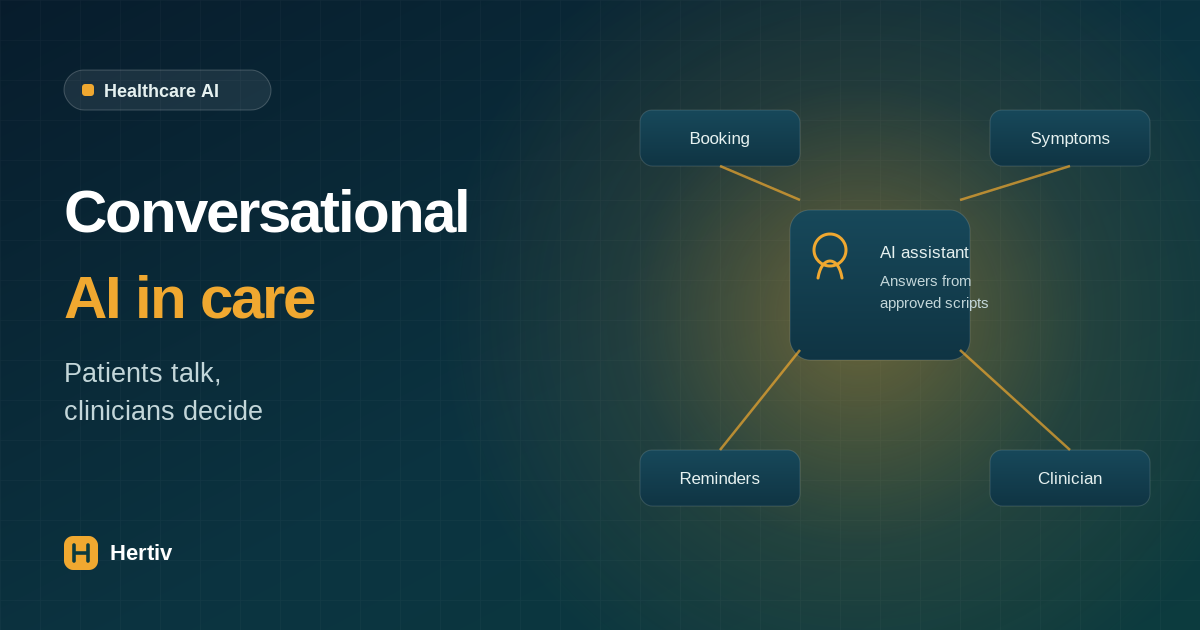
Conversational AI in healthcare books appointments, collects symptoms and answers questions by text or voice, with a person taking over when the script ends.
On this page
Short answer
Conversational AI in healthcare is software that talks with patients and staff in plain language to book appointments, answer questions, triage symptoms and handle routine admin. It works best on narrow, scripted tasks with a human fallback, and it must handle patient data under strict privacy rules, so accuracy and oversight matter more than speed.
What is conversational AI in healthcare?
Conversational AI in healthcare is software that talks with patients, carers and staff in plain language, by text or by voice, to handle the routine conversations around care. It books appointments, answers questions about opening hours and preparation, collects symptoms before a visit, and reminds patients about medication and follow-ups, handing over to a person whenever the conversation leaves its script.
It is not a doctor and it does not diagnose on its own. The safe systems work from approved scripts and known facts, ask clarifying questions when an answer is unclear, and send anything urgent or ambiguous to a clinician. That boundary is what makes the technology usable in a setting where a wrong answer can harm a patient.
The table below shows the main uses and where a human steps in.
| Use case | What the patient or staff member does | Where a human steps in |
|---|---|---|
| Appointment booking | Books, moves or cancels a visit | Complex scheduling and urgent cases |
| Symptom collection | Answers questions before a visit | Anything urgent or unclear |
| Medication reminders | Confirms doses taken on time | Missed doses and side effects |
| Pre-visit questions | Asks about preparation and forms | Questions the script cannot answer |
| Results and follow-up | Checks recovery after discharge | Bad news and abnormal results |
| Staff admin | Chases forms, referrals and confirmations | Decisions and exceptions |
The table shows the pattern: the AI handles the structured, repeatable conversation and a person handles judgement, bad news and anything the script does not cover.
Where does conversational AI help patients most?
Patients benefit most from access: booking at midnight, getting a straight answer about how to prepare for a scan, or being reminded to take medication on time. For people who find phone queues hard, a text conversation they can read at their own pace is easier than waiting on hold, and it works in the language they are most comfortable with when the system supports it.
The second benefit is preparation. A patient who arrives with symptoms already recorded, allergies checked and forms filled in gets a shorter, better visit, and the clinician starts from facts instead of spending the first ten minutes collecting them. For examples of AI in clinical settings, see AI in healthcare examples.
The third benefit is follow-up. A short message after discharge can check that a patient is recovering as expected and flag the ones who need a call back, which catches problems days earlier than a scheduled review would.
Where does it help staff and clinicians?
Staff benefit most from fewer routine calls. Reception teams spend much of their day on bookings, cancellations and repeat questions, and an assistant that handles those frees them for the patients who need a person. Clinicians benefit from cleaner notes: a pre-visit conversation that is already summarised saves time in the room.
The assistant can also chase the admin that falls through the cracks: unconfirmed appointments, missing forms, referrals that were never sent. These are small jobs, but they are the ones that cause missed appointments and delayed care when nobody does them. For the patient-care side, see AI agents for patient care.
None of this replaces clinical judgement. The assistant's job is to prepare, remind and route, and the clinician's job is to decide, which is why the handover from the AI to a person has to be instant and complete.
What safety and privacy rules apply?
Patient data is sensitive by law in most countries, so a conversational system must store conversations securely, limit who can read them, and keep a record of what the AI said and why. Consent matters too: patients should know they are talking to software, what data it keeps, and how to reach a person instead.
Accuracy is the second rule. A healthcare assistant must say when it does not know, refuse questions outside its scope, and never invent medical facts. That means answers come from approved content the care provider controls, not from the model's general knowledge, and every answer is logged so it can be checked later.
The third rule is escalation. Any mention of chest pain, breathing trouble, heavy bleeding or thoughts of self-harm must go straight to a clinician or emergency guidance, with no attempt by the AI to assess the risk itself. A system without a tested escalation path should not be used with patients at all.
Testing matters as much as the rules. Before launch, the team should run the assistant through hundreds of real patient phrases, including misspellings, slang and non-native phrasing, and check that it still routes correctly. For the chatbot side of the build, see AI chatbot development.
How do you roll out conversational AI in healthcare?
A rollout in healthcare should be narrow, tested and watched closely, because the cost of a wrong answer is higher than in most industries. The steps below keep the risk small while the team learns what patients actually ask.
- Pick one narrow use case. Appointment booking or medication reminders are good first choices, because the conversation is structured and the failure mode is a missed booking, not a wrong diagnosis.
- Write and approve the scripts. Clinicians approve every answer the assistant can give, including what it says when it does not know, and the escalation phrases for urgent symptoms.
- Connect to the booking and records systems. The assistant needs live access to slots, patient records and referral status, with the same permissions a receptionist has and no more.
- Test with real phrases and edge cases. Run hundreds of real patient messages through the assistant, including typos, slang and urgent symptoms, and fix every wrong route before launch.
- Launch small with human review. Start with one clinic or one use case, review every conversation for the first weeks, and widen only when the escalation rate and error rate are both low.
For the voice side of the assistant, see AI voice agent development.
Example (hypothetical): an appointment booking assistant
Example (hypothetical): a clinic takes 400 booking calls a week, and each call takes a receptionist about 6 minutes. That is 400 x 6 = 2,400 minutes, or 40 hours, of booking calls a week.
An assistant handles 60% of those calls end to end, which is 240 calls, and 240 x 6 = 1,440 minutes, or 24 hours, of receptionist time saved. Reviewing the assistant's bookings takes 4 hours a week, so the net saving is 24 - 4 = 20 hours a week, which the clinic uses to answer the complex calls that need a person.
What are the common mistakes?
The mistakes that sink healthcare assistants are usually about scope and safety, not about the model. The list below covers the ones that appear most often.
- Letting the AI diagnose. An assistant that guesses at a diagnosis from symptoms will be wrong often enough to harm someone, and it puts the provider at legal risk.
- No escalation path. An assistant that cannot recognise urgent symptoms and hand over instantly should not be used with patients at all.
- Answers from general knowledge. Medical facts must come from content the provider controls and approves, not from what the model happens to know.
- Hiding that it is software. Patients should know they are talking to an assistant and how to reach a person, or trust in the service falls fast.
- Skipping the testing. Real patient messages include typos, slang and non-native phrasing, and an assistant tested only on clean example sentences will route many of them wrongly.
- Measuring calls, not outcomes. Counting how many conversations the AI handled says nothing about whether patients got the care they needed, so track resolution and escalation rates instead.
Key takeaways
- The AI handles routine talk, people handle judgement
- Booking and reminders are the safest first uses
- Answers must come from approved content, not general knowledge
- Escalation for urgent symptoms must be instant and tested
- Launch small, review every conversation, then widen
Frequently asked questions
What is conversational AI in healthcare?
Conversational AI in healthcare is software that talks with patients and staff in plain language, by text or voice, to book appointments, answer routine questions, collect symptoms and send reminders. It works from approved scripts and hands over to a person whenever the conversation leaves its script.
Can conversational AI diagnose patients?
No, and it should not try. The safe systems collect symptoms and pass them to a clinician, and they send anything urgent or unclear straight to a person. A system that guesses at a diagnosis risks harming a patient and puts the provider at legal risk.
What can it do for patients?
It books appointments at any hour, answers questions about preparation and opening hours, reminds patients about medication, and checks recovery after discharge. For people who find phone queues hard, a text conversation they can read at their own pace is easier than waiting on hold.
How is patient data protected?
Conversations must be stored securely, access must be limited to staff who need it, and every answer the AI gives should be logged so it can be checked later. Patients should also know they are talking to software, what data it keeps, and how to reach a person instead.
Where should a clinic start?
Start with one narrow use case such as appointment booking or medication reminders, where the conversation is structured and the failure mode is a missed booking rather than a wrong diagnosis. Launch it in one clinic, review every conversation for the first weeks, and widen only when error and escalation rates are low.
What should it never do?
It should never invent medical facts, never assess urgent symptoms itself, and never deliver bad news or abnormal results. Any mention of chest pain, breathing trouble, heavy bleeding or thoughts of self-harm must go straight to a clinician or emergency guidance.


