Computer Vision vs Image Recognition: What's the Difference?
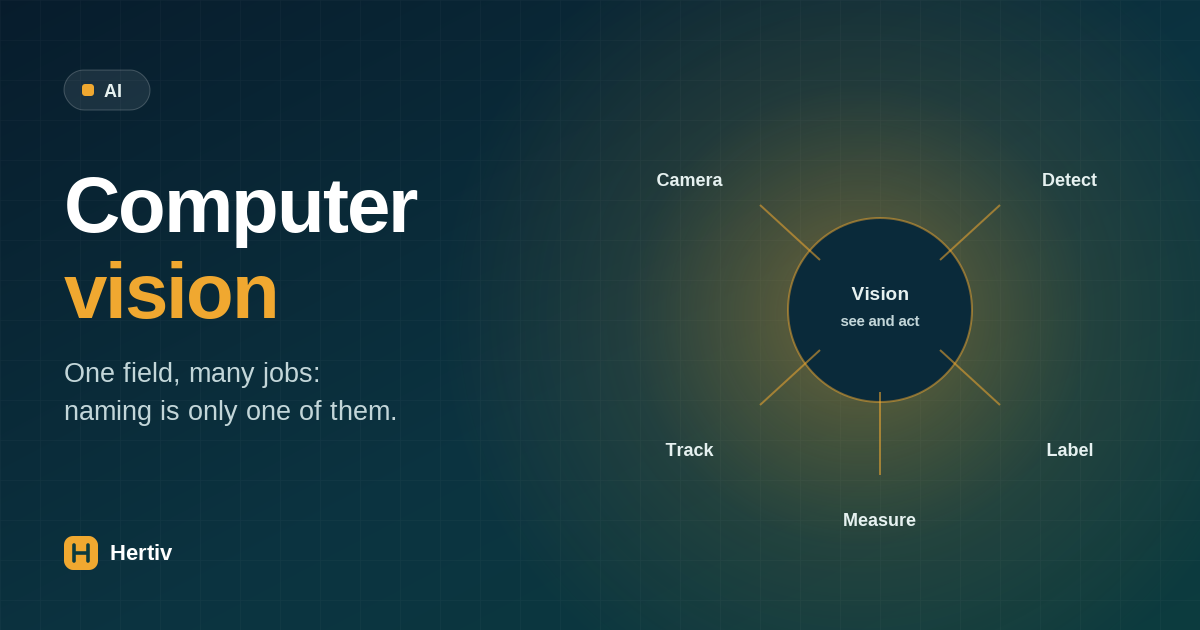
Computer vision is the wider field: it covers spotting objects, tracking movement and measuring scenes, while image recognition only names what is in a picture.
On this page
Short answer
Computer vision is the branch of AI that lets machines take in images and video, make sense of them and act on what they find. Image recognition is one job inside that field: it names the objects, people or text in a single picture. In short, every image recognition system uses computer vision, but computer vision covers far more than naming things.
What is the difference between computer vision and image recognition?
Computer vision is the field of artificial intelligence that lets a machine take in images or video, make sense of what it sees and act on it. Image recognition is one task inside that field: it looks at a picture and names the objects, people, animals or text it contains. The two terms overlap, but they are not the same, and mixing them up leads teams to buy the wrong tool for the job.
Think of it as a toolbox and one tool inside it. Computer vision holds the whole set: detection, tracking, measurement and 3D understanding. Image recognition is the tool that answers one question, "what is in this picture?" The table below shows where each one fits.
| Capability | Computer vision | Image recognition |
|---|---|---|
| Names objects in a picture | Yes | Yes |
| Follows an object across video | Yes | No |
| Measures size or distance | Yes | No |
| Reads text in an image | Often, with OCR | Sometimes |
| Works on video streams | Yes | Usually one frame at a time |
| Needs a trained model | Yes | Yes |
What does image recognition actually do?
Image recognition takes one still image and returns labels for what it contains. A photo app might tag "dog", "beach" and "sunset"; a shop app might match a photo of a chair to the same chair in its catalogue. The model is trained on labelled examples, so it learns the patterns that separate one class from another, then applies that learning to new pictures it has never seen.
The output is usually a list of labels with a score for each one. A score of 0.9 for "cat" means the model is fairly sure, not certain, and teams set a cut-off below which a human checks the result.
Image recognition is a good fit when the job is one picture at a time and the answer is a name, a category or a match. See computer vision use cases for where the wider field is applied.
What else does computer vision cover?
Computer vision covers every job that starts with a camera and ends with a decision. Object detection draws boxes around each item in a scene. Tracking follows those boxes from frame to frame, so a system can count people entering a shop or follow a parcel along a belt. Pose estimation reads body positions, depth estimation reads distance, and optical character recognition reads printed text.
These jobs often run together in one pipeline. A warehouse camera might detect a box, read its label, track it to the right shelf and flag it if the label does not match the order. None of those steps is image recognition on its own, and that is why teams that only need a label should not pay for a full vision pipeline. Our computer vision development page explains how these pipelines are built.
How do the two work together in a real system?
In most real products the two work as a pair. Computer vision finds where things are and image recognition says what they are. A checkout-free shop, for example, uses detection and tracking to follow a shopper and their basket, then uses recognition to name each product the shopper picks up. One without the other would either miss items or name the wrong ones.
The split matters when you plan the work. Detection and tracking need video data, camera positions and time to tune, while a recognition model needs a labelled set of still images. Teams that plan for both from the start avoid rebuilding the data pipeline halfway through the project. A small proof of concept is the usual way to test the split; see how to build an AI proof of concept.
Which one does your project need?
Choose image recognition when the input is a single picture and the output is a label. Choose computer vision when the input is video, when objects move, or when you need to measure, count or track. If you are unsure, start with the smallest job that proves value and add the wider pipeline only when the first step works.
- Write down the exact question the system must answer.
- Check whether the input is still images or video.
- List the outputs you need: labels only, or boxes, counts and tracks.
- Gather a small labelled sample and test the simplest model first.
- Add detection and tracking only if the label-only test leaves a gap.
Budget matters too. A recognition model is usually cheaper to build and run, because it needs fewer labelled examples and less compute. A full vision pipeline costs more in data, hardware and testing, so it should earn its keep with a job that labels alone cannot do. Start small and measure the result before you spend on the wider system.
Example (hypothetical): sorting parcels in a warehouse
A warehouse handles 2,000 parcels a day and a worker takes 30 seconds to read each label and sort it. That is 2,000 x 30 seconds, or 60,000 seconds, which is about 17 hours of work a day. A vision system reads the label and routes the parcel in about 2 seconds, so the same 2,000 parcels take about 1 hour of machine time, with a worker checking the few labels the system cannot read.
If the system misreads 2 in every 100 labels, that is 40 parcels a day sent to a check lane, where a worker fixes each one in about a minute. The team still saves roughly 15 hours a day, and the check lane keeps errors from reaching customers. The lesson is to plan for the misses, not just the average case.
Common mistakes
The most common mistake is asking a recognition model to do a vision job, such as counting people from a single frame instead of tracking them across video. Another is training on clean studio photos and then testing on blurry warehouse shots. A third is skipping the human check step, so a wrong label ships straight to the customer.
A fourth mistake is judging a model by one score. Accuracy on a test set says little about how it behaves on new images, so teams should test on fresh data from the real setting and watch the errors the model makes most often. See how to test AI models for a practical routine.
Key takeaways
- Computer vision is the wider field; image recognition is one task inside it.
- Image recognition names what is in a single picture; computer vision also tracks, measures and acts.
- Detection and tracking need video data, while recognition needs labelled still images.
- Most real products use both: vision finds where things are, recognition says what they are.
- Start with the smallest job that proves value, then add the wider pipeline only if needed.
Frequently asked questions
Is image recognition the same as computer vision?
No. Image recognition names what is in one picture, while computer vision is the wider field that also covers detection, tracking, measurement and acting on what a camera sees in the real world.
Can image recognition work on video?
It can, but only one frame at a time. It will name what is in each frame without following objects between frames, so counting or tracking needs the wider computer vision pipeline.
Do I need a trained model for image recognition?
Yes. The model learns from labelled examples, so you need a set of pictures with the right labels before it can name anything new with useful accuracy. Gather that set before you build.
What data does computer vision need?
It needs images or video from the real setting, plus labels for the job at hand: boxes for detection, tracks for tracking, and names for recognition. Plan the labelling work early.
How do I choose between the two?
Pick image recognition when one picture and one label is enough. Pick computer vision when the input is video, objects move, or you need to count, measure or track. Start with the smaller job.
Is OCR part of computer vision or image recognition?
It sits in both. Reading text is a recognition task, but it usually runs inside a wider vision pipeline that first finds where the text is on the page or label.


