ChatGPT in the Retail Supply Chain: Where It Helps
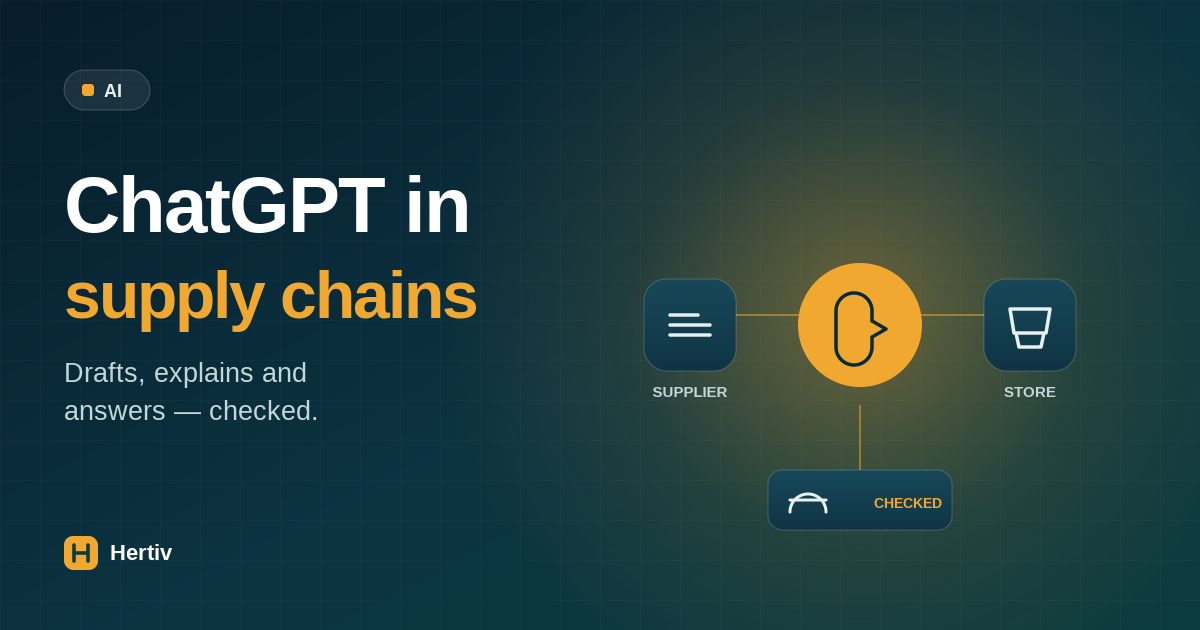
ChatGPT can draft supplier messages, explain stock alerts and answer staff questions in a retail supply chain. It suits language tasks, not live stock counts.
On this page
Short answer
ChatGPT is a language model that can read and write text, so in a retail supply chain it helps with the words around the work: drafting supplier messages, explaining stock alerts, and answering staff questions. It does not run the warehouse or count stock, and it is never a source of live inventory numbers. Its value is speed on language tasks, with a person checking the facts.
What does ChatGPT do in a retail supply chain?
ChatGPT is a language model that reads and writes text, so in a retail supply chain it helps with the words around the work: drafting supplier messages, explaining a stock alert in plain language, and answering staff questions about orders and deliveries. It works on text, not on the warehouse itself.
A typical use starts with a system that already holds the facts, such as an order, a delivery date or a stock level. ChatGPT turns those facts into a message, a summary or an answer. The facts come from the retailer's own systems; the model only shapes the words.
That split matters. ChatGPT can write a clear email about a late delivery, but it cannot know the delivery is late unless a system tells it. Teams that connect it to real data get useful drafts, while teams that ask it to guess numbers get confident-sounding errors.
The tool fits best where staff spend time writing the same messages again and again. Supplier updates, stock explanations and internal questions are all language work, and language work is where the model saves time. Teams that already use AI agents for support often start with the same pattern in the supply chain, because the handover rules are similar.
Where does ChatGPT help most in the supply chain?
ChatGPT helps most where the work is writing, summarising or answering questions. The table below sets out the main uses, what the model does in each one, and what a person still has to check.
| Task | What ChatGPT does | What to check |
|---|---|---|
| Supplier messages | Drafts updates and order changes | Dates, quantities, prices |
| Stock alerts | Explains why an alert fired | The live stock figure |
| Demand notes | Summarises sales and season patterns | The underlying sales data |
| Staff questions | Answers how-to and policy questions | Current policy wording |
| Delivery problems | Drafts customer and store updates | The real delivery status |
| Reports | Turns weekly numbers into a short brief | Every number in the brief |
Supplier messages are the clearest win. A buyer who sends fifty updates a week can draft them in minutes and spend the saved time on the suppliers that actually need a call. The draft is a starting point, and the buyer still checks the numbers before sending.
Staff questions are the second win. New warehouse staff ask the same questions about returns, damaged goods and shift cover, and a model trained on the team's own guides can answer them at once. The answers must come from current guides, not from the model's general knowledge.
How does it help with demand signals and planning?
ChatGPT helps with demand signals by turning sales data into readable notes. A planner hands it last month's sales by product and store, and the model writes a short brief: which lines rose, which fell, and which stores ran out first. The planner reads the brief, checks the numbers, and decides what to order.
The model does not forecast on its own. It cannot see next month's weather, a local event or a supplier shutdown unless someone tells it. A planning team should use it to summarise what happened, and use its own forecasting tools to decide what happens next. The predictive analytics tools a retailer already runs are the right place for the numbers.
Seasonal notes are a good test case. The model can compare this year's spring sales with last year's and write the comparison in plain language for buyers who do not read spreadsheets. That saves a meeting, as long as someone checks the comparison first.
The limit is simple: the model explains data, it does not create it. If the sales data is wrong, the brief will be wrong too, and it will sound confident while being wrong.
How does it help with suppliers and purchase orders?
ChatGPT helps with suppliers by drafting the messages that go back and forth around an order: confirming a delivery date, asking about a short shipment, or explaining a change in quantity. A buyer gives the model the order facts, and the model writes a polite, clear draft in the supplier's language.
Translation is part of the value. A retailer buying from suppliers in several countries can draft the same message in each supplier's language, which cuts down on misunderstandings about dates and quantities. The buyer still checks the numbers, because a wrong quantity in any language is a wrong order.
Purchase orders themselves should stay in the ordering system. The model can draft the email that carries an order, but the order lives in the system, where quantities and prices are checked. Mixing the two is how orders go wrong.
For a small team, the gain is time. Drafting fifty supplier messages by hand takes most of a morning; drafting them with a model takes under an hour, and the buyer spends the rest of the morning on the suppliers that need a real conversation.
How does it help with stock alerts and warehouse questions?
ChatGPT helps with stock alerts by explaining them in plain language. A system fires an alert when a product falls below its reorder level, and the model writes a short note: what the product is, how many are left, how fast it sells, and when it will run out at the current rate. Store staff can read the note and act without opening a report.
Warehouse questions work the same way. Staff ask where a product is stored, how to handle a return, or what to do with damaged goods, and the model answers from the team's own guides. The answers are only as good as the guides, so the guides have to be kept current.
The danger is asking the model for a live stock number. It does not know the warehouse, and it will answer with a plausible-sounding number that may be wrong. Live numbers must come from the inventory system, and the model should only explain them, never invent them.
A good rule is to show the number next to the note. When staff see "12 left, sells 4 a day, runs out in 3 days" beside the explanation, they can spot a wrong number at once.
Example (hypothetical): a grocer clears a supplier backlog
Example (hypothetical): a grocer's buying team handles 60 supplier emails a day, and drafting each reply by hand takes 10 minutes, so the team spends 600 minutes, or 10 hours, a day on email. The backlog grows every Friday, when suppliers send their weekly updates.
The team starts drafting with ChatGPT. Each draft now takes 4 minutes to check and send, so 60 emails take 240 minutes, or 4 hours. The team saves 6 hours a day, and the backlog clears by Friday afternoon instead of Monday morning.
The team keeps one rule: the buyer checks every date, quantity and price before sending. In the first month, the model drafts one wrong delivery date, and the buyer catches it because the date does not match the order. The saving holds, and no wrong order goes out.
The lesson is that the model saves drafting time, not checking time. The 6 hours saved come from writing, and part of them should be spent on checking, because one wrong order costs more than a morning of drafting. Retailers seeing the same pattern elsewhere, for example in the impact of AI in retail, usually find the same rule: automate the draft, keep the check.
What are the common mistakes?
The most common ChatGPT mistakes in a retail supply chain are asking it for live numbers, feeding it supplier prices without care, and sending its drafts unchecked. Each one is easy to avoid once the rules are written down.
- Asking for live stock numbers. The model does not know your warehouse. Live numbers come from the inventory system; the model only explains them.
- Sending drafts unchecked. A draft can carry a wrong date or quantity and still read well. Check every number before you send.
- Sharing sensitive prices. Supplier prices and margins are business secrets. Do not paste them into a tool your team does not control.
- Using it as a forecaster. The model summarises the past; it does not predict the future. Use forecasting tools for orders, and the model for the brief.
- Out-of-date guides. Staff answers are only as good as the guides behind them. Update the guides when the policy changes, or the answers will be wrong.
Key takeaways
- ChatGPT helps with language tasks in the supply chain, not with live stock counts
- Supplier messages and staff questions are the clearest time savings
- The model explains data; it does not create it, so check every number
- Keep purchase orders in the ordering system, and use the model for the email around them
- Do not paste supplier prices or margins into a tool you do not control
Frequently asked questions
Can ChatGPT manage inventory?
No. ChatGPT is a language model, so it can explain a stock alert or draft a message about a delivery, but it cannot count stock or know what is in a warehouse. Live stock numbers must come from the inventory system, and the model should only explain them.
How does ChatGPT help with suppliers?
It drafts the messages around an order: confirming a delivery date, asking about a short shipment, or explaining a change in quantity. It can also draft the same message in a supplier's own language. The buyer still checks every date, quantity and price before sending.
Is it safe to share supplier prices with ChatGPT?
Be careful. Supplier prices and margins are business secrets, and you should not paste them into a tool your team does not control. Check your company's data rules first, and use a company-approved setup with clear rules on what the model stores.
Can ChatGPT forecast demand?
Not on its own. It can summarise past sales into a readable brief, but it cannot see next month's weather, a local event or a supplier shutdown unless someone tells it. Use forecasting tools for the numbers and the model for the brief.
What should a retailer try first?
Start with supplier messages and staff questions, because both are language work with clear facts behind them. Measure the time saved for a month, keep the checking step in place, and only then try demand briefs or delivery updates.
Does ChatGPT replace supply chain staff?
No. It drafts and summarises, but people still check the numbers, talk to suppliers and make the buying decisions. The gain is time: staff spend less of the day writing and more of it on the suppliers and problems that need a real conversation.


