Chatbots in Insurance: Where They Help Most
Insurance chatbots now help with quotes, underwriting, claims and renewals, not just support. Here is where they work, and where a human must step in.
On this page
Short answer
Chatbots in insurance are chat tools that help customers and staff across the insurance business, from getting a quote to reporting a claim and renewing a policy. They work by asking the right questions in order, looking up policy and claims data, and passing the hard cases to a human. They help most where the task is routine and the answer comes from data the company already holds.
What are chatbots in insurance?
Chatbots in insurance are chat tools that guide a customer through an insurance task, such as getting a quote, buying a policy, reporting a claim or renewing cover. The customer types or speaks, the bot asks the next question, and the answer is recorded or looked up in the company's systems.
They differ from a simple FAQ page because they act: they collect the details for a quote, start a claim, or change a policy, instead of only pointing to information. Behind the chat, the bot connects to policy records, pricing rules and claims systems, so its answers are based on the customer's own record rather than a generic page.
The value is in the routine work. A large share of insurance contact is a customer asking the same few questions, or giving the same few details, over and over. A bot can handle those cases at any hour, and leave the unusual ones to people. For the support-only angle, customer service chatbots for insurance covers how bots handle service chats.
Where do insurance chatbots help most?
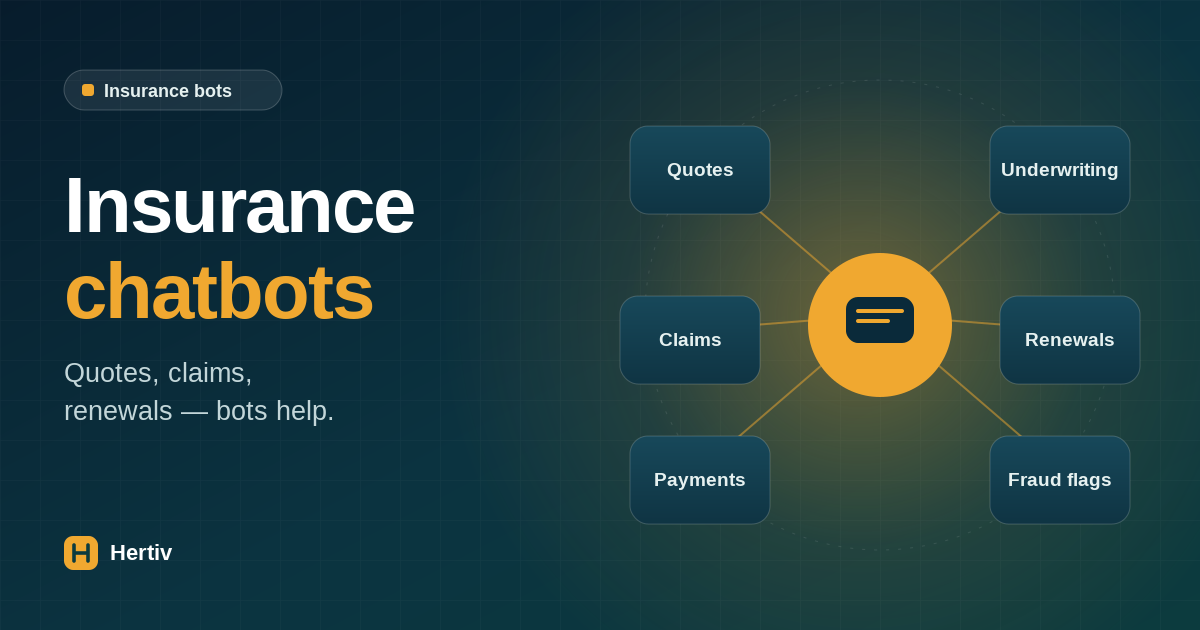
Insurance chatbots help most where the task follows a clear sequence and the data already exists in the company's systems. The table below shows the main places they fit and what each one does.
| Area | What the bot does | Why it works |
|---|---|---|
| Quotes and sales | Collects details and gives a price | Questions follow a fixed order |
| Underwriting | Gathers facts for the risk check | Data is structured and checkable |
| Claims | Starts the claim and tracks it | First notice follows a script |
| Renewals | Reminds and updates the policy | Details change slowly |
| Payments | Takes payments and explains bills | Amounts come from the policy record |
| Fraud signals | Flags odd answers for review | Patterns are easy to spot |
Quotes and claims are usually the first two areas to automate, because they are high in volume and clear in steps. Renewals and payments follow, once the bot is trusted with the customer's record.
How do chatbots help with quotes and sales?
Chatbots help with quotes and sales by turning a long form into a short conversation. Instead of showing twenty fields at once, the bot asks one question at a time, explains why it needs the answer, and gives a price as soon as it has enough detail.
This matters because long forms lose people. A customer who stops halfway through a form rarely comes back, while a customer who answers three questions in a chat is more likely to finish. The bot can also suggest cover that fits the answers, such as adding contents cover to a home policy, and it can hand the customer to an agent when the case is unusual.
The pricing itself stays with the company's rules. The bot collects facts and passes them to the pricing engine; it does not invent a price. That separation matters, because a wrong price given by a bot is a promise the company may have to keep.
How do chatbots help underwriting?
Chatbots help underwriting by collecting the facts an underwriter needs, in the right order, before a human looks at the case. They ask about the property, the vehicle, the health history or the business, depending on the policy, and they check the answers as they go.
The gain is in completeness and speed. A bot will not forget to ask a question, and it can check an answer at once, such as a date that does not fit or a value that looks wrong. The underwriter then receives a complete file, instead of a half-filled form that needs three rounds of follow-up.
The bot does not make the underwriting decision. It gathers facts and flags the cases that need a human: a high value, a past claim, or an answer that does not fit the pattern. That line matters for fairness too, because the decision stays with a person who can be questioned about it.
How do chatbots help with claims?
Chatbots help with claims by taking the first notice of loss, which is the report a customer makes when something happens. The bot asks what happened, when, and where, collects photos and documents, and gives the customer a claim number at once.
Speed matters here. A customer who reports a claim at midnight wants to know it is recorded, not to wait until morning. The bot can also tell the customer what happens next, what documents are needed, and how to track the claim, which cuts the calls that ask for the same update.
The bot's limits are clear in claims. It can record facts and start the process, but it cannot judge a claim, approve a payment, or argue about a value. Those decisions stay with claims staff, and the bot's job is to hand them a complete, well-ordered file. For the chatbot patterns that work in general, AI chatbot use cases shows where teams start.
Example (hypothetical): an insurer handles 2,000 chats a month
Example (hypothetical): a small insurer receives 2,000 customer chats a month. Before the bot, staff answered all of them, and each chat took about 12 minutes, which is 400 hours a month.
The insurer adds a bot for quotes, claim first notices and payment questions. The bot finishes 1,200 of the 2,000 chats on its own, which saves 240 hours a month. The other 800 chats still go to staff, because they need a decision or a judgement call.
The bot also changes the timing. Before, a customer who wrote at night waited until morning. Now the bot answers at once, and the claim is recorded the same night. The staff hours saved are 240, but the insurer counts the faster first notice as the bigger gain, because a claim recorded early is cheaper to handle.
What are the common mistakes?
The most common mistakes with insurance chatbots are letting the bot decide what only a human should decide, trusting it with data it cannot check, and launching it on every task at once.
- Letting the bot price or approve. A bot that gives a wrong price or approves a claim creates a promise the company may have to keep. Keep decisions with people.
- No handover. A customer with a hard claim who cannot reach a person will leave. The bot must pass the full chat to staff.
- Trusting unchecked data. A bot that records a wrong date or value without checking it creates a bad file. Check answers as they are given.
- Launching on every task at once. Start with quotes or first notice of loss, fix the failures, then add the next task.
- Forgetting privacy. A chat holds personal and health details. The bot must store them safely and only ask for what the task needs. For the support side of this work, AI agents for customer support covers the handover patterns.
Key takeaways
- Insurance chatbots work across quotes, underwriting, claims, renewals and payments
- They help most where the task follows a clear sequence and the data already exists
- The bot collects facts and starts processes; pricing and claim decisions stay with people
- First notice of loss is the strongest claims use case, because speed cuts cost
- Start with one task, fix the failures, and keep a clear handover to staff
Frequently asked questions
Are insurance chatbots the same as customer service chatbots?
No, though they overlap. A customer service chatbot answers support questions, while an insurance chatbot also helps with quotes, underwriting facts, claim first notices and renewals. The wider role needs deeper connections to policy, pricing and claims systems, not just a help centre.
Can a chatbot sell an insurance policy?
It can collect the details and present a price from the company's pricing engine, then take the customer through the purchase. The price and the terms come from the company's rules, not from the bot, and unusual cases should go to an agent before the sale is closed.
Do chatbots handle claims on their own?
They handle the first notice of loss: recording what happened, collecting photos and documents, and giving a claim number. They do not judge a claim or approve a payment. Those decisions stay with claims staff, who receive a complete file from the bot.
What data does an insurance chatbot need?
It needs the policy record, the pricing rules and the claims system, plus the facts the customer gives in the chat. It should only ask for the details the task needs, and it must store personal and health details safely, following the privacy rules that apply.
How do you measure whether an insurance chatbot works?
Track how many chats the bot finishes without staff, how many hand over cleanly, and how fast a claim is recorded after it happens. Also track customer complaints about the bot. A bot that finishes chats but creates bad files is not working.
What is the biggest risk with insurance chatbots?
The biggest risk is a bot that makes a promise it should not, such as a wrong price or a claim approval. Keep pricing and claim decisions with people, check the bot's answers against the policy record, and make the handover to staff easy and fast.


