CBDC vs Stablecoin vs Cryptocurrency: What Is the Difference?
A CBDC is central bank money, a stablecoin is a private pegged token, and a cryptocurrency is a decentralised asset. Here is how the three compare.
On this page
Short answer
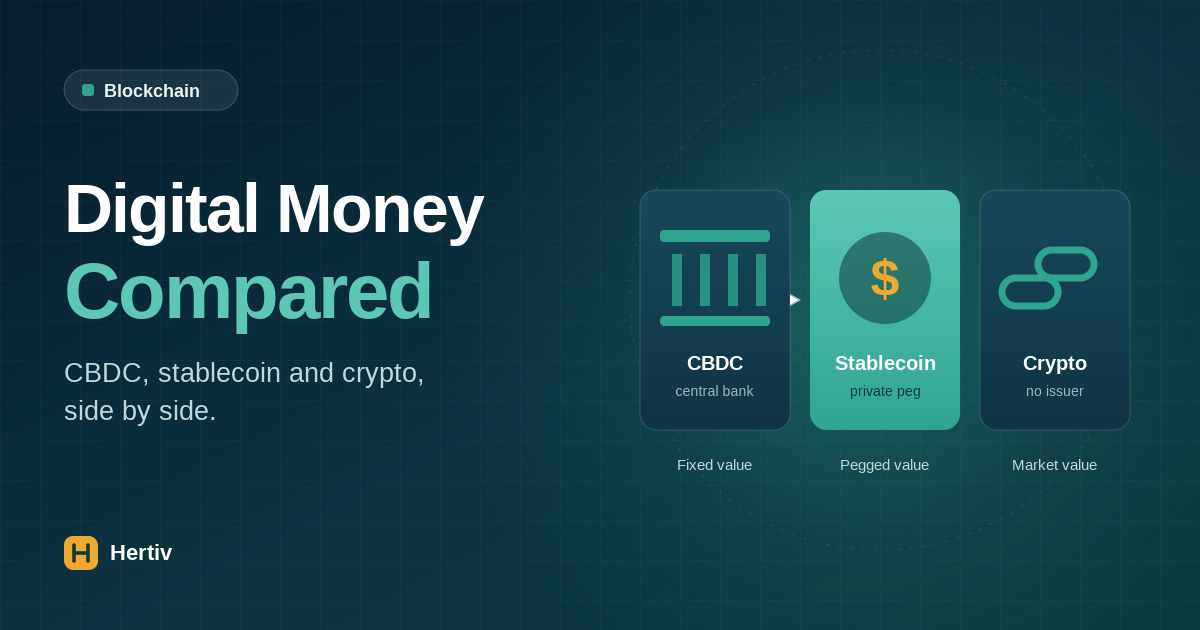
A CBDC is digital money issued by a central bank, a stablecoin is a private token designed to hold a steady value, and a cryptocurrency is a decentralised asset that runs on a public blockchain. The three differ in who issues them, what backs them and how their price behaves.
What is a CBDC?
A central bank digital currency (CBDC) is digital money issued and backed by a country's central bank, and it is a direct claim on the central bank in the same way as cash. It is a liability of the central bank, not of a private company.
Central banks study CBDCs for two main reasons: to offer a digital form of public money as cash use falls, and to make payments between banks faster and cheaper. Some CBDCs are built for the public to use, while others are built only for banks and financial firms.
A retail CBDC works like digital cash in a wallet or app, while a wholesale CBDC moves large sums between banks. In both cases the central bank controls issuance, and the value stays at one unit of the national currency, because the CBDC is the currency itself.
What is a stablecoin?
A stablecoin is a token issued by a private company or protocol that is designed to hold a steady value, usually by being backed by reserves such as cash or short-term government bonds. The best-known stablecoins are pegged to the US dollar.
There are three main designs. Fiat-backed stablecoins hold reserves in bank accounts, crypto-backed stablecoins hold other crypto assets as collateral, and algorithmic stablecoins try to hold their peg with supply rules instead of reserves. The first design is the most widely used.
Stablecoins are used for trading, payments and saving in crypto markets, because they let users hold dollar value without leaving the blockchain. Their safety depends on the issuer and the reserves, which is why the issuer and its audits matter. For a closer look at one pair, see stablecoin vs CBDC.
What is a cryptocurrency?
A cryptocurrency is a digital asset that runs on a public blockchain, is not issued by a central bank, and is secured by a network of computers rather than a single issuer. Bitcoin and ether are the best-known examples.
Its price is set by the market, so it can rise or fall sharply in a short time. That volatility makes it a poor choice for everyday payments, but it is the reason some people hold it as an investment or use it in decentralised finance.
Cryptocurrencies are also the base layer for many blockchain applications: they pay transaction fees, secure the network and act as collateral in lending and trading. If you are new to the idea, what a cryptocurrency is explains the basics in more depth.
How the three compare
The three forms of digital money differ on issuer, backing, price and control. The table below sets out the main differences at a glance.
| Feature | CBDC | Stablecoin | Cryptocurrency |
|---|---|---|---|
| Issued by | Central bank | Private company or protocol | No single issuer |
| Backed by | The central bank itself | Reserves or collateral | Market demand only |
| Price stability | Fixed to the currency | Pegged, usually to the dollar | Moves with the market |
| Who controls it | The central bank | The issuer | The network of users |
| Typical uses | Payments and bank settlement | Trading and cross-border payments | Investment and decentralised apps |
| Privacy | Set by the central bank | Set by the issuer and chain | Pseudonymous by design |
The key point is that a CBDC and a stablecoin both aim for a stable value, but for different reasons: a CBDC is public money in digital form, while a stablecoin is private money that borrows the stability of a currency it does not issue.
Which one fits which use?
For everyday payments inside one country, a CBDC or a bank transfer is the natural fit, because the value is fixed and the issuer is the central bank. A CBDC adds little for a user who already pays by card, unless it brings lower fees or offline use.
For cross-border payments and trading, stablecoins are often the practical choice, because they move on public blockchains at any hour and settle in minutes rather than days. Businesses that accept crypto payments usually settle in stablecoins to avoid price swings.
For investment and decentralised finance, cryptocurrencies are the base asset, because they secure the network and pay the fees. Holding a volatile cryptocurrency for a short-term payment is a poor fit, since the value can move between the quote and the payment.
Example: paying a supplier across borders
Example (hypothetical): a business must pay a supplier $50,000 for goods, and it compares a bank wire with a stablecoin payment. The numbers are made up for the example, but the arithmetic shows how the comparison works.
The stablecoin route costs a $25 transfer fee plus a 0.2% exchange spread, which is $100, so the total cost is $25 + $100 = $125. The bank wire costs a $45 fee plus a 1% exchange spread, which is $500, so the total cost is $45 + $500 = $545.
The stablecoin route saves $545 - $125 = $420 on this payment, and it settles the same day instead of taking several days. The saving is real, but the business must also check the rules in both countries, since stablecoin payments are regulated differently in each place.
What are the common mistakes?
The most common mistakes are treating a stablecoin as risk-free, confusing a CBDC with a cryptocurrency, and ignoring the rules that apply in each country. Each mistake comes from treating the three as if they were the same thing.
- Treating stablecoins as risk-free. A stablecoin is only as safe as its issuer and reserves. Check who issues it and how the reserves are audited before holding a large sum.
- Confusing CBDCs with crypto. A CBDC is central bank money, not a decentralised asset. It does not behave like a cryptocurrency and it is not an investment.
- Ignoring regulation. Rules for stablecoins and crypto payments differ by country and change often. A payment that is legal in one place may not be in another.
- Paying with a volatile asset. Using a cryptocurrency for a short-term payment means the value can move before the payment lands. Use a stable value for payments and keep volatile assets separate.
- Forgetting the off-ramp. Receiving a stablecoin is only useful if you can convert it to local currency when needed, so check the conversion path first.
How to choose between them
Choosing between a CBDC, a stablecoin and a cryptocurrency starts with the job you need it to do, not with the technology. Follow these steps to make the choice.
- Define the payment or use case. Is it a local payment, a cross-border payment, trading, or an investment? The use case narrows the choice at once.
- Check what is available where you operate. CBDCs exist only in some countries, and stablecoin rules differ by place, so availability comes before preference.
- Weigh stability against control. A CBDC and a stablecoin hold their value, while a cryptocurrency gives you independence from any issuer at the cost of price swings.
- Check the issuer and the reserves. For a stablecoin, look at who issues it and how its reserves are checked. For a CBDC, the issuer is the central bank.
- Test with a small amount. Run one small payment end to end, including converting back to local currency, before moving larger sums.
Key takeaways
- A CBDC is central bank money in digital form, a stablecoin is a private pegged token
- Stablecoins are only as safe as their issuer and reserves
- Cryptocurrencies are decentralised assets with market-set prices
- Use a stable value for payments and volatile assets for investment
- Check the rules in each country before moving money across borders
Frequently asked questions
Is a CBDC the same as a cryptocurrency?
No. A CBDC is issued by a central bank and holds a fixed value in the national currency, while a cryptocurrency is issued by no one and its price moves with the market. A CBDC is digital cash, not a decentralised asset.
Are stablecoins safe?
Stablecoins are safer than volatile cryptocurrencies for holding value, but they are not risk-free. Their safety depends on the issuer, the reserves behind them and the rules in the country where they are used.
Can a CBDC replace cash?
A CBDC can act as digital cash, but most central banks present it as an addition to cash rather than a replacement. Cash still works without power or a network, so it is unlikely to disappear quickly.
Why do businesses use stablecoins?
Businesses use stablecoins for cross-border payments and trading because they settle fast, work at any hour and hold a stable value. They avoid the price swings of cryptocurrencies while keeping the speed of blockchain payments.
Do I need a wallet for a CBDC?
It depends on the design. Some CBDCs use a wallet app provided by a bank or the central bank, while wholesale CBDCs are used only by banks and never reach the public. The wallet, if any, is part of the system design.
Which one should I use for saving?
For saving in a stable value, a CBDC or a well-backed stablecoin fits better than a volatile cryptocurrency. A cryptocurrency can rise or fall sharply, so it suits long-term holding only if you accept that risk.


