Carbon Credit Tokenization in Germany, Explained
Carbon credit tokenization in Germany turns verified emission reductions into digital tokens that can be traded and retired on a blockchain, under EU rules.
On this page
Short answer
Carbon credit tokenization in Germany means recording a verified carbon credit — one tonne of avoided or removed emissions — as a digital token on a blockchain. The token can be transferred, split or retired, while the underlying credit stays recorded in a registry. German projects work under EU climate rules, so buyers check the registry entry, the standard and the retirement record before paying.
What is carbon credit tokenization in Germany?
Carbon credit tokenization in Germany is the process of turning a verified carbon credit into a digital token that can be traded, split and retired on a blockchain. One credit normally stands for one tonne of carbon dioxide avoided or removed, and the token is a digital record of that credit, not a replacement for it.
The credit itself comes from a project — a forest, a renewable energy plant, a methane capture site — that has been checked by an independent verifier against a recognised standard. Once verified, the credit is listed in a registry. Tokenization adds a blockchain record on top: the token carries a link to the registry entry, and when the credit is used, the token is retired so it cannot be sold again.
Germany matters because it is one of the largest economies in the EU emissions trading system and home to companies that buy credits to cover emissions they cannot yet cut. German buyers, project developers and platforms are therefore a natural meeting point for tokenized credits, even though the credits themselves can come from projects anywhere in the world.
How does a carbon credit become a token?
A carbon credit becomes a token in a short chain of checks, and each step has a record that a buyer can follow. Skipping a step is how bad credits reach the market.
- Project and standard. A project is designed to a recognised standard, which sets the rules for measuring reductions.
- Verification. An independent auditor checks the project data and confirms the credits.
- Registry listing. The verified credits are listed in a registry with a serial number.
- Token minting. A token is minted on a blockchain, linked to the registry entry.
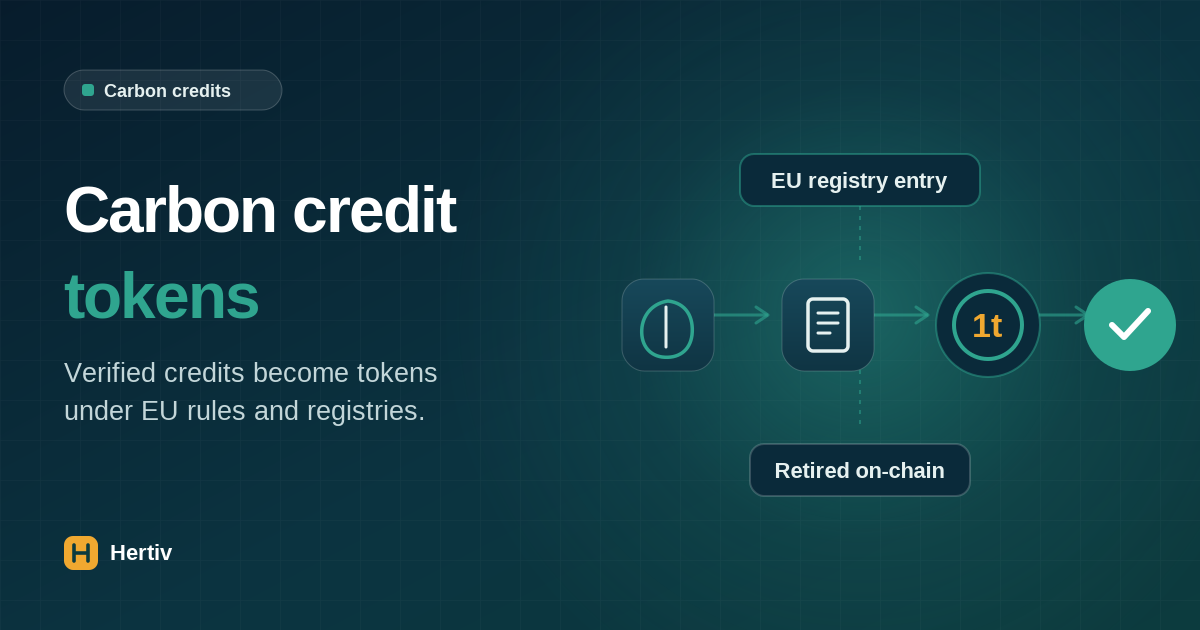
- Trading and retirement. The token can change hands, and when the credit is used it is retired in both records.
The registry is the source of truth, not the token. A token without a matching registry entry is just a picture of a credit, and a buyer who cannot find the entry should not pay. The carbon credit tokenization service page explains how Hertiv approaches this registry-first design.
Where does Germany fit in the market?
Germany fits in as a buyer, a rule-maker and a home for platforms. German companies in energy, industry and transport buy credits to cover emissions while they change their operations, and German law and EU rules shape what counts as a valid credit and how it must be reported.
The EU emissions trading system covers large emitters and sets a cap on total emissions, while voluntary credits sit outside it and are used for claims companies make about their own footprint. Tokenized credits are mostly voluntary credits, so buyers need to understand which system they are in and what a credit can honestly be used to claim.
German platforms and registries add the local layer: language, contracts under German law, and connections to German banks and auditors. A buyer in Munich and a project in another country can still trade through a German platform, but the credit's quality depends on the project and the standard, not on where the platform is based.
What can buyers and project owners do with tokenized credits?
Tokenized credits give buyers and project owners options that paper certificates do not, mainly around splitting, tracking and settling. The table shows the main uses and what each one needs.
| Use | What it does | What it needs |
|---|---|---|
| Buy and hold | Hold credits for future use | Registry account, wallet |
| Split a credit | Sell part of a large credit | Token fractions, registry rules |
| Retire on-chain | Use a credit and mark it spent | Retirement record, registry update |
| Track a credit | Follow ownership history | Public ledger, registry link |
| Fund a project | Pay in advance for future credits | Forward contract, verification |
| Report a claim | Show emissions covered | Retirement proof, auditor sign-off |
Splitting is the use most buyers notice first: a small company can buy a fraction of a large credit instead of a whole one. Retirement is the use that matters most for trust, because a credit that is not retired can be sold twice. For the broader picture of how tokenized assets work, the RWA tokenization guide covers the same pattern across asset types.
Example (hypothetical): a forest project sells credits
Example (hypothetical): a forest project in Germany is verified for 500 credits, each one tonne of avoided emissions. A buyer wants to cover part of its footprint and asks for 100 of them.
On paper, checking 500 individual certificates at 10 minutes each would take 5,000 minutes, or about 83 hours. With tokens, the project mints 500 tokens linked to the registry entries, and the buyer checks 10 batches of 50 at 30 minutes per batch, which is 300 minutes, or 5 hours. The batch check saves about 78 hours, and the buyer still has the registry entry for every credit.
When the buyer uses the 100 credits, the tokens are retired and the registry is updated, so the same credits cannot be sold to another buyer. The project keeps the other 400 tokens for future sales, and each later buyer can trace the same chain of records.
What are the risks and limits?
The biggest risk is a credit that does not stand for a real reduction. If a project would have happened anyway, or if its emissions are counted twice, the credit is worth little no matter how it is tokenized. Tokenization makes a credit easier to trade; it does not make it a good credit.
Double counting is the specific danger. A credit retired in one registry but still listed in another, or a token sold after the underlying credit was already used, creates two claims on one tonne. Buyers should check both the token record and the registry entry, and ask for the retirement proof before reporting a claim.
Rules are also still forming. EU and German rules on what counts as a valid credit and how companies may report it are changing, and a credit that is acceptable today may face new requirements tomorrow. Projects and buyers should follow the registry and the standard, and treat any platform promise as secondary to those records.
What are the common mistakes?
The most common mistakes are trusting the token instead of the registry, buying credits without checking the standard, and reporting a claim before the credit is retired.
- Trusting the token alone. A token without a registry entry is not a credit.
- Skipping the standard. Different standards have different rules; know which one your credit follows.
- Reporting before retirement. A credit only counts once it is retired, not when it is bought.
- Ignoring double counting. Check the registry entry and the retirement record, not just the seller's word.
- Assuming German law covers everything. The project, the standard and the registry may sit under different rules.
Key takeaways
- A carbon credit stands for one tonne of avoided or removed emissions, and the token is a digital record of it, not a replacement
- The registry is the source of truth: a token without a matching registry entry should not be bought
- Germany matters as a buyer and rule-maker under EU climate rules, though credits can come from anywhere
- Tokenization helps with splitting, tracking and retiring credits, and saves checking time in batches
- The main risks are poor-quality credits and double counting, which tokenization alone does not fix
Frequently asked questions
What is a carbon credit?
A carbon credit stands for one tonne of carbon dioxide avoided or removed by a project, such as a forest, a wind farm or a methane capture site. The project is checked by an independent verifier against a recognised standard, and the verified credit is listed in a registry with a serial number.
How is a tokenized carbon credit different from a normal one?
The underlying credit is the same. Tokenization adds a blockchain record that can be split, transferred and retired on-chain, with a link to the registry entry. The token makes trading and tracking easier, but the credit's quality still depends on the project, the verifier and the standard.
Can German companies use tokenized carbon credits?
Yes, for voluntary claims about their own footprint, subject to EU and German rules on what can be claimed and how it must be reported. Credits in the EU emissions trading system are a separate system with its own rules, so buyers should check which system their credit belongs to.
What is double counting in carbon credits?
Double counting happens when the same tonne of avoided emissions is claimed twice — for example, sold to two buyers, or counted by both the project country and the buyer. Checking the registry entry and the retirement record is how buyers confirm a credit has been used once and only once.
How do I check a tokenized carbon credit before buying?
Ask for the registry entry and serial number, the standard it follows, the verification report and the retirement plan. Confirm the token links to that registry entry, and check that the credit has not already been retired or sold elsewhere.
Do tokenized carbon credits cost more than normal ones?
Prices depend on the project, the standard and the market, not on tokenization itself. Some platforms charge fees for minting and trading, so ask for the full cost — including any platform fee — before buying, and compare it with the same credit sold without a token.


