Business Analytics vs Data Science: How They Differ
Business analytics explains what happened and what to do next. Data science predicts what will happen and builds the models. Learn when each one fits.
On this page
Short answer
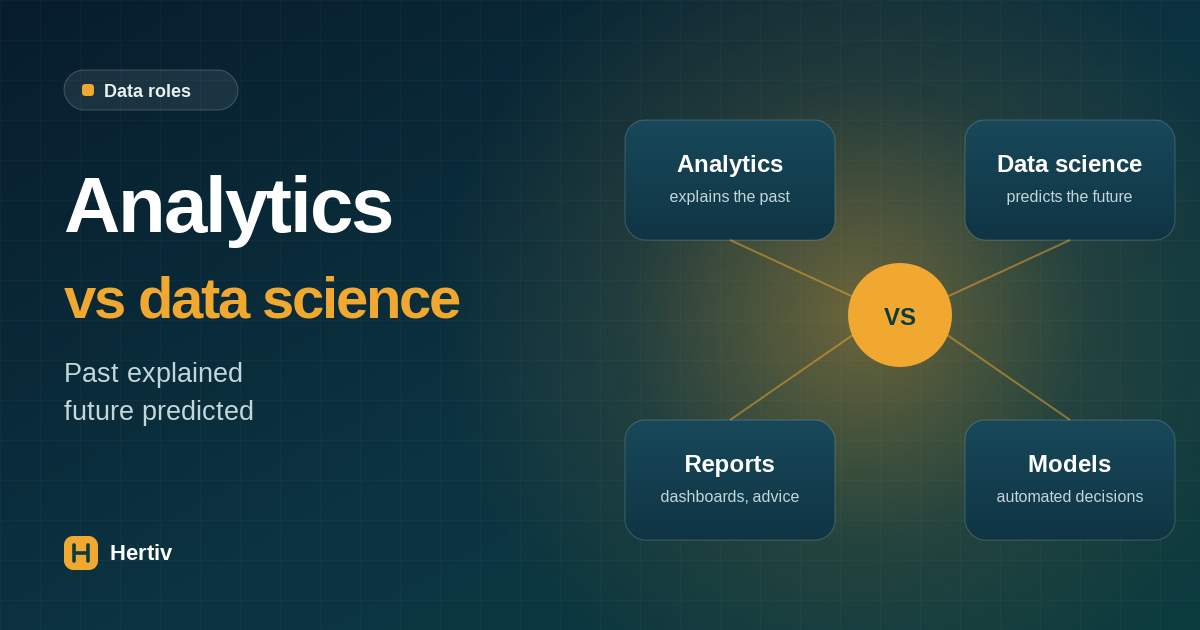
Business analytics is the work of turning business data into reports, dashboards and recommendations that explain what happened and what to do next. Data science is the work of building statistical models and machine learning systems that predict what will happen and automate decisions. The first answers questions a manager asks; the second builds tools that answer questions on their own.
What is business analytics?
Business analytics is the practice of analysing a company's own data to explain performance and guide decisions. An analyst looks at sales, costs, customers and operations, finds the patterns, and presents the findings in a dashboard or a report that a manager can act on. The questions are practical: which product sells best, why did churn rise, and which region is growing.
The work uses tools most teams already know: spreadsheets, SQL, and dashboard tools such as Power BI or Tableau. The skill is not the tool, it is asking the right question and presenting the answer so a non-technical reader can act on it. The guide to machine learning covers the modelling side that analytics often leads into.
Business analytics looks mostly at the past and the present. It explains what happened, why it happened, and what should happen next, using data the business already holds.
What is data science?
Data science is the practice of building models that learn from data to predict outcomes or automate decisions. A data scientist might build a model that predicts which customers will leave, which transactions are fraud, or which products a shopper will buy next. The model runs on new data every day and gets better as more data arrives.
The work uses programming, statistics and machine learning, with tools such as Python and libraries for modelling. It also needs data engineering: collecting, cleaning and storing the data the model learns from. A model that is never put into production is only an experiment, so deployment is part of the job.
Data science looks mostly at the future. It predicts what will happen and, in the best cases, acts on the prediction without a person in the loop, such as blocking a risky payment before it clears.
Business analytics vs data science: the key differences
The two fields overlap, but they differ in the question, the output and the skills. Business analytics answers a question a manager already asked. Data science builds a system that answers questions nobody asked yet, or answers them faster than a person could. The table below compares them side by side.
| Point | Business analytics | Data science |
|---|---|---|
| Main question | What happened, and what next? | What will happen, and what to do? |
| Main output | Reports, dashboards, advice | Models and automated decisions |
| Time focus | Past and present | Future |
| Core skills | SQL, dashboards, business sense | Python, statistics, machine learning |
| Data needed | Clean business records | Large, varied data sets |
| Typical user | Managers and teams | Products and systems |
Neither is better in general. A company that does not know why sales fell needs an analyst, not a model. A company that must score a million transactions a day needs a model, not a dashboard.
When should a business use each one?
Use business analytics when a decision needs an explanation a person can read and defend. A manager choosing where to open a store, a team deciding which product to discount, or a board asking why costs rose all need a report with reasons, not a score from a black box.
Use data science when the decision must be made many times a day, faster than a person could, or when the pattern is too subtle for a report to show. Fraud checks, product recommendations and demand forecasts are the usual cases. The guide to building an AI proof of concept shows how a first model project is scoped.
Most companies need both, in sequence. Analytics finds the problem and proves it is worth solving; data science builds the model that solves it at scale. A model built before the analytics is a solution looking for a problem.
How do the two work together?
The two roles usually work as a pair. The analyst explores the data, finds the pattern and writes the brief: here is the problem, here is the data, and here is how we will know the model helped. The data scientist builds the model, tests it against the past, and hands it over with a way to check its answers.
Example (hypothetical): a retailer finds through analytics that 200 customers a month stop buying after a late delivery. The analyst shows that late deliveries happen on 1 in 10 orders.
The data scientist then builds a model that flags orders at risk of being late, using the delivery address, the item and the day of the week. If the model flags 100 orders and 80 of them would have been late, the team can warn those customers early.
The handover matters: the analyst must stay involved while the model is tested, because the model can be right in a way that does not help the business. A model that flags every order is useless, even if it never misses a late one.
What skills and tools does each need?
Business analytics needs SQL to query data, a dashboard tool to present it, and enough business sense to ask the right question. A good analyst also needs to write clearly, because a report nobody reads is wasted work. The learning curve is months, and many analysts come from business roles.
Data science needs programming, usually Python, statistics to know whether a result is real, and machine learning to build the model. It also needs data engineering skills to keep the model fed with clean data. The learning curve is longer, often a year or more, and the work is harder to check without technical review.
A team hiring for analytics should test for clear writing and business questions. A team hiring for data science should test for working code and honest evaluation. Both should be tested on the company's own data, not on a textbook problem.
Common mistakes
The most common mistake is hiring a data scientist to do an analyst's job. The scientist builds a model when a dashboard would have answered the question in a day, and the team waits months for an answer it could have had by Friday. Start with analytics, and hire for data science only when the analytics shows a problem that needs a model.
Another mistake is treating a model's output as a decision. A model predicts; a person decides. A model that says a customer will leave is a warning, not a reason to act without checking. Keep a human in the loop, and review the model's answers every week until you trust them.
Key takeaways
- Business analytics explains the past and guides decisions
- Data science predicts the future and automates decisions
- Analytics answers a manager's question; data science builds a system
- Most companies need analytics first, then a model
- Keep a human in the loop for both
Frequently asked questions
Which is better, business analytics or data science?
Neither is better in general. Business analytics fits decisions that need an explanation a person can read, while data science fits decisions that must be made many times a day or too fast for a person. Most companies need both.
Do I need to learn coding for business analytics?
No, not to start. SQL and a dashboard tool are enough for most analytics work. Coding helps later, when the analysis gets bigger, but clear questions and clear writing matter more.
Can a business analyst become a data scientist?
Yes, and many do. The path is to learn Python and statistics, then build a model on data from your own work. The business sense an analyst already has is the hardest part to learn.
How much data does data science need?
It depends on the problem. A simple model can learn from thousands of records, while a model that reads text or images needs far more. Start with the data you have, and test whether it is enough before you collect more.
Should a small business hire an analyst or a data scientist?
Hire an analyst first. A small business usually needs to understand its sales, costs and customers before it needs a model, and an analyst delivers that answer in weeks, not months.
How do I know if my business needs data science?
If analytics has found a problem that must be solved many times a day, such as scoring transactions or forecasting demand, and a report cannot solve it fast enough, data science is the next step.


