Build vs Buy RAG: Which Path Fits Your Team?
Build your own RAG system for full control over data and retrieval, or buy one when you need answers fast. The right choice depends on your data, team and timeline.
On this page
Short answer
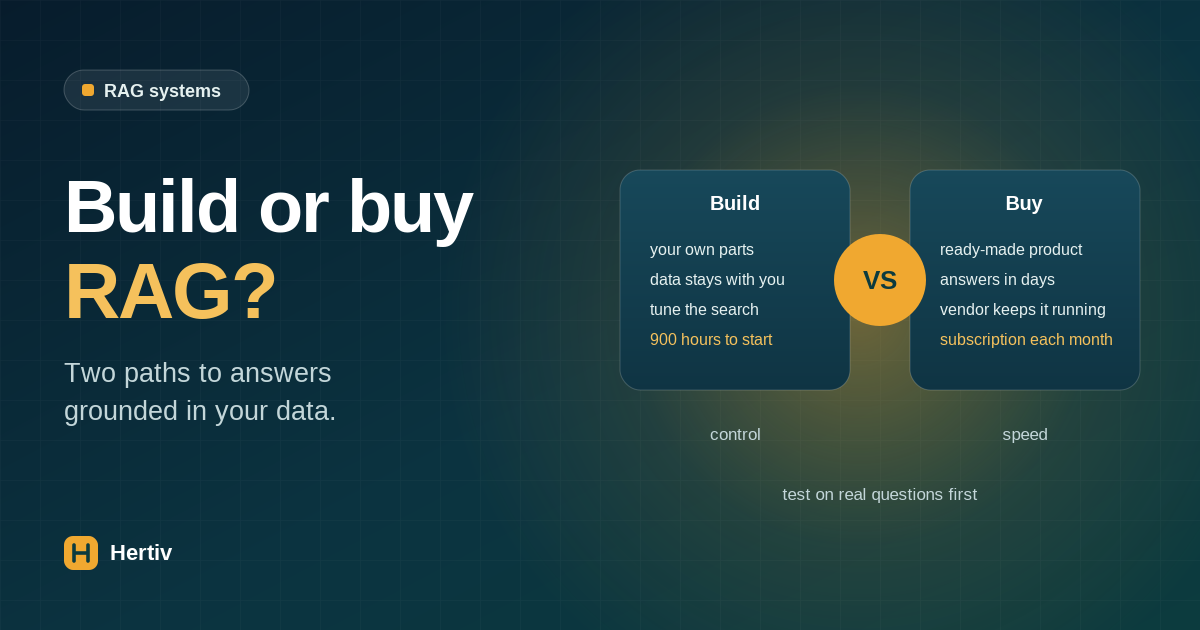
RAG, retrieval-augmented generation, lets a language model answer questions using your own documents, by finding the relevant passages first and then writing an answer from them. You can build a RAG system yourself from open parts, or buy a ready-made product. Build gives you control over data, retrieval and cost, while buy gives you speed and less maintenance. The choice depends on your data, your team and your timeline.
What is RAG, in plain terms?
RAG is a method that grounds a language model in your own documents. When a user asks a question, the system first searches your documents for the passages that match, then gives those passages to the model, and the model writes an answer based on what it found.
That grounding matters, because a model on its own can only answer from what it was trained on. With RAG, the answer comes from your price list, your manual or your policy, so it is current and specific to your business.
A RAG system has four parts: documents that are split into small chunks, a search index that finds the right chunks, a model that writes the answer, and a check that the answer matches the source. Build and buy differ in how much of those four parts you own and how much the vendor owns.
What does building your own RAG system involve?
Building means you choose and connect the parts yourself. You pick how documents are split, which search method finds the chunks, which model writes the answer, and how the answer is checked. You host it yourself or in your own cloud account, and your data stays inside systems you control.
The benefit is control. You can tune the search for your documents, change the model when a better one appears, and keep sensitive data out of a vendor's hands. The cost is time and skill: someone on your team must build it, keep it running, and fix it when the search or the model changes.
Building fits teams that have engineers, that work with sensitive data, or that need retrieval tuned to unusual documents. A guide to retrieval-augmented generation explains the four parts in more detail, and it is a good read before you decide.
What does buying a RAG product involve?
Buying means you use a ready-made product that already connects the four parts. You upload your documents, set who may ask questions, and the product handles splitting, search, answer writing and checks. You pay a subscription, and the vendor keeps the system running.
The benefit is speed. A team can have working answers in days instead of months, with no engineers needed to build or maintain the pipeline. The cost is less control: you use the vendor's search and models, your data sits in the vendor's system, and changing vendors later means moving your documents and retraining your users.
Buying fits teams that need answers fast, that have no engineers to spare, or that want to test whether RAG helps before investing in a build. Prices and plans change often, so check the vendor site for current figures.
Build vs buy: a side-by-side comparison
The table below compares the two paths on the points that matter most. No path wins on every row, which is why the decision comes down to your data, your team and your timeline.
| Point | Build your own | Buy a product |
|---|---|---|
| Time to first answers | Weeks to months | Days to a couple of weeks |
| Control over data | Full, data stays with you | Data sits in the vendor system |
| Control over retrieval | Full, tune search yourself | Limited to vendor settings |
| Team needed | Engineers to build and run it | One owner to manage documents |
| Running cost | Model and hosting, you control it | Subscription, scales with use |
| Switching later | You own the parts | Moving documents takes work |
Read the table as a trade-off, not a score. Speed and low effort point to buy, while control and sensitive data point to build. If the two paths tie on most rows, the deciding row is usually the team: a team with no engineers to spare should buy, and a team with engineers and strict data rules should build.
How to decide in 5 steps
Deciding works best as a short, ordered plan. Each step answers one question before you move on, so the choice is based on your situation instead of on a vendor pitch.
- Name the questions it must answer. List the real questions your team or customers ask, and check that your documents hold the answers.
- Check your data rules. Find out whether your documents may leave your systems, and who may see the answers.
- Count your engineers. Be honest about whether someone can build and run the system for the next year, not just for the first month.
- Run a small test. Try a bought product or a small build on one document set for two weeks, and measure answer quality.
- Decide with the numbers. Compare time to first answers, running cost and review time, and pick the path that fits your timeline.
A guide to RAG integration costs helps with the running-cost part of step five, because the cost per question is the number most teams forget to measure.
Example (hypothetical): a team of three engineers
A small software team wants RAG answers for its support docs. Building takes 3 engineers working 10 weeks at 30 hours a week on the build, which is 3 times 10 times 30, or 900 hours of work.
Buying takes 2 weeks to set up and about 20 hours a month to review answers and manage documents. Over 6 months that is 2 weeks of setup plus 120 hours of review, which is far less than 900 hours, but the team gives up control over search and pays a subscription each month.
The team buys first, because it needs answers in weeks, not months. It keeps the option to build later, once it knows which questions matter and how good the answers need to be.
Common mistakes
The most common mistake is choosing before testing. Teams that buy without a trial learn too late that the product cannot read their documents well, and teams that build without a pilot learn too late that no one has time to run it. Test on real questions for two weeks first.
The second mistake is ignoring answer quality. A RAG system that answers fast but wrong is worse than no system at all, because users stop trusting it. Measure how often the answer matches the source document, and keep a person reviewing answers in the first month.
The third mistake is forgetting the documents. RAG answers are only as good as the documents behind them. Old, duplicated or badly written documents give bad answers on either path, so clean the document set before you build or buy.
Key takeaways
- RAG grounds a language model in your own documents
- Build gives you control over data, retrieval and cost
- Buy gives you speed and far less maintenance
- Test on real questions for two weeks before you choose
- Clean documents matter more than the path you pick
Frequently asked questions
What does RAG stand for?
RAG stands for retrieval-augmented generation. It is a method where a system searches your own documents for relevant passages first, then lets a language model write an answer based on what it found.
Can I switch from buy to build later?
Yes. Start with a bought product to learn which questions matter, then build your own system once you know the requirements. Keep your documents in a format you control, so the move is easier.
How much data do I need for RAG?
You need enough documents to cover the questions people actually ask. A few hundred pages of manuals, policies or FAQs is a good start, as long as they are current and well written.
Does RAG work with sensitive data?
It can, but the data rules decide the path. If documents may not leave your systems, build your own system inside them. If you buy, check where the vendor stores your data and who can see it.
How do I measure whether RAG works?
Pick a set of real questions, check each answer against the source document, and count how many answers are correct and complete. Track that number weekly in the first month.
Is RAG the same as fine-tuning a model?
No. RAG finds answers in your documents at the time of the question, while fine-tuning trains the model on your data in advance. RAG is easier to update, because you change the documents, not the model.


