Why Blockchain Infrastructure Needs Security as a Service
Blockchain infrastructure needs round-the-clock monitoring, audits and incident response that most teams cannot staff alone. Security as a service fills that gap.
On this page
Short answer
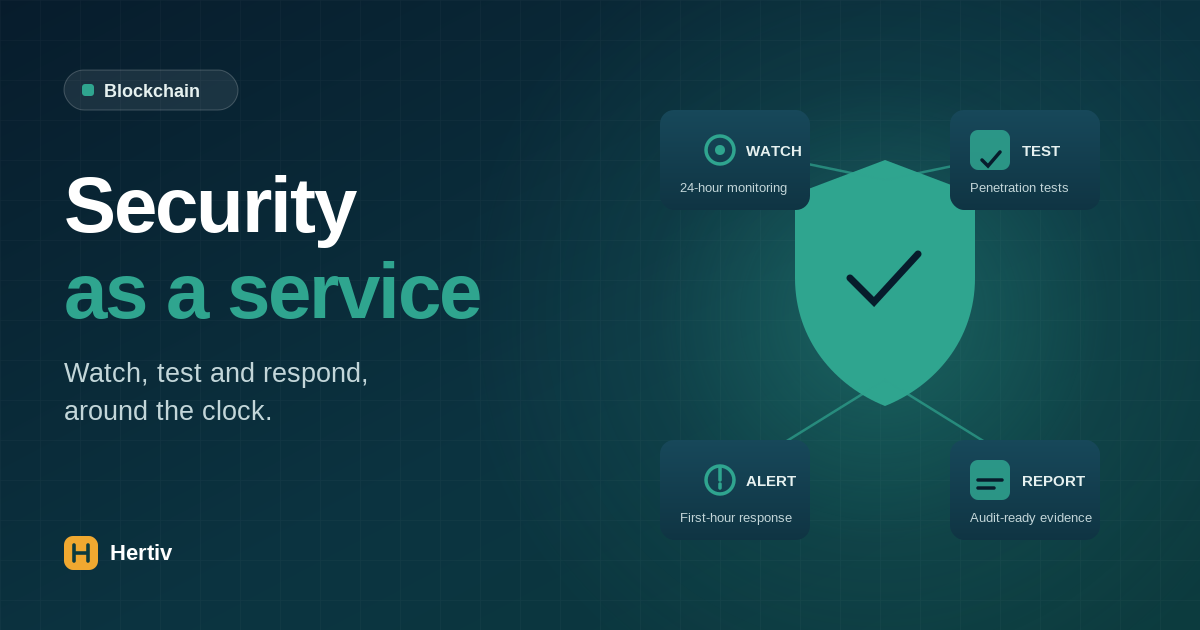
Blockchain infrastructure needs security as a service because the systems around a chain, nodes, bridges, wallets and APIs, are attacked constantly and hold real value. A managed service watches them around the clock, acts in the first hour of an incident and brings experience most product teams cannot hire in time.
What is security as a service for blockchain infrastructure?
Security as a service for blockchain infrastructure is a managed service that watches, tests and defends the systems a blockchain product runs on: nodes, validators, bridges, wallets, APIs and the contracts behind them. Instead of hiring a full security team, the product team rents one that is already staffed around the clock.
It covers the parts of a blockchain product that sit outside the smart contract itself. A contract audit checks the code once; security as a service keeps watching after launch, when the real attacks arrive. That is the gap it fills: audits are a point in time, while attacks are continuous.
| Service | What it does | When it matters most |
|---|---|---|
| Threat monitoring | Watches chains, mempools and your systems for attacks | Every day after launch |
| Incident response | Freezes, patches and recovers when an attack lands | The first hour of an incident |
| Penetration testing | Attacks your systems the way a real attacker would | Before a big release or listing |
| Key and node management | Secures signing keys, validators and endpoints | When funds or votes are at stake |
| Compliance reporting | Produces the evidence auditors and partners ask for | Fundraising, partnerships, regulation |
The service is usually bought as a monthly retainer with a defined response time, rather than as a one-off project. For the basics of what needs protecting, see what blockchain security is.
Why does blockchain infrastructure need it?
Blockchain infrastructure needs security as a service because the systems around a chain are attacked far more often than the chain itself. Nodes, bridges, wallets and APIs are all reachable from the internet, they hold real value, and they change every week as the product ships.
Three facts drive the need. The first is speed: an attack on a bridge or a hot wallet can drain funds in minutes, so the team that spots it must be awake and ready at 3 a.m., not just during office hours. The second is breadth: a single product can span several chains, a cloud account, a key service and a front end, and each one is a different kind of target.
The third is that attackers share knowledge. A bug found in one bridge is tried against every other bridge within days, so a team that only watches its own code is always behind. A managed service watches the whole ecosystem and applies what it learns from one client to all of them.
Most product teams cannot staff this themselves. A small team can write good code, but it cannot also run a 24-hour watch, a red team and an incident desk. Hiring for all three takes longer than most roadmaps allow.
What does the service actually watch?
The service watches four things at once, because an attack usually touches more than one of them. The first is the chain itself: unusual transactions, large withdrawals, new contracts interacting with yours and changes in validator behaviour. The second is the off-chain systems: APIs, front ends, cloud accounts and the servers that run your nodes.
The third is the keys. Signing keys are the single most valuable target in a blockchain product, so the service watches how they are stored, who can use them and whether any key has been used in a way that breaks the pattern. The fourth is the people: phishing aimed at the team, fake support accounts and social engineering that targets whoever holds access.
Good services also watch the ecosystem around you: new vulnerabilities in the libraries you use, attacks on similar products and changes in the chains you run on. An alert about a library you depend on is often the most useful warning of all.
The watch only works if the service can see the right data, so the setup phase matters: connecting logs, defining what normal looks like and agreeing which alerts wake someone up.
What should you look for in a provider?
Look for five things when you choose a provider, and treat a weak answer on any of them as a reason to keep looking. The first is blockchain experience: the team should have defended real chains, bridges or exchanges, not just general web apps. The second is response time in writing, with a named person and a defined escalation path.
The third is what they can actually do in an incident: freeze a contract, rotate keys, take a front end down, talk to an exchange. A provider that can only send an alert is a monitoring tool, not a service. The fourth is reporting: regular reports that show what was watched, what was found and what changed, in words your team and your partners can read.
The fifth is how they handle your data and your keys. Ask where logs are stored, who can see them and whether the provider ever holds signing keys. The answer should be short and clear; a long, vague answer is a warning sign.
Compare providers on the same questions, and ask each one to describe a real incident they handled. The best blockchain security software roundup covers the tools side, which is a useful check on what a provider should be using.
Example (hypothetical): a bridge attack caught in time
Example (hypothetical): a small bridge team runs a managed security service. At 2:40 a.m. the service flags a new contract calling the bridge with a pattern it has seen in another attack: a large withdrawal split into many small ones, all to fresh wallets.
The service wakes its analyst, who checks the pattern against the bridge's own logs and confirms it in 12 minutes. The provider pauses the bridge, calls the team's on-call engineer and starts the incident log. The attacker manages 3 withdrawals of $4,000 each, $12,000 in total, before the pause takes effect.
Without the service, the team's first sign would have been the morning check at 9 a.m., more than six hours later. At the attacker's pace of roughly $48,000 an hour, the loss by then would have been about $288,000. The service cost the team $6,000 a month; the one night paid for four years of it.
The numbers are the point: in blockchain security, the cost of the service is usually far smaller than the cost of one slow night. The arithmetic only holds because the service could act, not just alert.
What does security as a service cost?
Security as a service for blockchain infrastructure usually costs a monthly retainer that depends on what is covered and how fast the response must be. A small product with one chain and one front end pays far less than an exchange with several chains, a bridge and a hot wallet.
| Scope | What is covered | Planning range |
|---|---|---|
| Monitoring only | Alerts on chains and systems, no incident action | $2,000-$5,000 a month |
| Monitoring and response | Alerts plus a team that can act in an incident | $5,000-$15,000 a month |
| Full service | Monitoring, response, testing and reporting | $15,000-$40,000 a month |
These are planning ranges, not quotes: the price depends on the number of chains, the value at risk and the response time you need. Ask for the price in writing, with the response times and the scope listed, before you sign.
Compare the retainer with the cost of staffing the same cover yourself. A single security engineer costs more than most small retainers, and one person cannot cover nights and weekends. An audit is a separate cost, and the smart contract audit cost guide covers what that usually runs to.
What are the common mistakes?
The most common mistakes are buying monitoring and calling it security, picking a provider on price alone and keeping the service at arm's length from the team that ships the code.
- Buying alerts with no one who can act on them
- Choosing the cheapest provider with no blockchain experience
- Not giving the service access to logs, keys and the incident channel
- Skipping penetration testing because monitoring is in place
- Treating the service as a replacement for secure code
- Never testing the incident plan until a real attack arrives
Key takeaways
- Audits check code once; attacks are continuous, so the watch must be too.
- The first hour of an incident decides most of the loss, so response speed matters more than alerts.
- A provider must be able to act, pause a system or rotate a key, not just send a warning.
- The service usually costs far less than one slow night of an attack.
- Monitoring is not a replacement for secure code or for regular testing.
Frequently asked questions
What is security as a service for blockchain?
It is a managed service that watches, tests and defends the systems a blockchain product runs on, including nodes, validators, bridges, wallets and APIs. The product team pays a monthly retainer instead of hiring a full security team.
How is it different from a smart contract audit?
An audit checks the contract code once, before launch. Security as a service keeps watching after launch, when the real attacks arrive, and it covers the off-chain systems an audit never touches.
What does security as a service cost?
Planning ranges run from about $2,000 a month for monitoring only to $15,000-$40,000 a month for a full service with response, testing and reporting. The price depends on the number of chains, the value at risk and the response time.
Can a small team afford it?
Most small teams cannot afford to staff the same cover themselves, since one security engineer costs more than a small retainer and cannot cover nights. A monitoring-only plan is the usual starting point for a small product.
What should I ask a provider before signing?
Ask for blockchain experience, response times in writing, what they can do in an incident, how they handle your keys and data, and a description of a real incident they handled. A short, clear answer on each is a good sign.
Does the service replace secure coding?
No. It catches attacks and responds to them, but it cannot fix insecure code or a bad key design. Secure code, regular testing and a managed service work together, and none of them replaces the others.


