Blockchain Land Records: How Titles Move On-Chain
Blockchain land records put title history on a shared ledger that no single office can rewrite. Learn how they work, what changes and where pilots stand.
On this page
Short answer
Blockchain-powered land records store property title history on a shared ledger, so every transfer, mortgage and lien becomes a signed, time-stamped entry that no single office can quietly change. The government registry usually remains the legal record of ownership; the blockchain adds a tamper-evident layer that buyers, banks and courts can verify. Only hashes of documents go on-chain, while personal details stay in the registry database.
What are blockchain-powered land records?
Blockchain-powered land records are property title and ownership records stored on a shared ledger, so that every transfer, mortgage and lien is recorded as a signed, time-stamped entry that no single office can quietly change. The ledger becomes the audit trail for who owns a parcel of land and how it changed hands.
The key idea is not that the blockchain replaces the land registry. In most designs the government registry remains the legal record of ownership. The blockchain adds a tamper-evident layer: anyone can check that a record has not been altered since it was written.
That matters because land disputes are common where records are paper-based, incomplete or held by one office. A shared, verifiable history makes fraud harder and due diligence faster for buyers, banks and courts. It also matters for owners: a clear, checkable title is easier to borrow against, sell or pass on to family.
How does a land record move on-chain?
A land record moves on-chain in stages, and the legal transfer still happens through the registry. The blockchain records the steps and proves they happened in order.
- The parcel is surveyed and given a digital identity: boundaries, area and a unique parcel ID.
- The current title deed is digitised and its hash is written to the ledger.
- Buyer and seller sign the transfer, and the signatures are recorded.
- The bank or notary checks the record and adds its approval.
- The registry updates the title and writes the new ownership entry to the ledger.
- Anyone can verify the chain of entries back to the first record.
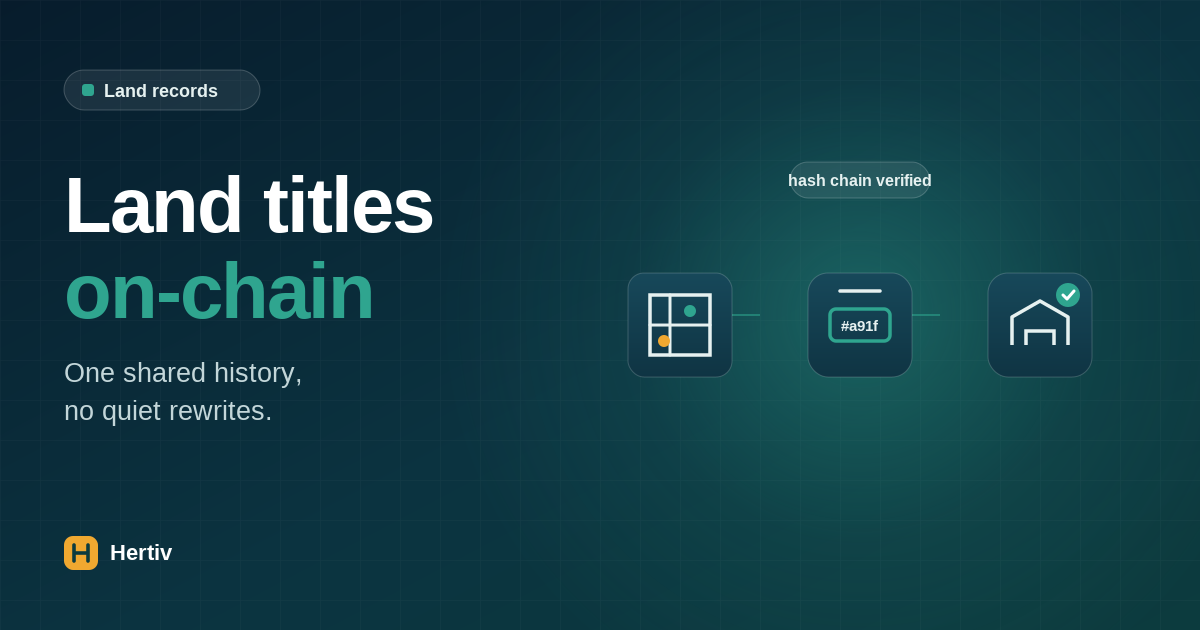
The hash is the important part. The full deed, with personal details, stays in the registry's database. Only a fingerprint of the document goes on-chain, so the record can be verified without publishing private data. If the deed is ever disputed, the hash proves which version existed and when it was recorded.
What changes compared with a paper registry?
The differences show up in verification speed, fraud resistance and who can check the record. Paper registries depend on one office and one set of files; a shared ledger lets many parties check the same history.
| Aspect | Paper registry | Blockchain-backed registry |
|---|---|---|
| Who holds the record | One registry office | Shared ledger across participants |
| Checking a title | Days of manual searches | Minutes, from the ledger history |
| Altering a record | Possible if files are changed | Visible, since hashes no longer match |
| Transfer steps | Sequential, paper-based | Shared workflow with signed steps |
| Dispute evidence | Original documents only | Full time-stamped history |
None of this removes the need for a legal framework. A ledger entry is only as strong as the law that recognises it, and most countries still require the registry's own stamp for a transfer to be legal. Technology can make a registry faster and harder to corrupt, but it cannot give a record legal force on its own.
What did the early pilots show?
Two early pilots are the most cited. In Georgia, the National Agency of Public Registry began working with Bitfury in 2016 to anchor land title records to the Bitcoin blockchain, adding a tamper-evidence layer to the existing registry. In Sweden, the land authority Lantmäteriet tested property transactions on a private blockchain with ChromaWay and two banks.
Both pilots showed the same lesson: blockchain works best as an integrity and coordination layer, not as a replacement for the registry. Georgia kept the state registry as the legal record; Sweden tested the transfer workflow rather than moving title itself.
Other countries have announced trials since, but few have moved to full production. Before citing any programme as a success, check its current status with the responsible land agency, since pilots are often paused or redesigned. A pilot that proved the technology is not the same as a registry that runs on it every day.
What are the limits and risks?
The limits are legal, practical and social. A ledger cannot fix a bad title, a disputed boundary or a registry that never recorded the parcel in the first place. If the first entry is wrong, the chain carries the error forward.
- Garbage in. Wrong or missing records stay wrong once they are on-chain.
- Legal recognition. A transfer is only valid if the law accepts the ledger entry.
- Privacy. Land ownership is sensitive, so personal data must stay off-chain.
- Key management. Losing the keys that sign transfers can block a sale.
- Cost and capacity. Digitising millions of parcels takes years and funding.
There is also a fairness question. Systems that assume every owner has an ID, a phone and a digital signature can exclude people who hold land informally. A registry project that ignores them can make their position worse, not better.
Example: a district digitises 12,000 parcels
Example (hypothetical): a district holds 12,000 land parcels on paper, with 300 sales a year. Each sale needs four documents checked by hand, and a title search takes about five working days.
The district digitises the parcels and writes a hash of each title to a shared ledger. A title search then takes minutes: the buyer checks the hash chain, confirms the seller is the recorded owner, and sees every transfer since the parcel was first registered.
The arithmetic is simple. At 300 sales a year and five days per search, the district spends 1,500 working days a year on searches. Cutting each search to under a day frees most of that time, but only if the underlying titles are accurate in the first place.
What are the common mistakes?
The most common mistakes are treating the ledger as the law, digitising bad records, and ignoring the people who use the system.
- Assuming a blockchain entry is legally binding without a law that says so.
- Putting personal data on-chain, where it cannot be deleted.
- Digitising paper records without checking them first.
- Designing for officials and banks, and forgetting smallholders and tenants.
- Promising instant transfers when the registry still needs manual approval.
Land records are a long game. Blockchain in the mortgage industry shows how the same ideas apply to lending, where title checks are part of every deal. The projects that last are the ones that fix the records, respect the law and design for the people who actually use the land.
Key takeaways
- Blockchain land records add a tamper-evident layer; the registry stays the legal record.
- Only hashes go on-chain; personal details stay in the registry database.
- Georgia and Sweden showed the model works as an integrity layer, not a replacement.
- Bad titles stay bad on-chain, so records must be checked before digitising.
- Privacy and legal recognition decide whether a project works, not the technology.
Frequently asked questions
Can blockchain replace the land registry?
No, not on its own. The registry remains the legal record of ownership in almost every country, and a transfer is valid only when the law recognises it. Blockchain adds a verifiable audit trail around the registry. Projects that treat the ledger as the law, without legal backing, create records that courts may not accept.
How does blockchain prevent land fraud?
It makes tampering visible. Each record is hashed and linked to the one before it, so changing an old entry breaks the chain and anyone checking can see it. That deters backdated transfers and double sales. It does not stop fraud at the point of entry: a fake document recorded honestly still enters the chain.
Is my personal data on the blockchain?
It should not be. Good designs store only a hash, a fingerprint of the document, on-chain, while names, ID numbers and addresses stay in the registry database. A hash can prove a document existed and has not changed, without revealing its contents.
Which countries have tried blockchain land records?
Georgia began anchoring land title records to the Bitcoin blockchain in 2016 with Bitfury, and Sweden's Lantmäteriet tested property transactions on a private blockchain with ChromaWay and two banks. Other countries have announced trials. Check the current status of any programme with the responsible land agency before relying on it.
What does a blockchain land registry cost to build?
Costs depend on how many parcels need digitising, how clean the existing records are and how many parties join the network. Digitising records is usually the largest cost, ahead of the software. Any vendor quote should separate record cleanup, system build and ongoing operation.
Can blockchain help with disputed land?
It can help future disputes by giving both sides a shared, verifiable history. It cannot settle existing disputes on its own, since the chain only records what was entered. Disputes over boundaries, inheritance or informal tenure still need courts, mediation or a formal adjudication process.


