How Blockchain Improves Last-Mile Delivery in Logistics
Blockchain gives every parcel a shared, tamper-proof record from depot to doorstep, cutting disputes and failed deliveries. Here is how it works in practice.
On this page
Short answer
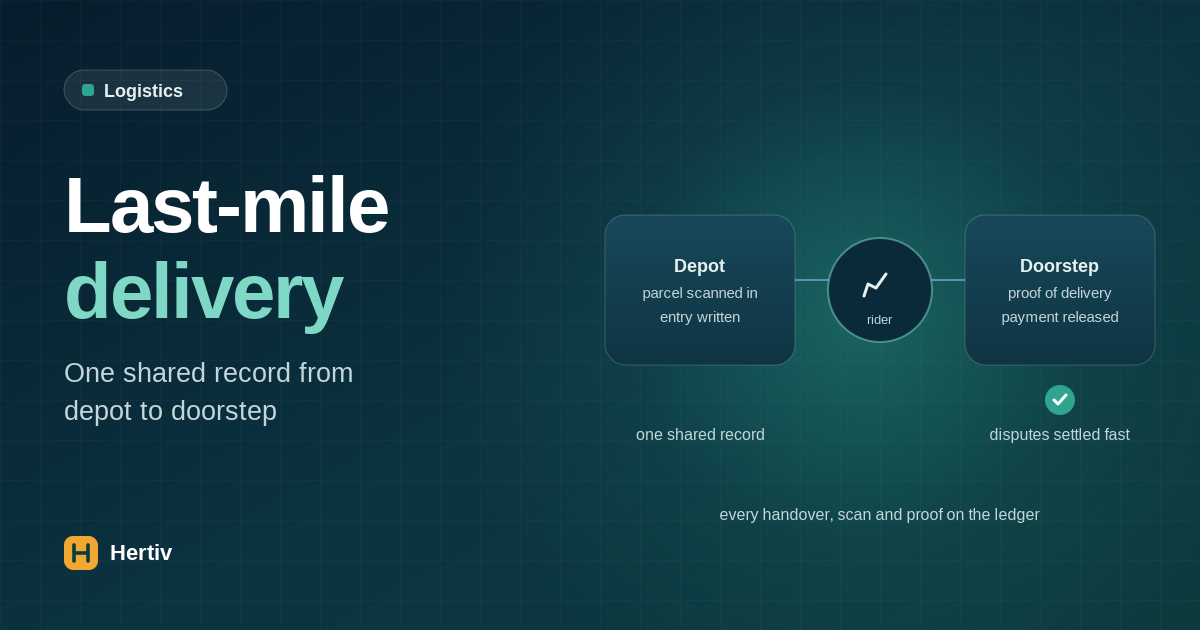
Blockchain improves last-mile delivery by giving every parcel one shared record that the sender, the courier and the customer can all see, from the depot to the doorstep. Each handover, scan and delivery proof is written to the record, so a dispute can be settled by reading it instead of arguing about it. The result is fewer failed deliveries, faster proof of delivery and less time spent chasing parcels.
How does blockchain change last-mile delivery?
Blockchain in last-mile delivery is a shared ledger that records every step of a parcel's final journey, from the depot to the customer's door, and its value is that the record cannot be changed after the fact. The sender, the courier company and the customer all read the same record, so nobody has to trust a single company's word about what happened.
Each scan writes a new entry: the parcel leaves the depot, it reaches the rider, it arrives at the address, and the delivery is confirmed. Because each entry is linked to the one before it, changing an old entry would break the chain, which makes the record a reliable source of truth when something goes wrong.
| Step | Without blockchain | With blockchain |
|---|---|---|
| Parcel leaves depot | One company's internal scan | Shared entry all parties can see |
| Handover to rider | Paper or app log | Signed entry linked to the parcel |
| Delivery attempt | Customer must call to check | Live status on the shared record |
| Proof of delivery | Photo or signature in one system | Proof stored with the parcel record |
| Dispute | Days of calls and emails | Settled by reading the record |
The idea fits naturally with other logistics tools. A guide to AI in logistics shows how route planning and demand forecasts cut the same costs from a different side, and the two work well together: AI plans the route, blockchain proves what happened on it.
What does proof of delivery look like on a blockchain?
Proof of delivery on a blockchain is a record that links the parcel, the time, the place and the person who received it. The rider scans the parcel, the customer signs or enters a code, and the system writes the proof to the ledger with a time stamp that cannot be edited later.
Photos can be stored with the proof too, either on the chain as a small record or off the chain with a link that the ledger can verify. The point is not to store everything on the chain, but to store enough that the proof cannot be faked or lost.
Smart contracts can act on the proof automatically. When the delivery proof is written, the contract can release the courier's payment, update the order status and send the customer a confirmation, all without anyone filing a claim. A guide to smart contract development explains how these rules are written and tested.
How do smart contracts help the last mile?
Smart contracts help the last mile by turning delivery rules into code that runs itself. The contract holds the delivery terms, such as the address, the time window and the payment, and it acts when the proof arrives instead of waiting for a person to check it.
The most useful rule is payment on proof. When the delivery proof is written to the ledger, the contract releases the courier's fee. That removes the invoice, the check and the wait, and it gives the courier a reason to record the proof correctly every time.
Contracts can also handle failed deliveries. If the rider cannot reach the customer, the contract can book a second attempt, notify the customer and update the delivery window, all from the same record. The customer sees the same status the courier sees, so there is less room for confusion.
How to run a blockchain last-mile pilot in six steps
A pilot should cover one route and one customer group, not the whole network. A small pilot shows whether the record, the scans and the proof flow actually save time, before the team spends on a full rollout.
- Pick one depot, one route and the parcels that cause the most disputes.
- Write down the delivery steps and the proof each step needs.
- Choose the chain and the wallet or app the riders will use.
- Train the riders on the scan and proof steps for two weeks.
- Measure disputes, failed deliveries and proof time against the old route.
- Decide whether to expand, fix the weak step, or stop.
Measure the pilot against the old route, not against a guess. A breakdown of logistics app costs shows how to price the build and the pilot separately, so the team knows what the trial really costs before scaling it.
Example (hypothetical): a courier's dispute problem
Example (hypothetical): a courier handles 200 parcels a day, and 12 of them end in a dispute that takes 20 minutes each to resolve, which is 240 minutes, or 4 hours a day. The team adds a shared ledger with proof of delivery for every parcel.
After a month, disputes fall to 3 a day, and each one takes 20 minutes, which is 60 minutes, or 1 hour a day. The team saves 3 hours a day, and the riders spend less time on the phone and more time delivering.
The example shows where the saving comes from. The ledger does not make the riders faster, it makes the proof clear, so disputes that once took calls and emails are now settled by reading one record.
What are the limits of blockchain in the last mile?
The first limit is the scan. A blockchain record is only as good as the data written to it, and a rider who scans the wrong parcel or skips a scan creates a record that is wrong from that point on. Training and simple checks at the scan step matter more than the chain itself.
The second limit is cost and speed. Writing every scan to a public chain can be slow and expensive, so most pilots use a private chain or a layer-two network, and store photos off the chain. The design must fit the number of parcels, not the other way round.
The third limit is adoption. The record only helps when the sender, the courier and the customer all use it. A pilot with one courier and one customer proves the idea, but the real value appears when the whole route uses the same record.
Common mistakes
The first mistake is putting everything on the chain. Photos, signatures and long notes belong off the chain, with a small verified link in the ledger. Teams that store everything on the chain pay too much and wait too long for each write.
The second mistake is skipping the rider's workflow. If the scan step adds a minute to every delivery, riders will skip it when they are busy, and the record will have gaps. The scan must be faster than the paper step it replaces, or the pilot will fail.
The third mistake is promising customers a live map the team cannot keep live. A status page that lags behind the real delivery is worse than no page at all. Show only the steps the record can prove, and update them the moment the scan is written.
Key takeaways
- One shared record replaces three separate versions of the truth.
- Proof of delivery, stored on the ledger, settles most disputes.
- Smart contracts can release payment the moment proof is written.
- Pilot one route first and measure disputes against the old route.
- Keep photos off the chain and the scan step faster than paper.
Frequently asked questions
Does blockchain track parcels in real time?
Not on its own. The ledger records each scan, so the status is as fresh as the last scan. Real-time tracking needs the rider's phone to send location updates, and the ledger can store the proof that each update happened.
Which parcels benefit most from blockchain?
High-value parcels, parcels with many handovers, and deliveries that cause frequent disputes benefit most. A single parcel handed from depot to rider to customer in one step gains less than a parcel that changes hands three times.
Is a private chain better than a public one here?
Most pilots use a private chain or a layer-two network, because they are faster and cheaper for thousands of scans a day. A public chain fits cases where outside parties must verify the record without joining the network.
What does a last-mile blockchain pilot cost?
It depends on the number of parcels, the chain chosen and the rider app. Price the build, the pilot and the running cost as separate lines, and check the vendor site for current platform fees before budgeting.
Do customers need a wallet to use it?
No. Customers usually see a status page or a delivery link, while the wallet and the chain sit behind the scenes. The customer only needs the proof, not the technology that stores it.
Can blockchain stop parcels from being lost?
No, it cannot stop a loss, but it shows exactly where the parcel was last scanned and who held it. That makes the loss easier to find and the responsibility clear, which is what cuts the dispute time.


