Blockchain Infrastructure Security: Nodes, RPC and Networks
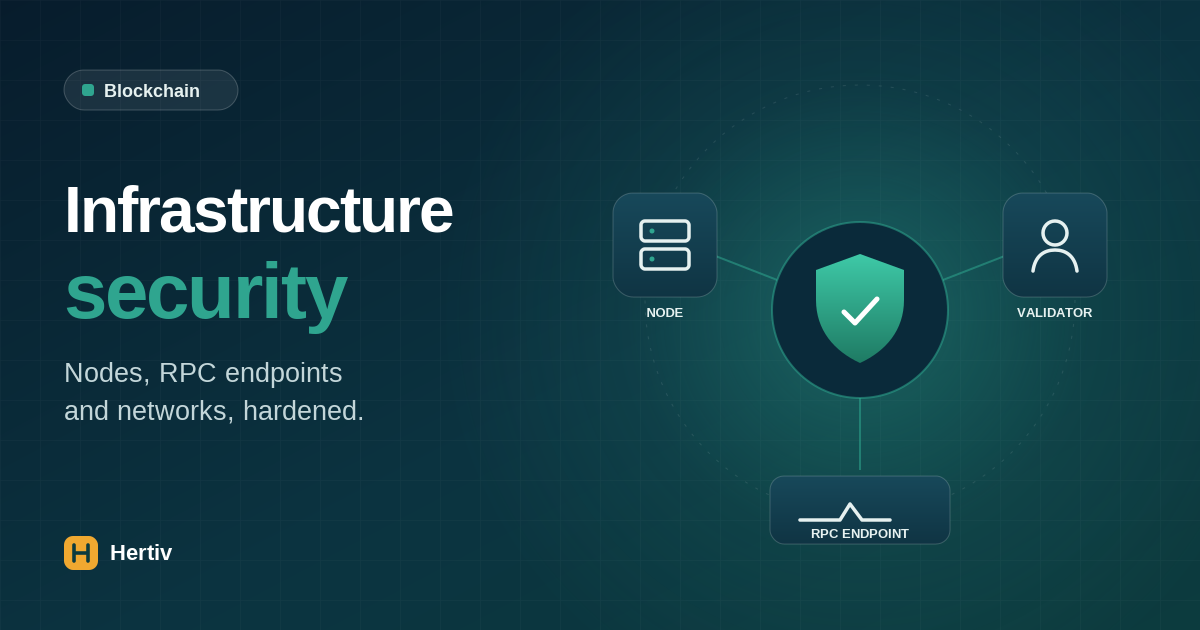
Blockchain infrastructure security protects the nodes, RPC endpoints, validators and networks a chain runs on. Here is what to harden first.
On this page
Short answer
Blockchain infrastructure security is the practice of protecting the servers, nodes, RPC endpoints, validators and networks that keep a blockchain running. It covers patching, access control, network segmentation, key protection and monitoring, so that an attacker cannot take down the chain or steal the funds it secures.
What is blockchain infrastructure security?
Blockchain infrastructure security is the practice of protecting the servers, nodes, RPC endpoints, validators and networks that keep a blockchain running. It is about the machines and connections underneath the chain, not the smart contracts on top of it.
A chain is only as safe as the infrastructure that runs it. If an attacker can reach a validator's signing key, flood an RPC endpoint, or take a node offline, the chain can stall, fork, or lose funds, even when the contracts themselves have no bugs.
The work covers five areas: securing the nodes, protecting RPC and API endpoints, keeping validators and keys safe, hardening the network, and monitoring everything so problems are caught early. It is ongoing work, not a one-time setup, because nodes, software and threats all change.
Which parts of blockchain infrastructure need protection?
Blockchain infrastructure has six parts that need protection, and each one fails in a different way.
| Part | What it does | Main threat | Key control |
|---|---|---|---|
| Nodes | Store and relay chain data | Unpatched software | Patching and backups |
| RPC endpoints | Let apps read and send transactions | Abuse and flooding | Authentication and rate limits |
| Validators | Propose and confirm blocks | Key theft | Remote signing and hardware keys |
| Network | Connects nodes and users | Partition and denial of service | Segmentation and diverse peers |
| Hosting and cloud | Runs the servers | Exposed admin panels | Least privilege and logging |
| Keys and secrets | Sign blocks and transactions | Leaks and theft | Hardware modules and rotation |
Start with the parts that hold keys or face the internet, because those are the first places an attacker looks. The general security picture is covered in what blockchain security is.
How do you secure blockchain nodes?
You secure blockchain nodes by keeping their software current, limiting who can reach them, and making sure they can be rebuilt quickly if they fail.
Patching comes first. Node software is updated often, and known bugs in old versions are a common way in. Run a regular patch schedule, test updates on a non-production node first, and keep a record of which version each node runs. A node that falls several versions behind is an easy target, because its known flaws are public.
Limit network access so that only the ports a node needs are open, and only to the addresses that need them. Peering should use a diverse set of peers from different networks and regions, so that losing one provider does not cut the node off. Keep regular backups of chain data and configuration, and test restoring from them, because a node that cannot be rebuilt is a single point of failure.
How do you protect RPC and API endpoints?
You protect RPC and API endpoints by requiring authentication, limiting request rates, and keeping private endpoints separate from public ones.
Public RPC endpoints are an easy target: anyone can send requests, so an attacker can flood them and crowd out real users. Require an API key for every request, set a rate limit per key, and block keys that break the limit repeatedly. Separate the endpoint your own apps use from the one the public uses, so an attack on the public endpoint does not stop your own services.
Log requests and watch for unusual patterns, such as a single key sending far more traffic than normal or a sudden rise in failed requests. For the checks that belong in the application layer, see blockchain security best practices.
How do you keep validators and signing keys safe?
You keep validators and signing keys safe by keeping the keys away from the internet, using hardware to hold them, and making sure no single person or machine can sign alone.
Use remote signing: the validator asks a separate signing service to sign blocks, and the key never leaves that service. Store keys in a hardware security module or a dedicated signer, not in a file on the validator server. Require more than one approval for sensitive actions, such as changing validator settings or withdrawing funds.
Protect against double-signing, which can cost a validator its stake. Run only one active signer per validator key, and use double-sign protection so a mistake cannot produce two different signatures for the same block height. The custody side of this is covered in crypto custody best practices.
Example (hypothetical): an RPC service survives a traffic surge
Example (hypothetical): a team runs an RPC service with four nodes. Each node handles 300 requests per second, so the service handles 1,200 requests per second in total. Normal traffic is 800 requests per second, which leaves 400 requests per second of spare capacity.
One morning a popular app launches and traffic rises to 1,500 requests per second. At the same time one node goes down for a patch, leaving three nodes handling 900 requests per second. The shortfall is 1,500 minus 900, which is 600 requests per second, so over ten minutes about 360,000 requests would be delayed or dropped.
Because the team had set a rate limit per API key and a separate private endpoint for its own apps, the surge is shared fairly and the team's own services keep working. The team then adds a fifth node, raising capacity to 1,500 requests per second, and sets an alert when traffic passes 1,000 requests per second so the next surge is caught earlier.
What are the common mistakes?
The most common infrastructure mistakes are leaving admin access open, running one node with no backup, and trusting the network to stay up on its own.
- Open admin panels. Dashboards and SSH exposed to the internet are found quickly by automated scans. Restrict them to a private network or VPN.
- One node, no backup. A single node is a single point of failure. Run at least two, in different places, with tested backups.
- Keys on the validator. A signing key stored in a file on a server that faces the internet can be stolen in one breach.
- No rate limits. An open RPC endpoint will be flooded sooner or later, and real users pay for it.
- No monitoring. If nobody watches peer counts, block height and disk space, a node can fall behind for hours before anyone notices.
Fix the key-holding and internet-facing parts first, then work through the rest. For contract-level checks that sit above the infrastructure, see smart contracts security.
Key takeaways
- Infrastructure security protects nodes, RPC endpoints, validators and networks
- Patch nodes on a schedule and test restoring from backups
- Require API keys and rate limits on every RPC endpoint
- Keep signing keys in hardware and never on an internet-facing server
- Monitor peer counts, block height and traffic so problems are caught early
Frequently asked questions
What is blockchain infrastructure?
Blockchain infrastructure is the servers, nodes, RPC endpoints, validators and networks that run a chain. It is the layer underneath the smart contracts: it stores chain data, relays transactions, proposes blocks and lets apps talk to the chain.
How is infrastructure security different from smart contract security?
Smart contract security checks the code that runs on the chain. Infrastructure security protects the machines and connections underneath it. Both matter: a safe contract on a compromised validator can still lose funds.
What is an RPC endpoint?
An RPC endpoint is a server that lets apps read chain data and send transactions without running their own node. Apps send requests to it, and it answers with balances, transaction results or block data. Public endpoints need authentication and rate limits.
Why do validators need special protection?
Validators propose and confirm blocks, and their signing keys control their stake. If a key is stolen, an attacker can sign bad blocks or steal funds. Keys should live in hardware or a remote signer, never in a file on the validator.
How many nodes should a project run?
At least two, in different places, so one failure does not stop the service. Larger projects run more, with separate nodes for public RPC, private use and backups. What matters most is that a failed node can be rebuilt quickly.
What should I monitor on blockchain infrastructure?
Watch peer counts, block height against the network, disk space, CPU and memory, RPC request rates and error rates, and validator signing activity. Alert on anything that drifts from normal, so problems are caught in minutes, not hours.


