Blockchain in Travel: Where It Helps and Where It Does Not
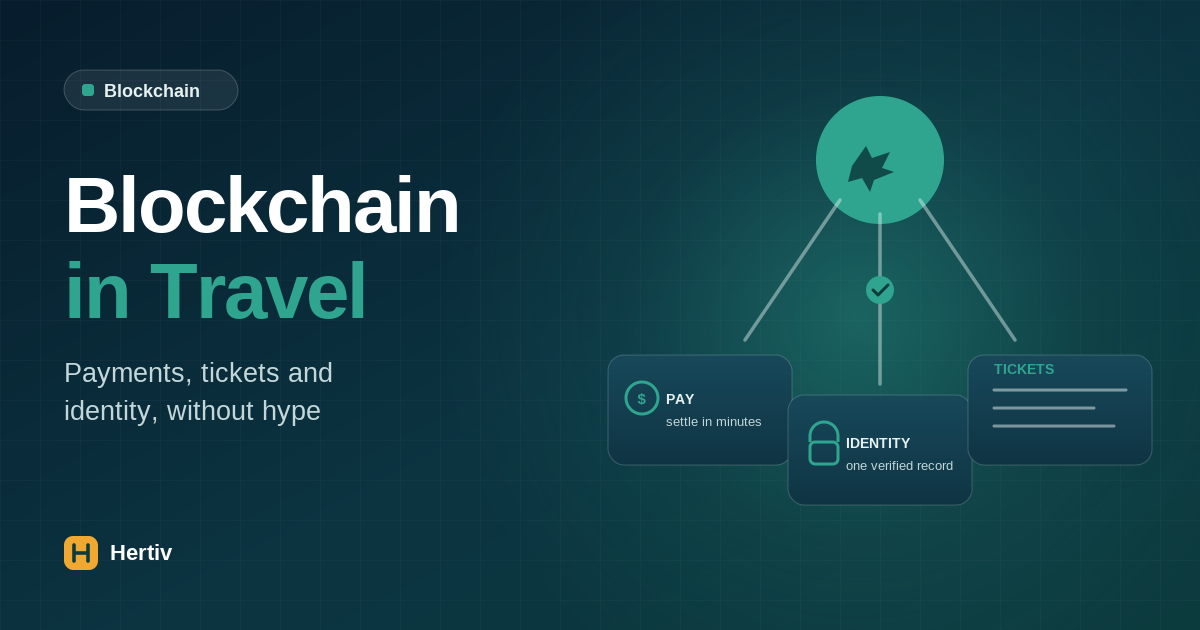
Blockchain in travel covers payments, identity, tickets, loyalty and shared records. It helps where firms must trust one record, not where one firm holds the data.
On this page
Short answer
Blockchain technology in travel is a shared, tamper-resistant record that several travel companies can read and write to, so they agree on payments, bookings, identity and baggage without passing files back and forth. It is a tool for shared records between firms, not a replacement for the booking systems travellers already use.
What is blockchain technology in travel?
Blockchain technology in travel is a shared ledger that airlines, hotels, agents and payment firms use to record the same facts once, instead of each keeping a separate copy. When a payment is made, a ticket is issued or a bag changes hands, the event is written to the shared record and every party sees the same version.
The key idea is agreement between firms that do not fully trust each other. A hotel does not need to trust an agent's spreadsheet if both can read the same booking record. A traveller does not need to carry paper proof if the airline, the hotel and the border system can check the same verified record.
Most travel blockchain work runs on permissioned networks, where known companies operate the nodes, rather than open public chains. That keeps the data private and the costs predictable, which matters for firms handling bookings and payments every day.
| Area | What blockchain adds | Where it is used today |
|---|---|---|
| Payments | Direct settlement without card rails | Cross-border supplier payments |
| Identity | One verified record reused at check-in | Airports and hotels |
| Tickets | Tickets that cannot be copied | Events and flights |
| Loyalty | Points that move between partners | Airline and hotel programmes |
| Baggage | Shared record of where a bag is | Airline transfers |
| Supply | Provenance for food and goods | Hotel and cruise supply chains |
How does blockchain help with travel payments?
Blockchain helps travel payments by letting firms settle directly with each other using stablecoins or tokenised money, instead of routing every payment through card networks and banks that each take a fee and add days of delay.
Cross-border payments are the clearest case. A hotel in one country and an agent in another can settle in minutes rather than waiting days for a bank transfer, and both sides can see the payment on the shared record. That reduces disputes about whether and when money arrived.
Refunds are another case. When a flight is cancelled, a smart contract can release the refund automatically once the cancellation is recorded, instead of a traveller chasing the airline, the agent and the bank separately. For more on how this works in practice, see how stablecoins work for travel payments.
Payments are not free of risk. Stablecoin rules differ by country, and firms need clear rules for who holds the funds and what happens if a payment fails. A pilot with one route and one partner is the sensible way to learn these rules.
What can blockchain do for identity, tickets and loyalty?
Blockchain can give a traveller one verified identity record that is reused at booking, check-in and border control, instead of the same details being typed into every system. The traveller controls who sees the record, and each check leaves a trace.
Tickets work the same way. A ticket issued as a token cannot be copied, and its ownership history is visible, which makes resale fraud harder. When a ticket is transferred, the record updates for everyone at once, so the venue and the buyer agree on who holds it.
Loyalty points are a natural fit. Points issued by an airline could be spent with a hotel partner without a slow reconciliation between the two programmes, because both read the same balance. The hard part is commercial, not technical: partners must agree on what a point is worth.
None of this removes the need for good data. A shared record of wrong passport details is still wrong. Identity checks still depend on the authority that verified the traveller in the first place, and that authority must be trusted by everyone on the network.
Where does blockchain help behind the scenes?
Behind the scenes, blockchain helps where several firms handle the same physical thing, such as a bag, a meal or a spare part. Each handover is recorded once, so when something goes missing, the firms can see the last recorded handover instead of arguing from separate logs.
Baggage is the classic example. A bag that moves between two airlines passes through several handlers, and today each handler keeps its own record. A shared record gives the passenger and both airlines the same view of where the bag was last scanned.
Supply chains work the same way. A hotel group that buys food from many suppliers can check the provenance of a batch from the shared record, which matters for safety checks and for claims about where food came from.
These uses only pay off when several firms join the same network. One company on its own gains little from a shared record, which is why travel blockchain projects usually start as a small group of partners on one route or one product.
Example (hypothetical): a hotel group settles with agents on a shared ledger
Example (hypothetical): a hotel group with 40 properties works with 60 travel agents. Today each agent sends bookings by email or through a channel manager, and the hotel reconciles payments at the end of each month. Disputes about cancelled bookings take weeks to resolve.
The group and ten of its largest agents agree to record bookings and payments on a shared ledger. Each booking is written once, with the rate, the dates and the cancellation terms. When a guest cancels inside the free window, a smart contract releases the refund to the agent the same day.
After three months, the group compares the pilot with the old process. Reconciliation time falls from six days a month to one day, because both sides read the same record. Refund disputes drop, because the cancellation terms are part of the booking record rather than a separate email thread.
The pilot also shows the limits. Agents outside the network still use the old process, so the hotel runs two systems in parallel. The group decides to expand slowly, adding agents who already settle the most bookings, rather than forcing every partner onto the ledger at once.
What are the common mistakes?
The most common blockchain in travel mistakes are building a ledger nobody else joins, ignoring the law, and expecting the technology to fix bad data or bad partnerships.
- Building alone. A shared record with one member is just a database. Get partners to commit before you build.
- Ignoring regulation. Payment, identity and data rules differ by country. Check them before the pilot, not after.
- Putting everything on chain. Personal data and large files belong off the ledger, with only a reference stored on it.
- Expecting instant scale. A pilot on one route teaches more than a grand plan that never launches.
- Forgetting the traveller. If the new process is harder for guests than the old one, they will not use it.
How to run a small blockchain pilot in travel
You run a small blockchain pilot in travel by picking one shared problem, one group of partners and one measure of success, then running it for a few months before deciding whether to expand.
- Pick the problem. Choose one case where firms disagree about records, such as refunds or baggage handovers.
- Gather the partners. Find two or three firms who share the problem and will use the pilot daily.
- Agree the rules. Decide who can write to the ledger, who can read it, and who pays for running it.
- Keep personal data off chain. Store only references on the ledger and keep details in existing systems.
- Measure against the old way. Compare time, cost and disputes with the same work done the old way. For a smart contract angle, see smart contracts in travel.
If the pilot does not beat the old process on time, cost or disputes, stop and keep the old process. A pilot that fails cheaply is still useful, because it tells you what not to build.
Key takeaways
- Blockchain helps where several travel firms must trust one shared record
- Payments and refunds are the clearest use case, especially across borders
- Tickets, identity and loyalty work when partners agree on shared rules
- A ledger proves what was written, not that the data is true
- Start with one route, a few partners and a clear measure of success
Frequently asked questions
Is blockchain used in travel today?
Yes, in small pilots and a few live systems, mostly for payments, identity checks, tickets and shared records between partners. It is not yet the normal way bookings work, and most travellers never notice it.
Do travellers need a crypto wallet to use blockchain travel services?
No. In most travel pilots the traveller uses a normal app, and the blockchain runs behind the scenes between companies. A wallet is only needed where the traveller holds tokens directly.
How does blockchain help with flight refunds?
When a cancellation is recorded on the shared ledger, a smart contract can release the refund automatically under the agreed terms. This removes the back-and-forth between airline, agent and bank, though the rules must be agreed in advance.
Is blockchain in travel safe for personal data?
It can be, if personal data is kept off the ledger and only a reference is stored on it. Firms must still follow data protection law, and travellers should be told what is recorded and who can read it.
Why have some travel blockchain projects failed?
Most failed because too few partners joined, so the shared record had no advantage over a normal database. Others ran into unclear rules on payments or identity, or tried to replace working systems all at once.
What should a travel firm pilot first?
A single shared problem with a few willing partners, such as cross-border payments on one route or refunds with one agent. A small pilot with a clear measure of success is the best way to learn.


