How Blockchain Games Make Money: Monetization Explained
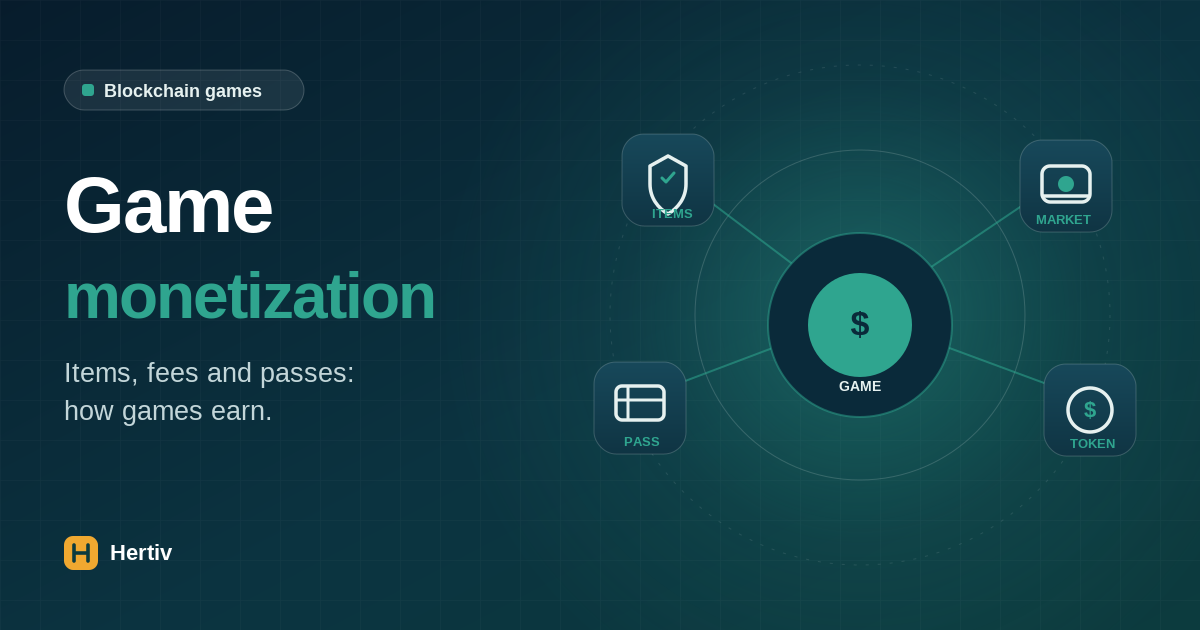
Blockchain games earn from item sales, marketplace fees, season passes and tokens, with players owning the items they buy. Here is how each model works.
On this page
Short answer
Blockchain games earn money from selling in-game items as tokens, taking fees on player-to-player trades, and selling season passes and cosmetics. The game must balance rewards with spending, or the economy collapses. The safest games mix several income streams instead of relying on one.
What is monetization in blockchain games?
Monetization in blockchain games is how a game earns money from players while using blockchain for ownership of in-game items. Players can own, trade and sell items as tokens, and the game earns from the first sale of those items, fees on trades between players, and other in-game purchases.
The difference from a normal game is ownership. In a normal game the publisher owns the items and players rent access to them; in a blockchain game the items live in the player's wallet and can move to a marketplace. That changes both the revenue model and the risks, since players can cash out.
| Revenue model | How the game earns | Who pays |
|---|---|---|
| Item sales | First sale of characters, skins and land | Players buying new items |
| Marketplace fees | Small fee on player-to-player trades | Players trading items |
| Season passes | Recurring pass for rewards and content | Regular players |
| Token sales | Sale of the game's token | Players and speculators |
| Cosmetics | Visual items with no gameplay power | Players who want a look |
Most blockchain games mix several of these models rather than relying on one. A game that depends on a single token sale for income is fragile, while a game with item sales, fees and passes has steadier revenue.
How do in-game asset sales work?
In-game asset sales work by selling items as tokens on a blockchain, so each item has a verifiable owner and a history. A player buys a character, weapon or plot of land, and the game records the sale on-chain while the item itself appears in the game.
Primary sales are the first sale of a new item by the game itself, and they are the simplest revenue. The game sets a price, mints a limited number of items, and keeps the proceeds. Scarcity matters here: an item that is rare and useful sells for more than a common one, but flooding the market with items destroys their value.
Secondary sales happen when players trade items with each other on a marketplace. The game usually takes a small fee on each trade, often a few percent, which creates ongoing income long after the first sale. This is the model behind many NFT games in the metaverse, where the marketplace is part of the game economy.
How does play-to-earn change the economics?
Play-to-earn changes the economics by paying players in tokens or items for time spent in the game, which turns players into earners as well as customers. The game must fund those rewards from new income, since every token paid out is a cost unless new players keep arriving.
The risk is well known: if rewards are generous and new players slow down, the token supply grows faster than demand and its value falls. Players then earn less, some leave, and the fall speeds up. Games that survived this cycle usually cut rewards early, tied them to real spending by other players, or made earning a small part of the game rather than the point of it.
A safer design treats earning as a bonus for skilled or committed play, not as a wage. The game earns from players who spend on items and passes, and a share of that income funds rewards, so the economy balances without needing endless new players.
What other revenue streams do blockchain games use?
Other revenue streams in blockchain games include season passes, cosmetics, land rent and partnerships. Season passes are the most reliable: players pay a fixed amount per season for rewards, challenges and content, which gives the game predictable income.
Cosmetics sell well because they change how a character looks without changing how strong it is, so they do not upset the balance of the game. Players buy them to stand out, and since they are tokens, they can also be traded later, which adds a reason to buy.
Land and guild features add another layer. A game can sell or rent virtual land to players who build on it, and charge for guild tools, tournaments or branded events. Partnerships with other games or brands can add income too, for example a crossover item that appears in two games at once.
Studios building this kind of economy usually plan the revenue mix before the game launches, since adding monetization after players have formed habits is far harder than designing it in from the start. Teams that need help with the build often work with a blockchain development partner to get the economy and the contracts right.
Example (hypothetical): a small game's first month
Example (hypothetical): a small blockchain game launches with 5,000 players in its first month. It sells a starter pack, takes a fee on marketplace trades, and offers a season pass.
The arithmetic is simple. Of the 5,000 players, 400 buy a starter pack at $10 each, which is 400 × $10 = $4,000. Players trade $20,000 worth of items on the marketplace, and the game's 5% fee on those trades is $20,000 × 0.05 = $1,000. A further 300 players buy a $5 season pass, which is 300 × $5 = $1,500. Total first-month revenue is $4,000 + $1,000 + $1,500 = $6,500.
The mix matters more than the total. The starter pack is a one-off sale, the season pass repeats each season, and the marketplace fee grows with trading volume. A game whose income is mostly one-off sales must find new buyers every month, while a game with passes and fees earns from the players it already has.
What are the common mistakes?
The most common monetization mistakes in blockchain games are printing too many rewards, selling power instead of cosmetics, and treating a token sale as a business model.
- Rewarding every action. When everything a player does pays tokens, supply grows fast and the token loses value.
- Selling power. Items that make a player much stronger create pay-to-win complaints and push free players away.
- Depending on token sales. A token sale is one-off income; it is not a revenue stream that repeats.
- No sinks for tokens. If tokens are only earned and never spent inside the game, they pile up and fall in value.
- Ignoring fees and taxes. Marketplace fees, chain fees and local tax rules all take a share, so the plan should include them.
What should you check before building monetization into a game?
Before building monetization into a blockchain game, check the economy on paper, the rules in your target markets, and whether players actually want to spend. A spreadsheet that balances income and rewards is cheaper than a launched game with a broken economy.
First, model the economy: how many tokens are created, how many are spent inside the game, and what happens if player growth stops for three months. If the model only works while new players arrive, redesign it before writing code.
Second, check the rules. Some regions treat game tokens as financial products, and app stores have their own rules about in-app purchases and crypto. A short legal review early is far cheaper than rebuilding the economy after launch.
Third, test spending with real players. A small closed test that asks players to buy a pass or an item tells you more than any survey, and it shows whether the game is fun enough to spend on. Games that players enjoy but never pay for need a different model, not a bigger marketing budget.
Key takeaways
- Blockchain games earn from item sales, marketplace fees, season passes and cosmetics
- Players own in-game items as tokens, so they can trade and sell them on a marketplace
- Play-to-earn only works when rewards are funded by real player spending, not new arrivals
- A balanced economy needs token sinks: ways for players to spend tokens inside the game
- Model the economy on paper and test real spending before launching monetization
Frequently asked questions
What is the most reliable way for a blockchain game to earn money?
Season passes and cosmetics are usually the most reliable, since they repeat and do not depend on token prices. Item sales give a strong launch but are one-off, while marketplace fees grow only when trading is active. Most games mix several models.
Do players really own items in blockchain games?
In most cases the item is a token in the player's wallet, so the player can trade or sell it outside the game. The game still controls how the item works inside the game, and the art and servers usually belong to the studio, so ownership has practical limits.
Is play-to-earn still a good model?
It can work when earning is a bonus for skilled play and rewards are funded by player spending. It fails when rewards are generous, funded by new players, and disconnected from spending. Many newer games have moved earning to a small part of the game rather than the main draw.
How much can a small blockchain game earn?
It depends on the player count and how many players spend. A game with 5,000 players and a few hundred buyers can earn a few thousand dollars in a month from packs, passes and fees. The figures vary widely, so model your own numbers rather than copying another game's results.
Are blockchain game tokens a safe investment?
No game token is a safe investment, and players should treat tokens as spending money for a game, not as savings. Token prices can fall sharply when rewards outpace demand, and rules differ by region. Never promise returns to players.
What rules apply to blockchain game monetization?
Rules vary by country and by app store. Some regions treat game tokens as financial products, and stores have rules about in-app purchases and crypto payments. Get a short legal review before launch, since rebuilding an economy after launch is costly.


