7 Stages of Building a New Blockchain Product
Building a blockchain product runs through seven stages, from proving the use case to running the live network. Skipping one is how most projects get into trouble.
On this page
Short answer
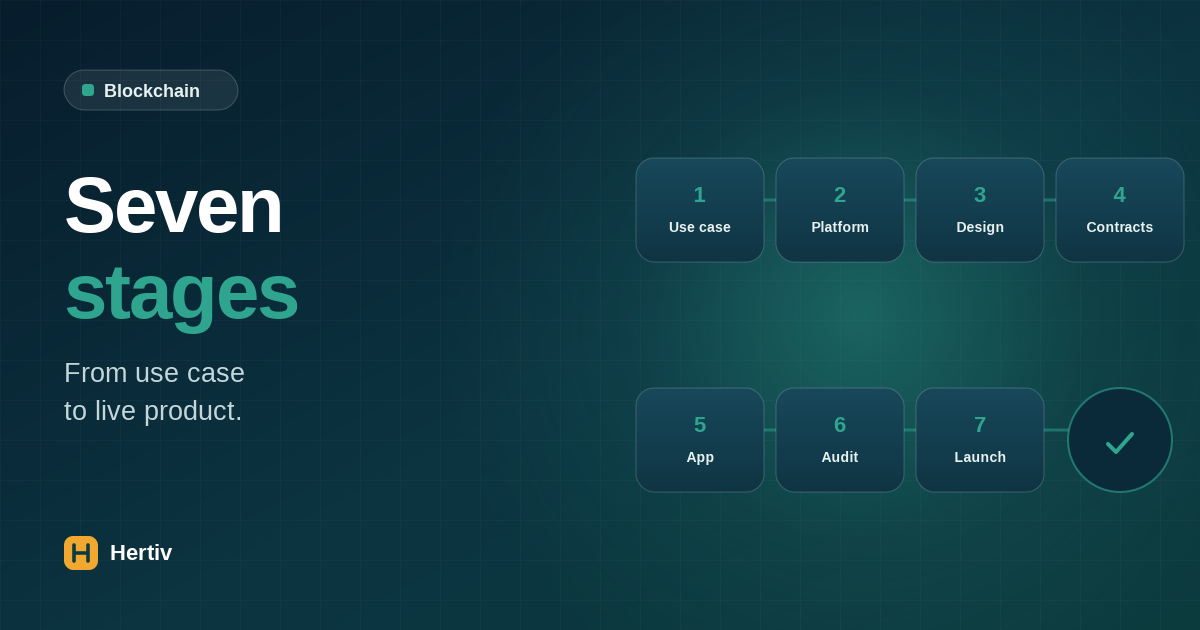
Building a new blockchain product takes seven stages: define the use case, choose the platform, design the system, build the contracts, build the app, audit and test, then launch and run. Each stage produces a decision or a document that the next stage depends on, so skipping one usually means redoing work later.
What are the stages of blockchain development?
The stages of blockchain development are the seven steps a team follows to take a new blockchain product from idea to live service: define the use case, choose the platform, design the system, build the contracts, build the app, audit and test, then launch and run.
| Stage | What happens | What you have at the end |
|---|---|---|
| 1. Define the use case | Pick the problem and check a chain is the right tool | A one-page problem statement |
| 2. Choose the platform | Pick a chain, consensus model and token approach | A written platform decision |
| 3. Design the system | Map contracts, data, wallets and off-chain parts | Architecture and contract specs |
| 4. Build the contracts | Write, test and review the smart contracts | Tested contracts on a test network |
| 5. Build the app | Connect wallets, interface and back-end services | A working product on testnet |
| 6. Audit and test | External review, load testing and bug fixes | An audit report and fixed code |
| 7. Launch and run | Deploy, monitor, govern and upgrade | A live product with monitoring |
The order matters. A team that picks a chain before defining the problem often builds on the wrong platform. A team that writes contracts before designing the data model often finds the contracts cannot hold the data the product needs.
Use this list as a checklist, not a rigid timeline. Small products can move through early stages in days, and stages can overlap, but each one still needs its decision written down before the next stage starts.
Stages 1 to 3: decide what to build, and how
1. Define the use case: best for teams still deciding whether a chain fits
Start by writing the problem in one page: who needs a shared record, what they do not trust each other about, and what happens if the record is wrong. If one company controls all the data and all the users, a database is usually the better answer.
The output is a problem statement with a clear user and a clear benefit. If you cannot name the user or the benefit, stop here; no platform choice will fix a missing use case.
2. Choose the platform: best for teams that have a real shared-record problem
Pick a chain and a consensus model based on what the product needs: how many transactions per second, how final they must be, what fees are acceptable, and whether the chain must be public or permissioned. Also decide whether the product needs its own token, or can use an existing one.
Write the decision down with the reasons. Platform choices are hard to reverse, so the reasoning should survive the people who made it. A blockchain development partner can help compare options, but the decision belongs to the product owner.
3. Design the system: best for teams with a platform decision in hand
Design covers what lives on the chain and what lives off it. Contracts should hold the smallest amount of data that must be shared and trusted; everything else, such as large files and private details, usually belongs off-chain with a reference on-chain.
The design also covers wallets, permissions, upgrades and failure modes. Write contract specifications before any code, including what each function may do and who may call it.
Stages 4 and 5: build the contracts and the app
4. Build the contracts: best for teams with finished specifications
Write the contracts in small pieces, each with tests that run on every change. Keep each contract focused on one job, and keep the logic simple enough that another developer can read it in an hour.
Test on a local network and a test network before touching real funds. Include tests for the unhappy paths: wrong inputs, failed payments, expired permissions and attempts to call functions from the wrong address.
5. Build the app: best for teams with contracts working on a test network
The app is what users actually touch: wallets, screens, back-end services and the connection between them. Most users will never see the chain, so the app must work even when the chain is slow or a wallet is not connected.
Build the off-chain parts with the same care as the contracts. Indexing, notifications and customer support all run off-chain, and a product with good contracts and a broken app still fails. See how to create Web3 dApps for the app-side steps in more detail.
Stages 6 and 7: audit, launch and run
6. Audit and test: best for teams about to handle real value
An external audit is a review of the contracts by people who did not write them, looking for the bugs the authors cannot see. It is not a guarantee, but it catches a class of problems that internal testing misses.
Run load tests and a bug bounty in parallel. Fix what the audit finds, then re-test the fixes, because a fix can introduce a new bug. Never skip the audit to save time when real funds are involved.
7. Launch and run: best for teams with an audit report and a fix list
Launch in stages: a limited release to a small group, then wider access once the first week shows no serious problems. Monitor transactions, fees, failed calls and wallet errors from day one, and have a named person watching them.
Running a product means upgrades, governance and support. Decide before launch who can change the contracts, how that decision is made, and what happens if a critical bug appears at 2 a.m.
How to choose the right path through the stages
You choose the right path through the stages by matching the rigour of each stage to the value at risk, not by following the same plan for every project.
- Score the value at risk. A prototype holding no real funds can move fast; a product holding customer money cannot.
- Write the use case first. If the problem is not a shared-record problem, stop before stage 2.
- Pick the platform on needs, not fashion. Fees, finality and tooling matter more than what is popular this year.
- Budget for the audit. Treat it as part of the build cost, not an optional extra.
- Plan the launch in stages. A limited release with monitoring beats a big launch with no one watching.
Teams building a token-based product should also read how to create a cryptocurrency, because token design decisions made in stage 2 are hard to change after launch.
What are the common mistakes?
The most common mistakes in blockchain development are skipping the use case, putting too much data on-chain, and treating the audit as a checkbox.
- Choosing the chain first. A platform picked before the problem is defined is usually the wrong one.
- Storing everything on-chain. Large files and private data belong off-chain; the chain should hold the smallest trusted record.
- No upgrade plan. Contracts that cannot be fixed will eventually need to be replaced, which is far more expensive.
- Skipping the audit. An unaudited contract holding real funds is a risk the team is taking on behalf of its users.
- Forgetting the off-chain app. Wallets, support and monitoring decide whether users stay, not the contracts.
Key takeaways
- Blockchain development has seven stages, from use case to launch and run, and each one produces a decision the next stage needs
- The platform choice belongs in stage 2, after the problem is defined, not before it
- Contracts should hold the smallest trusted record; large files and private data belong off-chain
- An external audit is part of the build cost when real funds are involved, not an optional extra
- Launch in stages with monitoring, and decide who can upgrade the contracts before launch day
Frequently asked questions
How long does it take to build a blockchain product?
It depends on scope. A simple prototype with one contract and a basic app can take weeks, while a product handling real funds with an audit and a staged launch usually takes several months. The audit and the launch stages are the ones teams most often underestimate.
Do I need my own blockchain, or can I build on an existing one?
Most products should build on an existing chain. Running your own chain means operating consensus, security and tooling yourself, which is a separate product. Build on an existing chain unless you have a specific reason the product cannot work there.
What is the difference between a testnet and a mainnet?
A testnet is a copy of a chain where tokens have no real value, so teams can test contracts and apps without risking money. A mainnet is the live chain where transactions and tokens have real value. Always test on a testnet first, and never deploy untested contracts to mainnet.
How much does a blockchain audit cost?
It varies with the size and complexity of the contracts, and with the reputation of the auditor. Budget for it as a real line item, and get quotes early, because good auditors are often booked weeks ahead. A cheap audit that finds nothing is usually a sign it was not thorough.
Can smart contracts be changed after deployment?
Usually not directly, which is why upgrade patterns exist. Some teams use proxy contracts that point to new logic, while others accept that a contract is fixed and plan to deploy a new version. Decide the upgrade approach during design, not after launch.
What skills does a blockchain development team need?
At minimum: contract development and testing, back-end and front-end development, wallet integration, and someone who understands the business rules the contracts must enforce. Security review skills matter from the start, not only at audit time.


