Blockchain for Pharmaceuticals: Where It Actually Fits
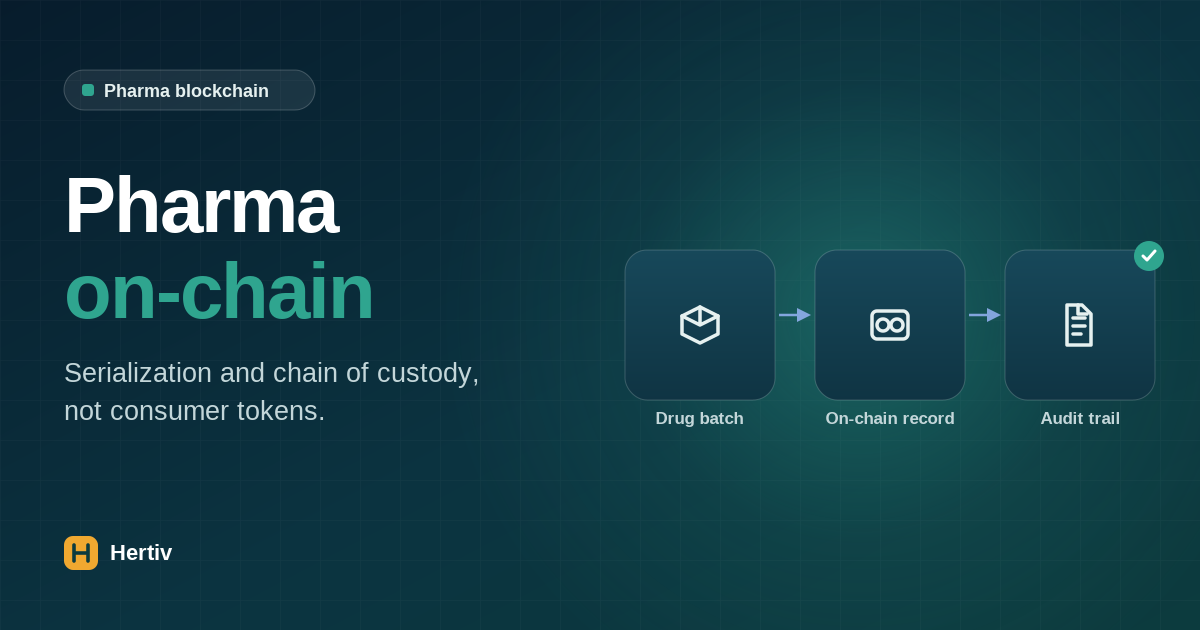
Blockchain in pharma is mostly about serialization, chain of custody and audit trails—not consumer tokens. Here is where it fits, what it costs and how to start.
On this page
Short answer
Blockchain development for pharmaceuticals means building shared, tamper-evident systems for drug serialization, chain of custody, clinical trial data integrity and supplier verification. Most value comes from permissioned networks that integrate with existing ERP and serialization systems, not from public chains or tokens.
What does blockchain development for pharmaceuticals actually mean?
Blockchain development for pharmaceuticals is the engineering work of building shared, tamper-evident ledgers that track drug units, batches, custody events and data integrity across companies that do not fully trust each other. It is closer to supply-chain infrastructure than to crypto.
The typical build has four parts: a permissioned ledger (Hyperledger Fabric is common, though other enterprise platforms work), integrations with ERP, manufacturing execution and serialization systems, identity and access control for each partner, and reporting that regulators and auditors can read. Public chains are rarely the right default because pharma data is commercially sensitive and partners need defined membership.
Which pharma use cases justify a blockchain?
The strongest cases share one trait: multiple organisations need a common record they cannot unilaterally edit. Here is a comparison of the realistic options.
| Use case | What it does | Typical data needed | Effort |
|---|---|---|---|
| Drug serialization and traceability | Tracks unit-level identity from packaging to dispense | Serial numbers, batch IDs, scan events | High |
| Chain of custody for cold chain | Records handoffs and temperature conditions | Sensor readings, custody signatures | Medium |
| Supplier and API provenance | Verifies origin of active ingredients | Supplier certificates, audit records | Medium |
| Clinical trial data integrity | Anchors trial documents and datasets | Document hashes, timestamps | Medium |
| Returns and recall management | Coordinates recalls across distributors | Batch lists, return scans | Medium |
| Credentialing for investigators | Shares verified qualifications | Credential hashes, issuer identity | Low |
| Patient consent tracking | Records consent changes across sites | Consent events, patient pseudonyms | High |
Serialization usually dominates because regulations in major markets already require unit-level tracking. Blockchain adds a shared view across contract manufacturers, distributors and pharmacies without one party owning the database.
Chain of custody is the second strongest case. Temperature excursions and handoff disputes are expensive, and a shared record shortens investigations.
Clinical trial integrity is real but narrower: anchoring document hashes proves a dataset existed in a given state at a given time. It does not replace electronic data capture systems.
Which blockchain platforms fit pharmaceutical supply chains?
Permissioned enterprise platforms fit best because membership, privacy and throughput matter more than public decentralization. Hyperledger Fabric is widely used in supply-chain consortia, with channels that let competitors share only what they must. Other enterprise options include R3 Corda for contract-style agreements between known parties, and enterprise deployments of Ethereum-compatible networks when teams want familiar tooling.
Public chains are worth considering only for narrow, non-sensitive proofs, such as timestamping a document hash. They are a poor fit for unit-level serialization data because of cost, privacy and unpredictable traffic.
Platform choice should follow integration reality. Ask which partners already run which systems, what identity provider they use, and whether the network will be hosted by one operator or several. A well-integrated Fabric network beats an elegant chain nobody can connect to. Hertiv's enterprise blockchain development work follows this integration-first pattern.
How do you integrate blockchain with ERP, MES and serialization systems?
Integration is the bulk of the work. The ledger should receive events from existing systems, not replace them. A practical pattern: serialization software remains the system of record for unit identity, and the ledger stores signed events that reference those units.
A typical integration sequence:
- Define canonical events: commissioned, aggregated, shipped, received, dispensed, returned, destroyed.
- Map each event to its source system and owner.
- Build an adapter layer that signs and submits events.
- Store only references and hashes on-chain; keep payloads in existing databases.
- Build reconciliation reports that compare ledger state with ERP state.
Expect integration effort to exceed ledger setup. Teams often underestimate the mapping work across contract manufacturers that use different naming conventions.
What does a pharmaceutical blockchain project cost and how long does it take?
Most first deployments are modest in scope and cost more in integration than in ledger licences. A pilot covering one product line and a handful of partners is typically a multi-month effort; a multi-country serialization network runs much longer. Cost ranges vary widely by scope, so treat any figure as indicative rather than quoted.
A realistic pilot includes:
- A permissioned network with two to five partners.
- Event adapters for one ERP and one serialization system.
- Identity and role management.
- An auditor-facing dashboard.
- A reconciliation report and exception workflow.
Example (hypothetical): a mid-sized manufacturer runs a pilot with three contract packagers. Before the pilot, batch discrepancies take an average of two days to resolve across email threads. After the pilot, the shared ledger gives each partner the same event history, so the team targets same-day resolution. The saving depends on how many discrepancies occur per month; the pilot exists to measure that, not to assume it.
If you are weighing scope, a short discovery phase with a blockchain consulting engagement usually prevents expensive rework later.
How do you start a blockchain project in pharma?
Start with a narrow, painful process and one willing partner group. Broad consortia sound impressive but stall; a focused pilot produces evidence.
A practical sequence:
- Pick a process with known friction, such as cold-chain handoffs or returns.
- Map the current data flow and identify who owns each record.
- Choose a permissioned platform and hosting model.
- Build event adapters for the two most important systems.
- Run a time-boxed pilot with clear success measures.
- Decide whether to scale based on measured exception reduction.
Success measures should be operational: time to resolve disputes, number of manual reconciliations, audit preparation effort. Avoid vanity metrics like transaction counts.
Legal and regulatory review belongs early, not at the end. Data-sharing agreements between competitors take time, and the ledger's privacy model must match what partners will actually accept.
What are common mistakes in pharma blockchain projects?
Most failures come from treating blockchain as the goal rather than a shared-record tool. The technical work is usually manageable; governance and scope are where projects break.
Common mistakes:
- No clear owner: a network without an operating entity stalls when the pilot ends.
- Replacing systems of record: the ledger should complement ERP and serialization, not duplicate them.
- Public chain by default: sensitive commercial data does not belong on a public ledger.
- Too many partners at once: governance complexity grows faster than technical complexity.
- No auditor view: if regulators and auditors cannot read the record easily, the value is limited.
- Ignoring data protection: pseudonymise patient-linked data and keep it off-chain.
- No exit plan: decide how partners leave and how data is retained before launch.
Key takeaways
- Focus on serialization, chain of custody and audit trails first; they map to existing regulatory obligations.
- Use permissioned networks where partners need a shared record without exposing commercial data.
- Integrate with ERP, MES and serialization platforms; blockchain should not become a second system of record.
- Keep patient and commercial data off-chain; store hashes and references on-chain.
- Start with one product line or one supplier group and measure exception handling time before scaling.
Frequently asked questions
Do pharmaceutical companies actually use blockchain?
Some do, mainly in supply-chain traceability pilots and consortia, often alongside existing serialization systems. Adoption is uneven because the technology adds most value when multiple organisations need a shared record. Many projects remain pilots rather than full production networks.
Is blockchain required for drug serialization compliance?
No. Serialization regulations require unit-level tracking, but they do not mandate blockchain. Companies can comply with conventional databases and interoperable data exchange. Blockchain is an option when partners want a shared, tamper-evident record without one party controlling it.
Can blockchain store patient data?
It should not. Ledgers are poor places for personal data because records are hard to delete and visible to network members. Store hashes, references or pseudonymous identifiers on-chain and keep patient data in systems designed for privacy and consent.
Which platform is best for pharma supply chains?
Permissioned platforms such as Hyperledger Fabric are common because they support known membership, private channels and enterprise integration. Corda and enterprise Ethereum-compatible networks are also used. The best choice depends on partners' systems, hosting preferences and privacy needs.
How long does a pharmaceutical blockchain pilot take?
A focused pilot with two to five partners and one or two system integrations typically takes a few months, depending on legal agreements and integration complexity. Multi-country networks take much longer because governance and data-sharing contracts dominate the timeline.
What is the first step for a pharma blockchain project?
Map one high-friction process, such as cold-chain handoffs or returns, and identify who owns each record. Then confirm that multiple organisations genuinely need a shared record. If they do, scope a small pilot with clear operational success measures.


