Blockchain Development for Education: How Schools Build It
Blockchain development for education builds credential systems schools and employers can verify. Learn the build choices, the flow, and the mistakes to avoid.
On this page
Short answer
Blockchain development for education is the work of building systems that record certificates, transcripts, credits and payments on a shared ledger, so a school can issue a record once and any employer or institution can verify it without calling the issuer. It covers the choice of network, the design of the credential, the connection to school systems and the wallet students use.
What is blockchain development for education?
Blockchain development for education is the building of software that puts student records on a shared ledger. A school issues a certificate, a transcript entry or a credit as a signed record, and that record can be checked by anyone with the right key, without asking the school to confirm it again.
It differs from simply using blockchain in education. Using it means adopting a product that already exists. Developing it means making the choices underneath: which network to use, what a credential contains, how it is signed, how it is revoked, and how it connects to the systems a school already runs. Those choices decide whether the system is trusted, affordable and legal to run.
The work is done by a small team in most cases: one or two developers, a product owner from the school, and someone who understands student records and privacy rules. The school does not need a large engineering team, but it does need to own the rules, because the ledger will outlive any single vendor. For what blockchain does in education, see blockchain in education.
What can schools build on a blockchain?
Schools can build a small set of systems on a blockchain, and the useful ones share a pattern: several parties need to trust the same record, and checking it today is slow or manual.
| Build | What it does | Who uses it |
|---|---|---|
| Digital certificates | Issues diplomas anyone can verify | Graduates, employers |
| Transcripts and credits | Records courses and credits per student | Students, other schools |
| Micro-credentials | Records short courses and badges | Learners, employers |
| Identity and access | Proves a student is enrolled | Students, services |
| Payments and funding | Tracks fees, grants and aid | Finance teams, funders |
| Content licensing | Records who may use course material | Teachers, publishers |
Digital certificates are the usual starting point, because they are simple, high volume and easy to verify. Transcripts and micro-credentials come next, once the certificate flow works. Payments and funding need more legal care, so they usually come later, after the school has a working system and a clear privacy review.
How do you choose the platform?
Choosing the platform means deciding between a public chain, a permissioned chain and a private ledger, and the choice should follow who needs to verify the record. If employers anywhere in the world must check a certificate, a public chain fits. If only a group of schools and regulators needs to check it, a permissioned chain is simpler and cheaper to run.
Five questions settle the choice. First, who verifies the record, and where are they? Second, what does a transaction cost, and who pays it? Third, how fast must a record appear after it is issued? Fourth, what happens when a record must be corrected or revoked? Fifth, where is the personal data stored, and does the law allow it on a ledger?
The last question is the one teams most often skip. A ledger is hard to change, so personal data such as names and grades should usually stay off the chain, with only a hash or a reference stored on it. The full record lives in the school's own system, and the ledger proves the record has not been changed. For a similar build-angle article in another sector, see blockchain development for retail.
How does a credential system work end to end?
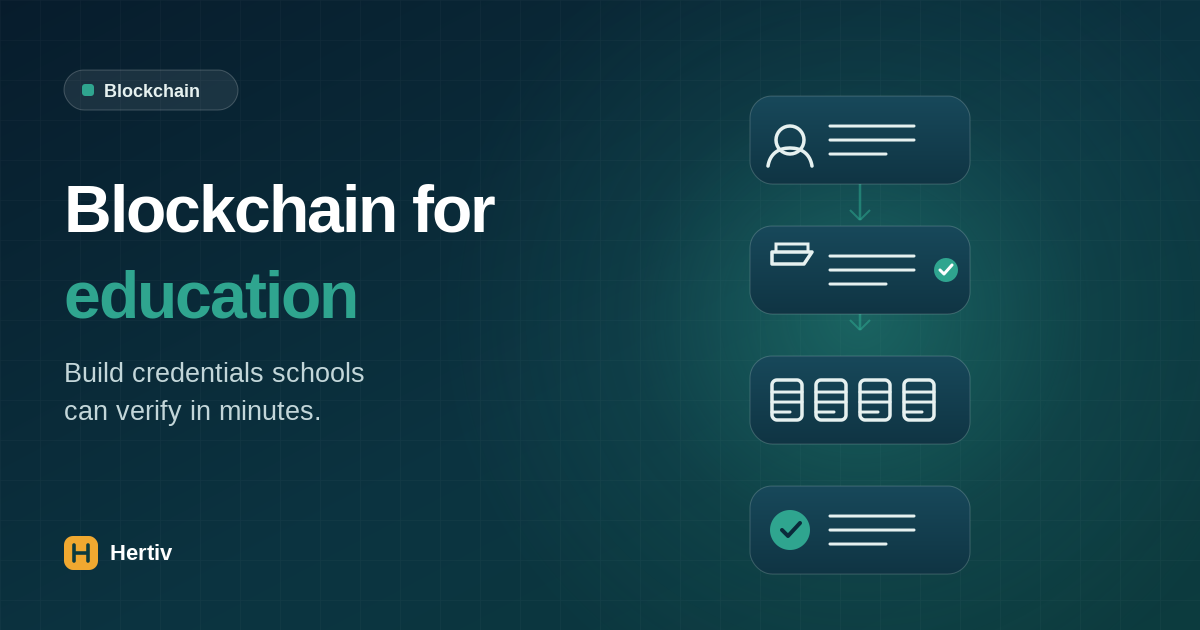
A credential system works in six steps, from the school deciding what a certificate contains to an employer checking it. Each step has one owner, and the steps are worth building in order.
- Define the credential. Decide what fields it holds: student name, course, date, issuer and a unique reference. Keep it small.
- Issue and sign. The school signs the credential with its key and writes a hash of it to the ledger. The signed credential goes to the student's wallet.
- Store the full record. The complete record stays in the school's system, not on the chain. The ledger holds only the proof.
- Share the credential. The student shares a link or a code with an employer, who opens it in a verifier.
- Verify. The verifier checks the signature, checks the hash against the ledger, and checks that the credential has not been revoked.
- Revoke when needed. If a certificate was issued in error, the school adds it to a revocation list that verifiers check.
The verifier is the part employers actually touch, so it should work in a browser with no account and no software to install. If verification needs a special app, employers will go back to calling the school, and the system loses its point.
How do you connect it to existing school systems?
Connecting the system means linking the ledger to the student information system, the learning platform and the wallet, without replacing any of them. The ledger is a new layer, not a new school system.
The student information system stays the source of truth for enrolment, grades and completion. When a student finishes a course, the system sends the result to the credential service, which signs it and writes the proof to the ledger. The learning platform does not need to change, except to show the student a link to their wallet once the credential is issued.
The wallet is where the student keeps the credential. It can be a mobile app, a browser wallet or a simple download, but it must let the student share the credential without the school's help. If the student loses access to the wallet, the school must be able to reissue the credential, so the system needs a recovery path. For the wider education picture, see AI for education and edtech.
Example: a college issuing digital certificates
Example (hypothetical): a college issues 2,000 certificates a year. Today, each verification request takes a staff member about 15 minutes to answer, so 2,000 verifications take 2,000 times 15 minutes, which is 30,000 minutes, or 500 hours of staff time a year.
With the new system, an employer checks the certificate in a browser verifier in about 2 minutes. The same 2,000 checks take 2,000 times 2 minutes, which is 4,000 minutes, or about 67 hours of employer time, and no staff time at all. The college saves about 500 hours a year, and the employer gets an answer in minutes instead of days.
The college still keeps the full records in its own system and only the proof goes on the ledger. If a certificate was issued with the wrong name, the college corrects its record and adds the old credential to the revocation list, so verifiers reject it. The build took a small team a few months, starting with certificates only, and transcripts were added once the first flow worked.
What are the common mistakes?
The most common mistakes in blockchain development for education are putting personal data on the chain, building before the rules are agreed, and forgetting the verifier and the wallet.
- Personal data on the ledger. Names and grades on a chain are hard to remove. Store only a hash or a reference on the chain.
- No revocation plan. Certificates are sometimes issued in error. Build the revocation list before issuing the first one.
- Building before the rules are agreed. Who signs, who verifies and who fixes mistakes must be decided before the code is written.
- A verifier nobody can use. If employers need an account or special software, they will call the school instead.
- No wallet recovery. Students lose phones and passwords. A system without reissue leaves them locked out of their own records.
- Starting with everything at once. Certificates, transcripts, payments and identity in one build is too much. Start with certificates.
Key takeaways
- Blockchain development for education builds credential and record systems schools can issue once and anyone can verify
- Start with digital certificates — simple, high volume and easy to verify — then add transcripts and micro-credentials
- Keep personal data off the chain: store a hash or reference on the ledger and the full record in the school's system
- The verifier matters most: it must work in a browser with no account, or employers will go back to calling the school
- Agree who signs, who verifies and how revocation works before writing any code
Frequently asked questions
How is blockchain development for education different from using blockchain in education?
Using blockchain means adopting a product that already exists. Developing it means making the choices underneath: the network, the credential design, the signing and revocation rules, and the connection to school systems. Development decides whether the system is trusted and legal to run.
Which blockchain should a school use?
It depends on who must verify the record. A public chain fits when employers anywhere must check a certificate. A permissioned chain fits when only a group of schools and regulators needs to check it, and it is usually simpler and cheaper to run.
Is student data stored on the blockchain?
It should not be. Personal data such as names and grades is hard to remove from a ledger, so the full record stays in the school's own system and only a hash or a reference goes on the chain. The ledger proves the record has not been changed.
How long does it take to build a credential system?
A small team can build a certificate flow in a few months, starting with one credential type and one verifier. Adding transcripts, micro-credentials and wallet recovery takes longer, and the rules and privacy review usually take as much time as the code.
What happens if a certificate is issued by mistake?
The school corrects its own record and adds the old credential to a revocation list that verifiers check. The wrong entry stays on the ledger, but verifiers reject it, which is why the revocation list must exist before the first credential is issued.
Do students need a crypto wallet to use their certificate?
They need a way to hold and share the credential, which can be a mobile app, a browser wallet or a simple download. The school must offer a recovery path, so a student who loses a phone can have the credential reissued.


