Blockchain in Cosmetics: How It Fights Fakes and Builds Trust
Blockchain gives every cosmetic product a checkable record, from ingredient to shelf. Here is how brands use it against fakes, for sourcing proof and loyalty.
On this page
Short answer
Blockchain in cosmetics is a shared record that tracks a product from its ingredients to the shelf, so buyers and brands can check where it came from and whether it is genuine. Brands use it to fight counterfeits, prove sourcing claims and run token-based loyalty, usually starting with one product line and a simple scan.
What is blockchain in the cosmetics industry?
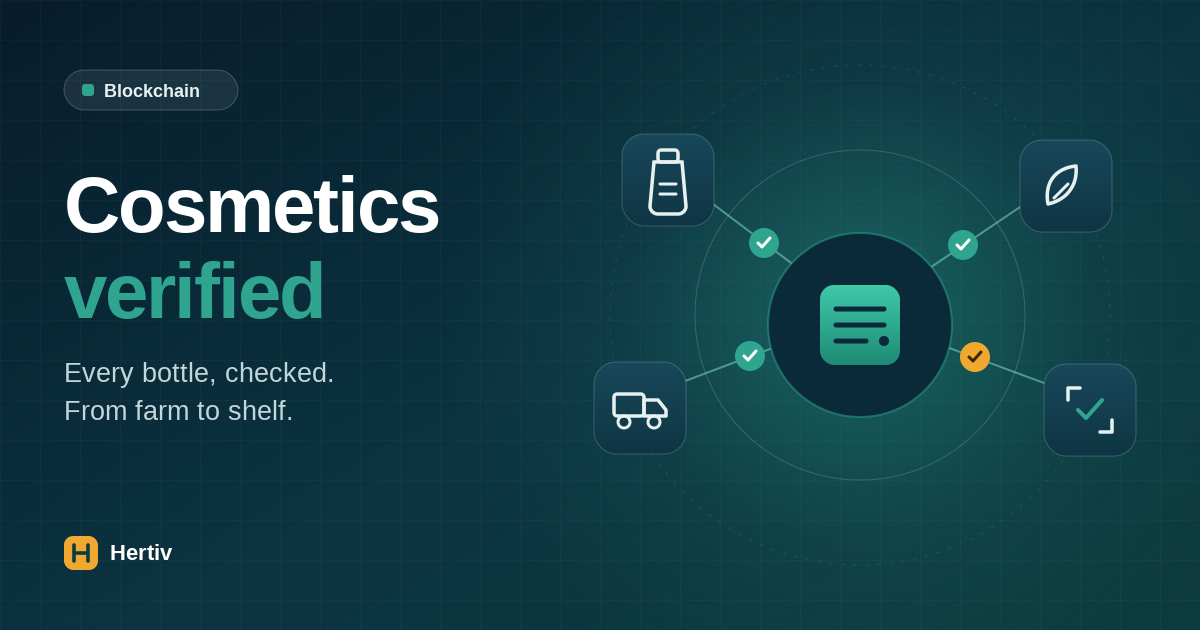
Blockchain in the cosmetics industry is a shared, tamper-resistant record that tracks a product from its raw ingredients to the shelf. Each step, from sourcing and manufacturing to shipping and sale, is written to the record as a separate entry that cannot be quietly changed later.
The record usually sits on a public or permissioned ledger, and customers reach it by scanning a code on the pack. A scan shows the batch, the factory, the ingredients and the shipping route, instead of asking the buyer to trust a label. The underlying idea is the same as in any blockchain system: many copies of the same record, so no single party can rewrite it.
Cosmetics is a good fit for this because the products are small, high-value and easy to copy, and because buyers care about what goes on their skin. A record that proves origin and handling answers both concerns at once.
| Use | What the record shows | Who it helps |
|---|---|---|
| Authenticity | Batch, factory, serial code | Buyer, brand |
| Ingredient sourcing | Origin, supplier, certificates | Brand, regulator |
| Supply chain | Handover, storage, shipping | Distributor, retailer |
| Loyalty rewards | Points earned and spent | Buyer, brand |
How does blockchain fight counterfeit cosmetics?
Blockchain fights counterfeits by giving every unit a unique, checkable identity instead of a label that anyone can copy. The brand records each batch and each serial code on the ledger when the product leaves the factory, so the record exists before the product reaches a shop.
When a buyer scans the code, the system checks it against the ledger. A code that was never issued, or one that has already been scanned many times in different places, is flagged as suspect. The check takes seconds and needs no special app beyond a phone camera.
A good check shows the buyer:
- The batch number and the factory that made it
- The date of manufacture and the expiry date
- How many times the code has been scanned before
- Whether the seller is an authorised stockist
This does not stop fakes from being made. It makes them easy to spot, which is what matters: a fake that fails a scan in a shop loses its value, and the brand learns where suspect stock is appearing.
What does ingredient and sourcing proof look like?
Ingredient and sourcing proof is a chain of signed records that shows where each ingredient came from and who handled it. A supplier records the harvest or batch, the manufacturer records the mix, and each handover is added to the same record.
For buyers, the visible result is a short, readable history: the plant extract came from a named farm, the preservative meets a named standard, and the product was made in a named factory on a named date. Claims such as organic, vegan or cruelty-free can be tied to the certificate that backs them, rather than standing alone on the pack.
For brands, the same record shortens audits. Instead of collecting paper certificates from every supplier after a problem, the team pulls the batch record and sees which suppliers and certificates were involved. That matters most during a recall, when hours count and guessing is expensive.
How do token rewards and loyalty work?
Token rewards turn loyalty points into digital tokens that live in the customer's wallet instead of in the brand's database. A purchase, a review or a referral earns tokens, and the customer spends them on products, samples or early access to a new range.
Because the tokens sit on a ledger, they can move between a brand's shops, its website and partner brands without a central points database. A customer who earns tokens in one country can spend them in another, and the brand can see redemption patterns without holding personal data.
The risk is complexity. If claiming a reward needs a wallet, a fee and a tutorial, most customers will not bother. The brands that make it work keep the wallet invisible and let customers earn and spend inside the normal checkout flow. Tokenised loyalty is one of the simpler blockchain in retail uses, because the amounts are small and the rules are easy to explain.
Can customers pay with crypto for cosmetics?
Yes, some cosmetics brands accept crypto payments, usually through a payment gateway that converts the crypto to local currency at checkout. The customer pays with a wallet, the brand receives the usual currency, and the price does not move with the market after the sale.
The main reasons brands try it are reach and fees: customers in countries with limited card access can still buy, and cross-border payments can settle faster than card networks. The main reasons most brands wait are tax rules, refund handling and the small share of customers who would actually use it.
A sensible test is a single online store with one gateway, a clear refund policy in local currency, and a limit on which coins are accepted. If the volume stays tiny after a few months, the brand can drop it without having rebuilt its checkout.
How do you start using blockchain in a cosmetics brand?
You start with one problem and one product line, not with a full platform. Pick the issue that costs the most, whether that is counterfeits, recall speed or loyalty churn, and build the smallest record that solves it.
- Pick one product line and one use, such as authenticity checks for a best-selling serum.
- Give every unit a unique code and record batches on a ledger at the factory.
- Build the scan page so a buyer sees the batch history in plain language.
- Train support and shop staff on what a failed scan means and what to do next.
- Measure scans, failed scans and support tickets for three months, then decide whether to expand.
Keep the customer experience simple. If scanning needs an app download or a wallet, most buyers will skip it, and the record will sit unused.
Example (hypothetical): a skincare brand checks a fake
Example (hypothetical): a skincare brand sells 20,000 bottles of its best-selling serum each month. It prints a unique code on every bottle and records each batch on a ledger when the bottles leave the factory.
In the first month, customers scan 6,000 codes. Of those, 180 scans flag a code that was never issued or had already been scanned in another city. That is 3% of scans, and it points to two suspect batches sold through one unauthorised seller.
The brand pulls the two batches from that seller, warns its authorised shops, and adds a check at the warehouse so future batches are verified before dispatch. The cost is the code printing and the scan page; the saving is the support time and refunds that 180 fake bottles would have caused.
What are the common mistakes?
The most common mistakes are building the ledger before choosing the problem, hiding the record behind an app, and promising more than the record proves.
- Recording everything. A ledger that tracks every minor step costs more to run than the problem it solves.
- Requiring an app or wallet to scan. Most buyers will not install one for a single product.
- Claiming the ledger proves quality. It proves origin and handling, not that a formula works or is safe.
- Ignoring returns and refunds. A code that cannot be voided after a return will be scanned again by the next buyer.
- No plan for suspect scans. A failed scan with no support path leaves the customer angry and the brand blind.
Key takeaways
- Blockchain gives each cosmetic product a checkable history, from ingredients to the shelf
- A unique code per unit is what makes counterfeits easy to spot at the point of sale
- Sourcing proof ties claims such as organic or vegan to the certificate behind them
- Token loyalty works only when the wallet stays invisible inside normal checkout
- Start with one product line and one use, then measure scans before expanding
Frequently asked questions
Can blockchain prove a cosmetic is safe to use?
No. A ledger proves origin, handling and batch history, not safety or effectiveness. Safety still depends on the formula, testing and regulation. What the record does is make it possible to check which batch a customer bought and which ingredients it contains.
Do customers actually scan product codes?
Some do, mainly when the product is expensive or the brand is often copied. Scan rates rise when the code is printed clearly on the pack and the result page is simple. Brands that require an app download see far fewer scans than brands that work with a phone camera alone.
Is blockchain in cosmetics only for luxury brands?
No. Luxury brands were first because counterfeits hurt them most, but mid-priced brands use the same pattern for sourcing proof and recalls. The cost is mostly the code printing and the scan page, so a single product line can be a cheap test.
What is the difference between a QR code and a blockchain record?
A QR code is only a link to information, and anyone can print a copy of it. A blockchain record is the history behind the code: the batch, the factory and the handovers, stored so it cannot be quietly changed. The code is the key; the ledger is what makes the answer trustworthy.
Can small brands afford this?
Yes, if they keep the scope small. One product line, one ledger, one scan page and a batch code is a modest project. The expensive version is a full platform covering every product and supplier at once, which most small brands do not need.
Does token loyalty need customers to own crypto?
Not if the brand hides the wallet. Most token loyalty schemes let customers earn and spend inside the normal shop or app, with the tokens held by the brand on their behalf. Customers only need a wallet of their own if the brand wants the tokens to move freely between brands.


