Blockchain Consulting Companies for Startups: 6 to Shortlist
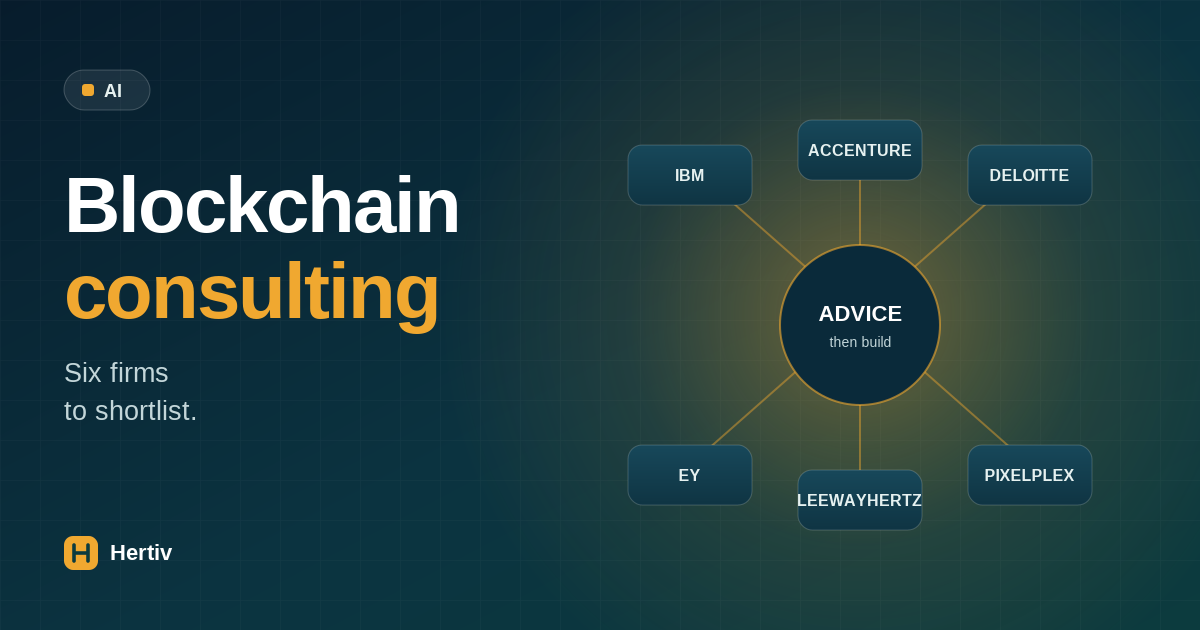
Blockchain consulting helps a startup choose the right chain, design the token model and pass compliance checks. Here are six firms worth a shortlist.
On this page
Short answer
Blockchain consulting companies help startups make the decisions that come before the code: which chain to build on, how the token model should work, what the compliance risks are and whether a blockchain is even the right tool. The six firms below are known for advisory work, and each suits a different kind of startup.
Which blockchain consulting companies should startups shortlist?
Startups shortlist blockchain consulting firms when the decision matters more than the build: chain choice, token design, security review and compliance. The table below compares six firms on focus and fit.
| Firm | Main focus | Best for |
|---|---|---|
| IBM | Enterprise blockchain and supply chains | Startups selling to large firms |
| Accenture | Strategy, digital assets, CBDC work | Regulated markets and pilots |
| Deloitte | Audit, tax and digital asset advisory | Compliance-heavy projects |
| EY | Tax, audit and blockchain analytics | Token and accounting questions |
| LeewayHertz | Product strategy and token design | Early-stage product teams |
| PixelPlex | Consulting and custom builds | Teams that need advice and delivery |
Advisory firms differ from development shops. A development shop sells engineering hours; a consulting firm sells a recommendation, a design and a plan, and may or may not build it. Startups that already have engineers usually need the first, while teams without a technical co-founder often need both.
Fees vary widely and are usually scoped per engagement, so see the vendor site for current rates. The shortlist below focuses on what each firm is actually good at, so a startup can match the firm to the decision it faces.
<h3>1. IBM: best for startups selling to large firms</h3>
IBM is best for startups that sell into large enterprises, because its blockchain practice is built around enterprise blockchain and supply chains, trade finance and permissioned networks. A startup that needs to integrate with a bank or a logistics group will find IBM's credibility and partner network useful in the room.
The firm works mainly on Hyperledger Fabric and enterprise Ethereum, and its consulting covers architecture, governance and integration with existing systems. It is not a cheap option, and it suits teams with a funded pilot rather than a pre-seed idea.
Pros
- Strong enterprise credibility and partner network
- Deep experience with permissioned networks and supply chains
Cons
- Engagements are large and slow to start
- Less suited to small, fast-moving consumer products
<h3>2. Accenture: best for regulated markets and pilots</h3>
Accenture is best for startups working in regulated markets, because its digital asset practice covers strategy, CBDC pilots and custody design alongside the technology. It has run central bank pilots and worked with large financial institutions on tokenised assets.
The firm is useful when the startup needs a credible plan to show a regulator or a bank partner, not just a working prototype. Its teams are large and its process is formal, so it fits funded teams with a clear pilot in mind.
Pros
- Broad experience across banking, CBDCs and digital assets
- Strong process for pilots with regulators and banks
Cons
- High fees and long sales cycles
- Overkill for a simple product decision
<h3>3. Deloitte: best for compliance-heavy projects</h3>
Deloitte is best for compliance-heavy blockchain projects, because it combines audit, tax and advisory teams under one roof. A startup planning a token sale or a regulated product can get accounting, tax and control advice from the same firm.
The firm's blockchain work covers digital asset strategy, controls and reporting, and it is often the right call when the hardest questions are about accounting treatment and regulatory filings rather than chain choice.
Pros
- Audit, tax and advisory in one engagement
- Well suited to token sales and regulated products
Cons
- Consulting fees are high for early-stage teams
- Less hands-on with product and token design
<h3>4. EY: best for token and accounting questions</h3>
EY is best for token and accounting questions, because its blockchain practice grew out of audit and tax work, including tools for analysing on-chain transactions. Startups that need to account for tokens, track cost basis or report crypto holdings will find that background useful.
The firm also advises on smart contract risk and internal controls, which matters once a product holds user funds. It is a good fit when the startup's biggest risk is getting the numbers wrong rather than picking the wrong chain.
Pros
- Strong accounting and on-chain analytics background
- Useful for reporting and internal controls
Cons
- Less focused on consumer product strategy
- Engagements can be slow for small teams
<h3>5. LeewayHertz: best for early-stage product teams</h3>
LeewayHertz is best for early-stage product teams, because it works as a product consultancy that covers strategy, token design and prototyping for startups. Its team is smaller than the large firms, which makes it easier to start quickly and to iterate on the product idea itself.
The firm has worked on tokenised assets, DeFi products and enterprise pilots, and it can carry a project from discovery through to a working build. That suits a startup that needs both the advice and the first version, without managing two vendors.
Pros
- Startup-friendly size and pace
- Covers strategy, token design and build in one team
Cons
- Smaller brand weight with large enterprise buyers
- Less audit and tax depth than the large firms
<h3>6. PixelPlex: best for teams that need advice and delivery</h3>
PixelPlex is best for teams that need advice and delivery together, because it combines blockchain consulting with custom development. A startup can get chain selection, architecture and a working product from the same engagement.
The firm has worked on tokenisation, DeFi and enterprise blockchain projects, and its consulting covers feasibility, architecture and security review. It suits teams that have a product idea and a budget, and want one partner to take it from plan to launch.
Pros
- Consulting and development under one roof
- Practical focus on shipping a working product
Cons
- Less suited to pure strategy or audit-only work
- Smaller compliance practice than the large firms
How to choose a blockchain consulting company
You choose a blockchain consulting company by matching the firm to the decision you face, not by brand size. A token sale needs different advice from a supply chain pilot, and the wrong firm will answer the wrong question well.
- Name the decision. Write down the one choice the engagement must resolve, such as chain selection, token design or regulatory approach.
- Ask for similar work. Ask each firm for two past projects in your sector and what changed as a result, not just a client list.
- Check who does the work. Ask which senior people will be on the project each week, since large firms can staff juniors after the sale.
- Agree the deliverable. A useful engagement ends with a written recommendation, a design and a plan, not just a slide deck of options.
- Compare total cost. Include travel, licences and follow-up reviews, and see the vendor site for current rates before signing.
Start with a short paid discovery of two to four weeks. It tests the working relationship cheaply and gives you a recommendation you can act on, whether or not you extend the engagement.
What are the common mistakes?
The most common mistakes when hiring a blockchain consulting firm are hiring for brand rather than fit, skipping the token economics, and letting the engagement end without a buildable plan.
- Hiring the biggest brand. A large firm is the right call for a bank pilot, but it can be slow and costly for an early product decision.
- Skipping token economics. A token that nobody needs to hold will not hold value. Ask the firm to model supply, demand and incentives, not just the smart contract.
- No written recommendation. If the engagement ends with options and no decision, the startup has paid for a workshop, not for advice.
- Ignoring compliance. A design that a regulator will not accept is not a design. Bring the compliance questions into the first week.
- No handover plan. The team must be able to run and change the system after the consultants leave, so ask for documentation and training as part of the scope.
Key takeaways
- Consulting firms sell a recommendation and a plan; development shops sell engineering hours
- Match the firm to the decision: token sales need tax and audit advice, pilots need enterprise credibility
- Ask for two similar past projects and the names of the senior people who will do the work
- Start with a short paid discovery before committing to a large engagement
- Insist on a written recommendation, a buildable plan and a handover
Frequently asked questions
What does a blockchain consulting company do?
A blockchain consulting company advises on the decisions before the build: which chain to use, how the token model should work, what the security risks are and what the regulators expect. Some firms also build the product, but the advice itself is the core service.
How much does blockchain consulting cost?
Fees vary by firm, scope and region, and most engagements are priced per project rather than per hour. A short discovery of two to four weeks costs far less than a full design and build. See the vendor site for current rates before budgeting.
Do startups need a consulting firm, or a developer?
It depends on the gap. A team with strong engineers usually needs advice on chain choice, token design and compliance. A team without technical staff often needs both advice and a build partner, in which case a firm that does both can be simpler.
What should a consulting engagement deliver?
It should deliver a written recommendation, an architecture or token design, a risk and compliance review, and a plan with costs and timeline. If the output is only a slide deck of options, the engagement has not finished the job.
Can a consulting firm help with tokenomics?
Yes, token economics is a core part of blockchain consulting. A good firm models supply, demand, incentives and distribution, and tests whether the token is actually needed, rather than adding one because the market expects it.
How do I check a firm's track record?
Ask for two past projects in your sector, the names of the people who did the work, and what changed for the client. Then speak to one reference directly. A firm that cannot name a reference for similar work is a warning sign.


