What Does a Blockchain App Cost to Build in the UAE?
A blockchain app in the UAE costs more than elsewhere, because regulation, free zone setup and audit work sit on top of the build. Here is what each part costs.
On this page
Short answer
A blockchain app built in the UAE typically costs more than the same app in a less regulated market, because licence advice, free zone setup, security audits and local talent add real cost on top of design and code. The build itself is the largest share, but the UAE-specific items can add a large share again, so budget them from the start.
What does a blockchain app cost to build in the UAE?
A blockchain app in the UAE is an app whose core logic runs on smart contracts, with a web or mobile front end, and it is built inside a regulated market. Dubai has the Virtual Assets Regulatory Authority (VARA), and Abu Dhabi Global Market (ADGM) has its own framework for virtual assets.
The cost comes in six parts, and the build is only one of them. The table below shows the parts and what each one covers.
| Cost part | What it covers | When you pay |
|---|---|---|
| Discovery | Scope, chain choice, licence mapping | Before the build |
| Design | Screens, flows, wallet experience | Early in the build |
| Smart contracts | Contract code and tests | During the build |
| Back end and apps | APIs, database, mobile or web app | During the build |
| Audit | Independent security review | Before launch |
| Launch | Deployment, listing, support setup | At launch |
No fixed price fits every app. A simple wallet or loyalty app costs far less than an exchange or a token platform, because the scope, the audit and the licence work are all larger.
What changes the price of a blockchain app?
Four factors move the price most: scope, chain, audit depth and integrations. Each one is a decision you make early, and each one is hard to change late.
Scope is the biggest lever. An app with one contract and a simple front end is a small build. An app with several contracts, a marketplace, a token and an admin panel is a large one, and the testing alone can double the work.
Chain choice matters too. Building on Ethereum means higher gas costs for users and more audit attention, while a layer 2 or a sidechain can be cheaper to run but needs its own integration work. The choice should follow the users, not the hype.
Audit depth is the third factor. A short review of a simple contract costs less than a full audit of a complex system with several contracts and upgrade paths. If the app holds user funds, the audit is not optional, and it should be budgeted as a separate line.
Integrations are the fourth factor. Wallets, payment rails, identity checks and oracles each add work and each need testing. An app with five integrations costs more than the same app with one.
UAE costs that other markets do not have
Building in the UAE adds three cost factors that a project elsewhere may not have: regulator engagement, free zone setup and the local talent market. Each one is manageable, but none is free.
Regulation is the largest. Depending on the activity, a project may need approval or a licence from a body such as VARA in Dubai or a financial free zone regulator. Legal advice, licence applications and compliance reporting add weeks and fees before any code is written.
Free zone setup is the second factor. Many Web3 teams register in a UAE free zone, which involves company formation, office or flexi-desk costs and annual renewal. These are business costs, not development costs, but they belong in the project budget.
The third factor is talent. The UAE has a growing pool of blockchain developers, but senior smart contract engineers are still scarce, so rates sit above many offshore markets. Hiring locally also means visa and employment costs that a fully remote team avoids. A blockchain consulting review early on can map which activities need a licence.
What does it cost to run after launch?
Running a blockchain app after launch has its own costs: hosting, monitoring, audits of later changes, support and compliance reporting. These are often left out of the build budget, and they surprise teams in the first year.
Hosting and monitoring cover the servers, the node access, the indexers and the alerting that tells you when something breaks. A small app can run on modest infrastructure, but an app with real users needs monitoring around the clock.
Later audits are the second running cost. Every material change to the contracts should be reviewed before it goes live, and the review costs money each time. Teams that skip this step save money once and risk far more later.
Support and compliance are the third running cost. Users need help with wallets and transactions, and regulators need reports. Budget for both from the start, because a launch without support will lose users within weeks.
How to budget a blockchain app in the UAE
Budget in five steps, and keep the UAE-specific items as separate lines so they cannot be hidden inside the build quote.
- Write the scope in one page. List what users do, which chain it runs on, and what must happen on-chain versus off-chain.
- Get the licence picture first. Ask a local adviser which activities need a licence and what the application involves, before you price the build.
- Price the build and the audit separately. Ask for the build, the audit and the launch as three lines, so you can see what each one costs.
- Add the free zone and setup costs. Include company formation, office costs and annual renewal in the same budget.
- Reserve a running-cost budget. Set aside a monthly figure for hosting, monitoring, support and later audits, and review it quarterly.
Compare quotes by scope, not by price. The cheapest quote is often the one that left the audit or the licence work out. See how much a tokenization platform costs for a related cost breakdown.
Example (hypothetical): a Dubai loyalty-token app
Example (hypothetical): a Dubai retailer wants a loyalty-token app where customers earn tokens for purchases and redeem them in store. The app has one token contract, a mobile app and an admin panel.
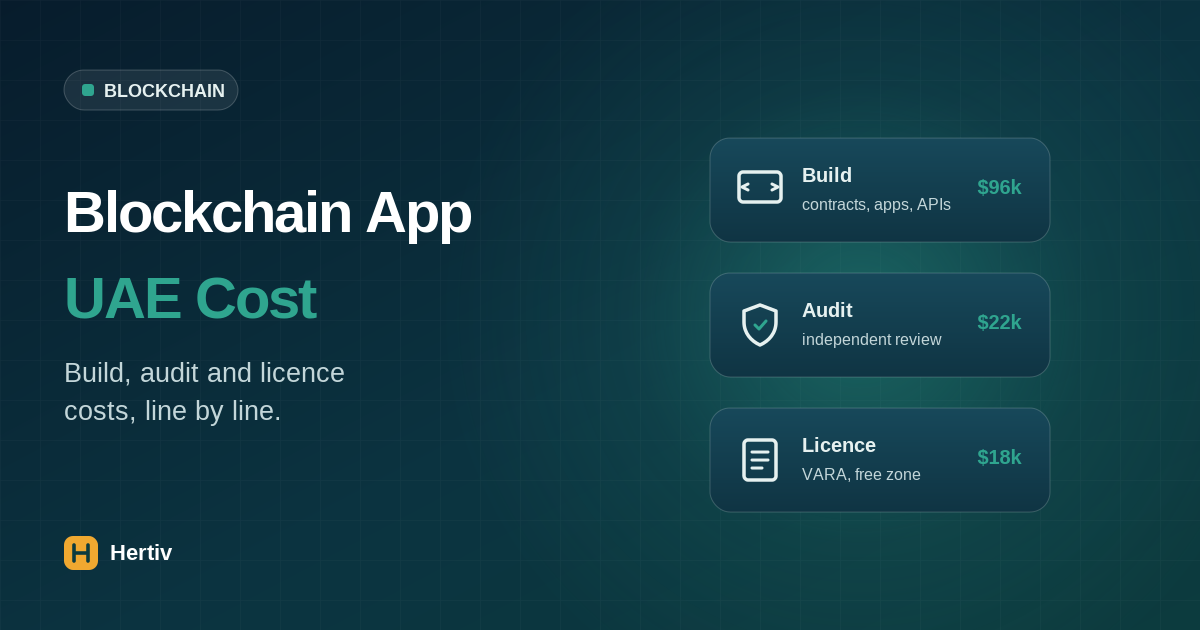
The build budget is $150,000. Discovery and licence mapping cost $18,000, the build costs $96,000, the audit costs $22,000 and the launch costs $14,000. The arithmetic adds up: $18,000 + $96,000 + $22,000 + $14,000 = $150,000.
Running costs are $4,500 a month, which is $54,000 a year, covering hosting, monitoring, support and one later audit. The free zone setup and licence fees sit outside this figure, because they are business costs rather than build costs.
The owner keeps a reserve of $20,000 for changes after launch, because the first real users always find something the plan missed. The total first-year figure is $150,000 + $54,000 + $20,000 = $224,000, and that is the number the board approves.
Common mistakes when budgeting a blockchain app in the UAE
The most common budgeting mistakes are treating the build as the whole cost, skipping the audit, and pricing the licence work last. Each one turns a planned budget into an overrun.
- Forgetting the licence work. Legal advice and licence applications take weeks and cost real money; start them before the build.
- Skipping the audit. An unaudited contract that holds user funds is a risk no launch should take.
- Comparing quotes by price only. The cheapest quote often leaves out the audit, the licence work or the support period.
- No running-cost budget. Hosting, monitoring and support start on day one and continue every month.
- No reserve for change. Real users find gaps the plan missed; a reserve of 10 to 15 percent of the build is a sensible buffer.
- Choosing the chain by price alone. The cheapest chain is not the right one if your users and your partners are elsewhere.
If you want the budget checked against a real scope, blockchain development support can price the build and the audit separately.
Key takeaways
- The build is the largest cost, but UAE licence, free zone and audit work add a large share again
- Scope, chain, audit depth and integrations are the four factors that move the price most
- Regulation is the largest UAE-specific cost; start the licence picture before the build
- Running costs start on day one: hosting, monitoring, support and later audits
- Budget the build, the audit and the licence work as three separate lines
Frequently asked questions
How much does a blockchain app cost to build in the UAE?
There is no fixed price, because scope, chain, audit depth and integrations move the cost. A simple loyalty or wallet app costs far less than an exchange or token platform, and UAE licence and free zone work add cost on top of the build.
Do I need a licence to launch a blockchain app in the UAE?
It depends on the activity. Some apps need approval or a licence from VARA in Dubai or a financial free zone regulator, while others do not. Ask a local adviser before you price the build, because the answer changes the budget.
What is the biggest extra cost in the UAE compared with other markets?
Regulation is usually the largest, followed by free zone setup and the local talent market. Legal advice, licence applications and compliance reporting add weeks and fees before any code is written.
Is a security audit required for a blockchain app in the UAE?
An audit is not always a legal requirement, but it is expected when the app holds user funds or tokens. Skipping it saves money once and risks far more later, so budget it as a separate line.
What does it cost to run a blockchain app after launch?
Running costs cover hosting, node access, monitoring, support, compliance reporting and later audits. A small app can run on modest infrastructure, but a live app with real users needs monitoring and support from day one.
Should I hire locally in the UAE or use a remote team?
Many teams mix both: local staff for compliance, partnerships and support, and remote engineers for the build. Senior smart contract engineers are scarce locally, so local rates sit above many offshore markets.


