What Does Billing Software Cost to Build?
Billing software usually costs between $80,000 and $300,000 to build for a first version, depending on invoicing, subscriptions, tax rules and payment integrations.
On this page
Short answer
Billing software is software that creates invoices, charges customers, handles subscriptions and tracks payments. A first version for a small business typically costs $80,000 to $300,000 to build, depending on the number of payment methods, tax rules and integrations it must support.
What is billing software?
Billing software is software that turns products and services into charges, invoices and payments. It creates invoices, applies taxes and discounts, charges cards or bank accounts, and records what each customer owes and has paid.
Most billing products cover a core loop: price a product, bill the customer, collect the payment, and reconcile the result. Larger systems add subscriptions, usage-based pricing, dunning for failed payments, and credit notes.
Billing is close to money, so accuracy matters more than speed. A wrong invoice or a double charge erodes trust fast, which is why billing projects spend more time on testing and edge cases than many other products. For a first build, see SaaS development services.
What drives the cost of billing software?
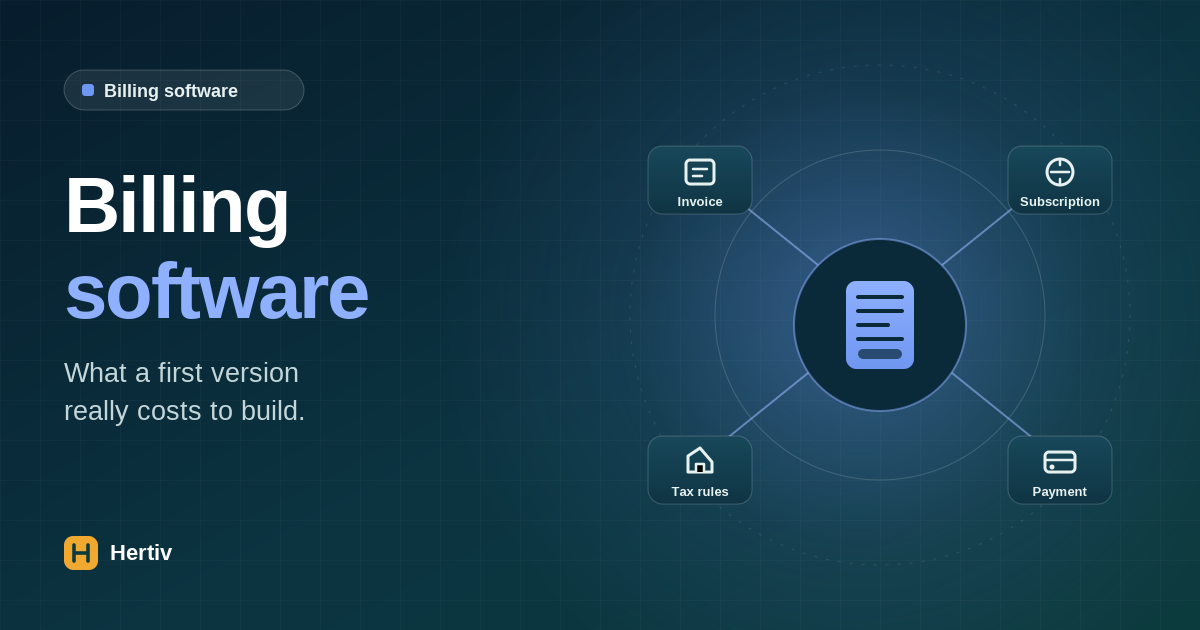
The cost of billing software is driven by pricing complexity, payment methods, tax rules and integrations. A simple invoicing tool is far cheaper than a subscription platform with usage metering and multi-currency support.
| Cost driver | Simple build | Complex build |
|---|---|---|
| Pricing model | Fixed prices, one-off invoices | Subscriptions, usage tiers, discounts |
| Payment methods | Cards only | Cards, bank debit, wallets, invoicing |
| Tax handling | One country, one rate | Multi-country VAT and sales tax |
| Integrations | One payment provider | CRM, accounting, ERP, banks |
| Compliance | Basic invoicing rules | PCI scope, audits, data rules |
Each row adds design, build and testing time. Tax rules alone can double the effort, because rates, exemptions and invoice formats differ by country and customer type.
Team rates matter too. A senior developer who has built billing before works faster than a generalist learning the domain, because billing has many small rules that only show up in testing. Paying for that experience usually costs less than fixing the mistakes later.
What does a first version include?
A first version should cover the billing loop end to end for one customer type. That means products and prices, invoices, payment collection, receipts, and a simple record of what was paid and what is overdue.
Useful additions for a first version are recurring billing, failed-payment retries, and a customer portal where people can see invoices and update a card. These three features cover most of the support questions a billing product receives.
Leave out usage metering, multi-currency pricing and complex discount rules until the core loop works reliably. Those features are easier to add once invoices, payments and reconciliation are solid. A minimum viable product keeps the first release focused on the loop that earns money.
Invoice formats also vary. Some customers need a PDF that matches their brand, others need a structured file their accounting system can read. Supporting two or three formats in the first version is enough; more can wait until customers ask for them.
How long does it take, and who builds it?
A first version of billing software usually takes four to seven months with a small team. A simple invoicing tool can ship in three to four months, while a subscription platform with tax rules and several integrations takes six to nine months.
A typical team is a product manager, two or three developers, a designer and a tester. Billing needs strong testing, so budget more tester time than a content product of the same size.
The timeline also depends on payment provider approval. Some providers need business checks before you can charge live cards, and that process can add weeks. Start it early, in parallel with the build.
Testing takes a bigger share of the schedule than in most products. Every price change, discount and refund path needs a test, because a billing error shows up on a customer's invoice. Plan for at least one full testing pass on the billing loop before launch.
Example (hypothetical): a billing tool for small agencies
Example (hypothetical): a startup wants billing software for small agencies. The first version covers fixed-price invoices, monthly subscriptions, card payments, tax in one country, and a customer portal.
The team is four people working for five months at $70 an hour and 160 hours a month. That is 4 x 160 x $70 x 5, which is $224,000. Design adds $12,000 and testing adds $10,000, giving $246,000. A 15 percent reserve of $36,900 brings the planning total to $282,900.
Running costs after launch include the payment provider fees, hosting, and support time for failed payments and invoice questions. Those costs scale with the number of customers and transactions.
Keep the example team small. A billing product does not need a large team, but it does need people who understand payments. One developer who has built billing before is worth two who have not.
What are the running costs after launch?
Running costs for billing software include hosting, payment provider fees, support, and ongoing tax and compliance updates. Payment fees are usually a percentage of each transaction plus a small fixed fee, so they grow with revenue.
Support is a larger cost than many teams expect. Failed payments, card updates, invoice corrections and tax questions generate steady tickets. A self-serve portal and clear invoice emails reduce that load.
Tax rules change every year, so budget time for updates. A billing product that falls behind on tax rules creates real risk for its customers, so this is not work you can defer.
Support tooling is part of the running cost. Your team needs a way to look up an invoice, reissue it, apply a credit and refund a charge without touching the database by hand. Build those admin tools in the first version, not after the first support tickets arrive.
What are the common mistakes?
The most common mistakes in billing software are weak testing, storing card data directly, and building complex pricing before the core loop works.
- Weak testing of edge cases. Prorations, refunds, failed payments and mid-cycle plan changes are where billing bugs hide.
- Handling card data directly. Use a payment provider's tokenised flow instead of storing card numbers yourself.
- Building every pricing model first. Start with one pricing model and add others after launch.
- No dunning flow. Failed payments need automatic retries and clear customer emails, or revenue leaks quietly.
- Skipping reconciliation. If payments and invoices do not reconcile, your customers will find the errors first.
Test the billing loop with real payment test cards, real tax scenarios and real refund flows before launch. A checklist helps; see the mobile app development checklist for a general release routine, and adapt it to billing.
Key takeaways
- A first version of billing software typically costs $80,000 to $300,000
- Pricing complexity, tax rules and integrations drive the cost most
- Start with the full billing loop for one customer type
- Payment provider approval can add weeks, so start it early
- Test prorations, refunds and failed payments before launch
Frequently asked questions
How much does billing software cost per month to run?
Running costs include hosting, payment provider fees and support time. Payment fees are usually a percentage of each transaction plus a small fixed fee. Hosting is modest for most billing products, while support for failed payments and invoice questions is the larger ongoing cost.
Can I use Stripe or another provider instead of building billing?
Yes, for many products a payment provider plus an invoicing tool is enough. Build custom billing only when your pricing, tax or workflow needs go beyond what those tools cover. Check the provider's pricing page for current fees.
Do I need PCI compliance for billing software?
If you handle card data, payment security rules apply. Most teams avoid direct card handling by using a provider's tokenised checkout, which keeps card numbers out of their own systems. Talk to your payment provider about the exact scope.
How long does billing software take to build?
A first version usually takes four to seven months with a small team. Simple invoicing tools can ship in three to four months, while subscription platforms with tax rules and several integrations take six to nine months.
What features matter most in billing software?
The core loop matters most: pricing, invoicing, payment collection and reconciliation. After that, recurring billing, failed-payment retries and a customer portal cover most of what users ask for.
Should billing software support multiple currencies?
Only if your customers need it. Multi-currency support adds exchange rates, rounding rules and tax complexity. Start with one currency and add others once the core loop is stable.


