8 Stablecoin Payment Gateways for Startups Compared
The best stablecoin payment gateway for a startup depends on fee, chains, settlement and onboarding. Here are eight that accept USDT and USDC, compared side by side.
On this page
Short answer
The best stablecoin payment gateways for startups are the ones that accept USDT and USDC on the chains your customers already use, charge a clear fee, settle to a bank account or a wallet on your terms, and will actually onboard an early-stage company. Stripe, Coinbase Business, BitPay, CoinGate, NOWPayments, BTCPay Server, BVNK and Triple-A cover that range.
Which stablecoin payment gateways suit startups?
The gateways that suit startups are the ones that accept USDT and USDC on the chains your customers already use, charge a clear fee, settle to a bank or a wallet on your terms, and will actually onboard an early-stage company. The eight below cover that range, from no-code checkout to self-hosted settlement.
| Gateway | Published fee | Stablecoins | Best for |
|---|---|---|---|
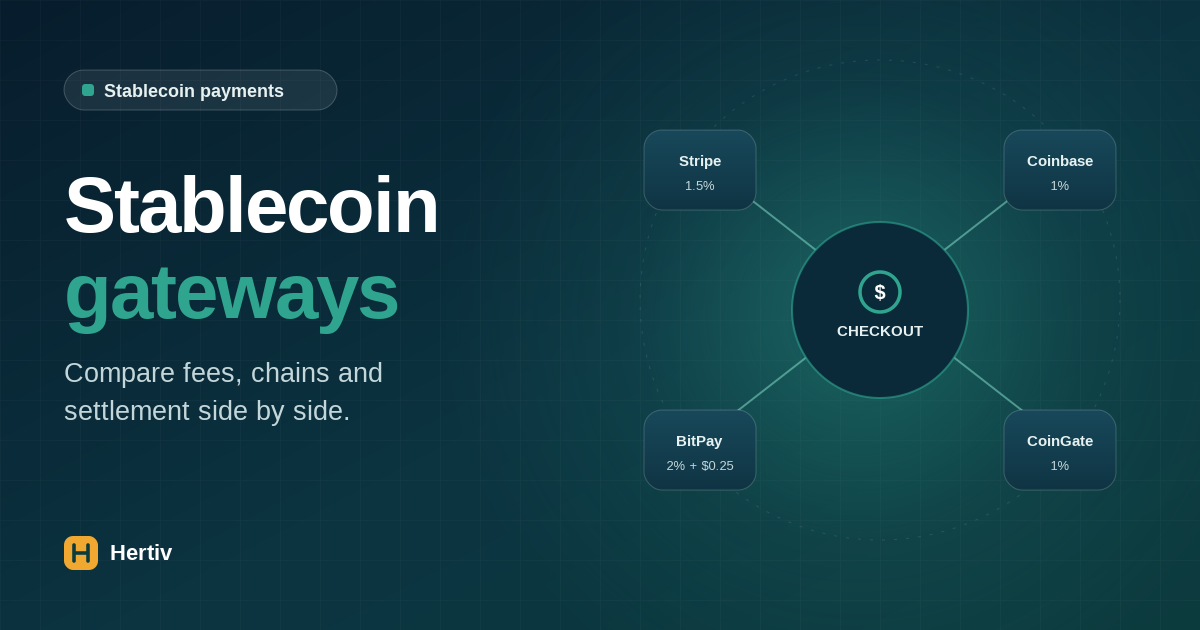
| Stripe | 1.5% per payment | USDC, USDP | SaaS teams already on Stripe |
| Coinbase Business | 1% on payment links | USDC | USDC-only checkout |
| BitPay | 2% + $0.25 under $500K a month | USDC, USDT, DAI, PYUSD | Fiat settlement at scale |
| CoinGate | 1% per transaction | USDT, USDC, DAI, EURC | EU startups |
| NOWPayments | 0.5% same coin, 1% with conversion | USDT, USDC, DAI, PYUSD | Wide coin coverage |
| BTCPay Server | 0% processing fee | USDT and more via plugins | Self-custody, zero fees |
| BVNK | Custom pricing | USDC, USDT | High-volume settlement |
| Triple-A | Custom pricing | USDT, USDC | Licensed local settlement |
Fees above are the published rates at the time of writing and can change; check the vendor site before you commit. The fee on a $20 payment matters more than the headline rate, because a fixed charge on top of a percentage hurts small tickets most. Stablecoin payment infrastructure explains the settlement models behind these fees.
<h3>1. Stripe: best for SaaS teams already on Stripe</h3><h3>2. Coinbase Business: best for USDC-only checkout</h3>
Stripe relaunched stablecoin checkout in mid-2025, charging 1.5% per stablecoin payment and settling to a normal Stripe balance in local currency, with no chargebacks and a $10,000 per-transaction limit. It runs on Bridge rails, the Stripe-owned stablecoin platform, and suits US businesses already on Stripe, with EU, Hong Kong, Mexico and Switzerland in private preview.
Coinbase Business charges 1% on completed payment-link transactions and is built for USDC. It is custodial and open only to US and Singapore companies, after the old Coinbase Commerce portal closed on 31 March 2026. For a startup that already invoices in USDC, it is the simplest option on this list.
Stripe pros: familiar dashboard and docs, fiat payout to bank, no chargebacks on stablecoin payments.
Stripe cons: 1.5% fee is higher than rivals, US-focused availability, per-transaction limit.
Coinbase Business pros: low 1% fee, simple payment links, strong USDC support.
Coinbase Business cons: US and Singapore only, USDC only, custodial by design.
<h3>3. BitPay: best for fiat settlement at scale</h3><h3>4. CoinGate: best for EU startups</h3>
BitPay charges 2% plus $0.25 per payment under $500,000 a month, falling to 1.5% plus $0.25 up to $999,999 and 1% plus $0.25 above $1 million. It accepts USDC, USDT, DAI, GUSD and PYUSD and settles in fiat or crypto, which suits mid-market and enterprise merchants that need bank payouts in several currencies.
CoinGate charges 1% per transaction and accepts USDT, USDC, DAI and EURC across Ethereum, Tron, BNB Chain, Polygon, Solana and Lightning. It is authorised as a Crypto-Asset Service Provider under the EU Markets in Crypto-Assets Regulation by the Bank of Lithuania, and SEPA withdrawals are free, which makes it a natural pick for EU startups.
BitPay pros: wide fiat settlement, long track record, volume discounts as you grow.
BitPay cons: 2% plus $0.25 is expensive on small tickets, full merchant KYC, buyer KYC over $3,000 a day.
CoinGate pros: flat 1% fee, MiCA-licensed in the EU, free SEPA withdrawals.
CoinGate cons: custodial, narrower coin list than NOWPayments, full merchant KYC.
<h3>5. NOWPayments: best for wide coin coverage</h3><h3>6. BTCPay Server: best for self-custody and zero fees</h3>
NOWPayments charges 0.5% when the customer pays in the same coin you receive and 1% when conversion is needed, plus network fees, across 350 or more coins and 15 or more chains. It runs non-custodial by default, so funds go to your own wallet, and it suits small merchants and teams that want the widest coin coverage for the lowest fee.
BTCPay Server charges a 0% processing fee. It is open source under the MIT licence and self-hosted, so you run the server and keep full custody. USDT is supported on Tron, Ethereum and Polygon through a plugin. The trade-off is work: you host, update and secure the server yourself.
NOWPayments pros: lowest headline fee, non-custodial by default, 350 or more coins.
NOWPayments cons: conversion fee on top, fiat settlement only through partners, lighter compliance tooling.
BTCPay Server pros: 0% fee, full self-custody, open source and no vendor lock-in.
BTCPay Server cons: you host and secure it, no built-in fiat settlement, steeper setup.
<h3>7. BVNK: best for high-volume stablecoin settlement</h3><h3>8. Triple-A: best for licensed local-currency settlement</h3>
BVNK is a London-based stablecoin infrastructure company that accepts stablecoins through hosted payment pages, payment links or an API, then converts them automatically into USD, EUR or GBP paid into named virtual IBANs, or keeps balances in stablecoins. It holds more than 40 licences and registrations, including FCA and Malta e-money licences and US money transmitter licences, and supports Tron, Ethereum, Solana, Polygon, BNB Chain, and USDC on Arbitrum and Base.
Triple-A is a Singapore-based licensed payment processor that settles stablecoin payments into local currency. It suits regulated merchants that want local-currency settlement without holding crypto. Both BVNK and Triple-A use custom pricing, so ask for a quote; see vendor site for current terms.
BVNK pros: deep licensing, named virtual IBANs, automatic conversion to bank payout.
BVNK cons: built for higher volumes, custom pricing only, onboarding takes time.
Triple-A pros: licensed, local-currency settlement, strong in Singapore and Asia.
Triple-A cons: custom pricing only, less suited to tiny startups, regional focus.
For the broader crypto processor market, see the top crypto payment processors.
If you need a custom checkout rather than a hosted one, crypto payment gateway development covers the build.
How to choose
Choose by fee on your real ticket size, chains your customers use, settlement, and whether the provider will onboard you. A gateway that looks cheap at 1% can cost more than a 0.5% rival once fixed charges and conversion fees are added.
- Work out your ticket size. A fixed charge on top of a percentage hurts small payments most; price a $20 and a $500 payment on each gateway.
- Match the chains. List the chains your customers pay on, such as Tron for USDT and Base for USDC, and drop any gateway that misses one.
- Decide on settlement. Choose bank payout, stablecoin balance or a mix, and check the payout time and currency.
- Check onboarding. Confirm the provider accepts your country, your company age and your volume before you build.
- Test with real money. Run a small live payment end to end, then check the fee, the payout time and the reconciliation before going live.
Keep a second gateway in mind as a fallback. If one provider pauses onboarding or raises fees, a tested alternative keeps checkout running.
Common mistakes
Most gateway mistakes come from judging on the headline fee alone, ignoring chains, and building before onboarding is confirmed. Each one is easy to avoid with a small live test.
- Comparing headline rates without pricing a real $20 payment, where fixed charges bite hardest
- Picking a gateway that does not support the chain your customers pay on
- Assuming fiat settlement is instant when it takes a day or more to reach the bank
- Building the integration before the provider confirms it will onboard your company
- Forgetting reconciliation: matching each payment to an invoice still needs a process
- Treating a custodial gateway as self-custody, and holding balances you did not plan to hold
How stablecoin payments work end to end is covered in stablecoin payments for business.
Key takeaways
- Stripe suits SaaS teams already on Stripe; Coinbase Business suits USDC-only checkout
- BitPay is expensive on small tickets; CoinGate is the natural EU pick at a flat 1%
- NOWPayments has the lowest headline fee; BTCPay Server charges 0% but you host it
- BVNK and Triple-A are licensed, custom-priced options for higher volumes
- Price gateways on your real ticket sizes, not the headline rate
- Confirm onboarding and run a small live payment before going live
Frequently asked questions
Which stablecoin payment gateway is cheapest for startups?
BTCPay Server charges a 0% processing fee because it is self-hosted and open source, while NOWPayments charges 0.5% when the customer pays in the same coin you receive. Both are cheap, but BTCPay needs you to host and secure the server, and NOWPayments adds 1% when conversion is needed.
Can a startup accept USDT and USDC without holding crypto?
Yes. Gateways such as Stripe, BitPay, CoinGate, BVNK and Triple-A convert stablecoin payments into fiat and pay your bank account. You can also keep a stablecoin balance if you prefer, and most gateways let you choose per payment.
Do stablecoin payments have chargebacks?
No, in the usual sense. Stablecoin payments settle on-chain and cannot be reversed by the buyer the way a card payment can. That removes chargeback risk, but it also means a mistaken payment needs a manual refund process.
Which chains matter most for stablecoin payments?
Tron carries most USDT payments because fees are low, while Base, Ethereum, Solana and Polygon carry most USDC. List the chains your customers already pay on before choosing, and drop any gateway that misses one of them.
What does onboarding a stablecoin gateway involve?
Most custodial gateways need company documents, director identity checks and a description of your business, which can take days or weeks. Self-hosted options such as BTCPay Server need no onboarding at all, since you run the server yourself.
Should a startup use one gateway or two?
Start with one, but keep a tested fallback. If your main provider pauses onboarding, raises fees or has an outage, a second gateway keeps checkout running while you sort it out.


