8 Free Open Source LLMs Worth Comparing
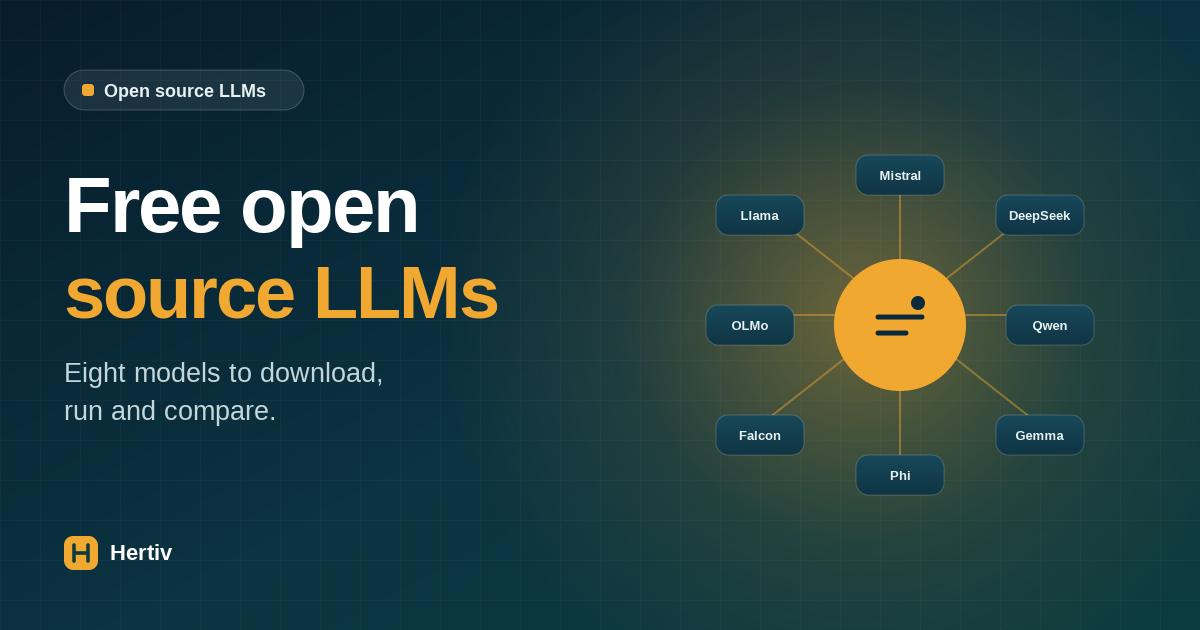
The free open source LLMs worth comparing: Llama, Mistral, DeepSeek, Qwen, Gemma, Phi, Falcon and OLMo, with licences, sizes and the jobs each one fits.
On this page
Short answer
The best free open source LLMs are Llama, Mistral, DeepSeek, Qwen, Gemma, Phi, Falcon and OLMo. All eight can be downloaded and run without a per-token fee, and each suits a different job, from chat and coding to on-device use. Pick by licence, model size, context length and whether you need commercial use, not by benchmark scores alone.
Which free open source LLMs are worth comparing?
The free open source LLMs worth comparing are the ones with a clear licence, an active community and weights you can download and run yourself. A model that is free to download but has no licence for commercial use is a different proposition from one released under a permissive licence.
Use this table to shortlist. 'Best for' reflects the job each model is most often chosen for, not a ranking.
| Model | Licence | Best for | Smallest size |
|---|---|---|---|
| Llama | Community licence | General chat and apps | 1B |
| Mistral | Apache 2.0 | Fast chat, coding | 7B |
| DeepSeek | MIT | Reasoning, coding | 1.5B |
| Qwen | Apache 2.0 | Multilingual chat | 0.5B |
| Gemma | Gemma terms | On-device, research | 2B |
| Phi | MIT | Small and fast tasks | 3.8B |
| Falcon | Apache 2.0 | General purpose | 7B |
| OLMo | Apache 2.0 | Open research | 1B |
Licences matter more than most teams expect. A community licence may restrict very large commercial deployments, while an Apache 2.0 or MIT licence places fewer conditions on use. Read the licence for the exact version you download, because terms can differ between model sizes. If you are weighing open models against hosted ones, open source vs closed LLMs covers the trade-offs.
<h3>1. Llama: best for general chat and apps</h3> <h3>2. Mistral: best for fast chat and coding</h3>
1. Llama. Llama is Meta's family of open-weight models, available in sizes from 1B to 405B. The smaller sizes run on a single workstation, while the largest need serious hardware. Llama is the most common starting point for teams building chat products, because the ecosystem around it is large: fine-tuning tools, quantised versions and hosting guides are easy to find.
The trade-off is the licence. Llama is released under a community licence rather than a permissive open source licence, and it carries conditions for very large commercial deployments. Read the licence terms before you build a business on it.
- Pros: largest ecosystem, many sizes, strong community support
- Cons: community licence with conditions, large sizes need heavy hardware
2. Mistral. Mistral's 7B model is known for strong performance at a small size, and the company also releases larger models under the same family. The 7B model runs well on a single GPU, which makes it a good fit for teams that want a capable chat model without a large hosting bill.
Mistral is released under Apache 2.0, which places few conditions on commercial use. That makes it a safe default when the licence matters as much as the quality.
- Pros: permissive licence, strong at small size, fast responses
- Cons: smaller ecosystem than Llama, fewer sizes to choose from
<h3>3. DeepSeek: best for reasoning and coding</h3> <h3>4. Qwen: best for multilingual chat</h3>
3. DeepSeek. DeepSeek's reasoning models are known for working through problems step by step, which helps on maths, coding and logic tasks. The distilled versions are small enough to run on modest hardware, while the full models need more resources. The models are released under the MIT licence.
The trade-off is that reasoning models are slower per answer, because they generate more tokens before responding. They suit tasks where the answer matters more than the speed.
- Pros: strong reasoning, MIT licence, small distilled versions available
- Cons: slower responses, full models need heavy hardware
4. Qwen. Qwen is Alibaba's family of models, available in sizes from 0.5B to 72B and released under Apache 2.0. It is a strong choice for multilingual work, including languages beyond English, and it includes models tuned for coding and for tool use.
The wide range of sizes is the main advantage: a 0.5B model can run on a laptop, while a 32B or 72B model can serve a production chat product. The trade-off is that the documentation and community are smaller than Llama's.
- Pros: wide size range, strong multilingual support, permissive licence
- Cons: smaller English-language community, more versions to sort through
<h3>5. Gemma: best for on-device and research</h3> <h3>6. Phi: best for small and fast tasks</h3>
5. Gemma. Gemma is Google's family of lightweight open models, released in 2B and 7B sizes under the Gemma terms of use. It is built for on-device use and for research, and it runs well on a laptop or a single GPU. Gemma is a good fit when you need a small model that still answers well.
The trade-off is the licence, which is not a standard permissive licence. Read the Gemma terms before using it in a commercial product.
- Pros: small and fast, runs on modest hardware, good for research
- Cons: custom licence terms, fewer sizes than larger families
6. Phi. Phi is Microsoft's family of small models, with the 3.8B version the best known. Phi is trained to do well on reasoning and coding tasks despite its size, and it is released under the MIT licence. It is a good fit for tasks where a small model must still be reliable.
The trade-off is capacity. A 3.8B model cannot hold as much knowledge as a 70B model, so it suits narrow tasks with clear inputs rather than open-ended chat.
- Pros: MIT licence, strong for its size, fast and cheap to run
- Cons: limited knowledge capacity, not suited to open-ended chat
<h3>7. Falcon: best for general purpose use</h3> <h3>8. OLMo: best for open research</h3>
7. Falcon. Falcon is the Technology Innovation Institute's family of models, released under Apache 2.0. The 7B and 40B versions are the best known, and Falcon is a solid general-purpose choice for teams that want a permissively licensed model with no surprises in the terms.
The trade-off is momentum. Falcon's community is smaller than Llama's, so fine-tuning guides and ready-made integrations are harder to find.
- Pros: Apache 2.0 licence, solid general performance, no licence surprises
- Cons: smaller community, fewer ready-made integrations
8. OLMo. OLMo is the Allen Institute for AI's fully open model, with weights, training data and training code released under Apache 2.0. It is the most transparent option on this list, which matters for research teams and for anyone who needs to explain how a model was built.
The trade-off is raw capability. OLMo is built for openness first, so it is not the strongest model on general chat tasks. It is the right choice when transparency matters more than top scores.
- Pros: fully open weights, data and code, Apache 2.0 licence
- Cons: weaker on general chat than larger families
If you are comparing these models against hosted options, large language models compared includes both open and closed models side by side.
How to choose a free open source LLM
Choose by licence, size, context length and the job, in that order. A model that is free to download but cannot be used commercially is not free for your purpose.
- Check the licence for your use. Read the licence for the exact version and size you plan to run. Community licences and custom terms can restrict large commercial deployments.
- Match the size to your hardware. A 7B model runs on a single GPU; a 70B model needs several. Pick the smallest model that answers your test cases well.
- Check the context length. Long documents need a long context window. A model with a short window will truncate the input you care about.
- Test on your own data. Run twenty real examples from your product through each candidate and compare the answers. Benchmarks do not predict performance on your data.
- Check the ecosystem. A model with quantised versions, fine-tuning tools and hosting guides will be cheaper to run in practice.
Start with two candidates, not eight. Test both on the same examples, then pick the one that is good enough and cheapest to run. For teams that need help setting up the evaluation, LLM development covers the production setup.
What are the common mistakes?
The most common mistakes are ignoring the licence, picking the largest model by default and skipping evaluation on real data.
- Ignoring the licence. A model that is free to download may still restrict commercial use. Read the terms for the exact version.
- Picking the biggest model. A 70B model costs far more to run than a 7B model. Test the small one first; it may be good enough.
- Trusting benchmarks. A benchmark score does not tell you how a model answers your customers' questions. Test on your own examples.
- Skipping the context check. A model with a short context window will fail on long documents, however good its answers are on short ones.
- Forgetting the running cost. Free weights do not mean free hosting. GPU time, memory and maintenance are real costs.
- No fallback. A self-hosted model can fail or run out of memory. Plan what happens when it does.
Key takeaways
- Llama, Mistral, DeepSeek, Qwen, Gemma, Phi, Falcon and OLMo are all free to download and run
- Licences differ: Apache 2.0 and MIT place few conditions, while community licences may restrict large commercial use
- Pick the smallest model that answers your test cases well, not the largest one available
- Test candidates on your own data; benchmarks do not predict performance on your examples
- Free weights do not mean free hosting: GPU time and maintenance are real costs
Frequently asked questions
Are open source LLMs really free?
The model weights are free to download, and there is no per-token fee. You still pay for the hardware to run them, whether that is your own GPU or a rented one, plus the time to maintain the deployment. Some licences also place conditions on commercial use, so read the terms.
What is the difference between open source and open weight LLMs?
Open weight means the model weights are available to download. Open source can also mean the training data and code are available, which is rarer. OLMo is fully open in this sense. Most models on this list are open weight with permissive or community licences.
Can I use these models commercially?
It depends on the licence. Apache 2.0 and MIT licences allow commercial use with few conditions. Community licences and custom terms, such as Llama's and Gemma's, may restrict very large deployments. Read the licence for the exact version and size you plan to use.
Which free open source LLM is best for coding?
Mistral, DeepSeek and Qwen all have versions tuned for coding, and Phi performs well for its size. The right choice depends on your hardware and the languages you use. Test two or three on real code from your project before deciding.
How much hardware do I need to run a 7B model?
A 7B model in a quantised form runs on a single consumer GPU with enough memory, or on a CPU more slowly. Larger models need more memory and more GPUs. Start with a small quantised version and measure the speed before buying hardware.
Do open source LLMs need fine-tuning?
Usually not at first. A good prompt and retrieval over your own documents handle most chat and search cases. Fine-tuning helps when you need consistent format or tone at scale, and it is easier to justify once you have an evaluation set.


