Best Enterprise Blockchain Agencies: 6 to Compare
Enterprise blockchain agencies build private networks, token platforms and smart contracts for large companies. Compare six firms and how to pick one.
On this page
Short answer
Enterprise blockchain agencies are service firms that design, build and run blockchain systems for large companies, such as private networks, token platforms and smart contract workflows. The best ones combine blockchain engineering with security, compliance and integration work, so the system fits the company's existing tools. This guide compares six agencies on what they do best and how to choose one.
Which enterprise blockchain agencies should you shortlist?
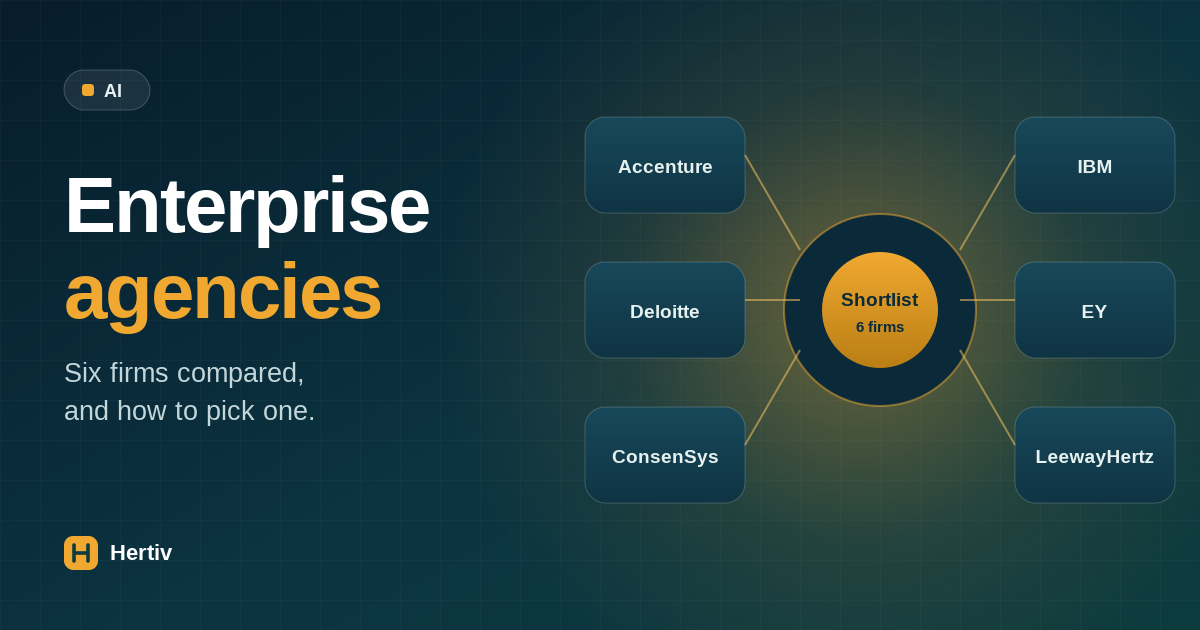
The agencies below build blockchain systems for large companies, from private networks and token platforms to smart contract workflows and integrations with existing software. Each has a different strength, so the right shortlist depends on your industry, your platform and how much of the work you want to keep in-house.
| Agency | Best for | Core strength |
|---|---|---|
| Accenture | Large regulated programmes | Scale and delivery across regions |
| IBM Consulting | Private networks and supply chains | Enterprise platforms and integration |
| Deloitte | Audit-ready blockchain projects | Controls, tax and compliance |
| EY | Privacy-first enterprise use | Privacy tooling and public networks |
| ConsenSys | Ethereum-based products | Deep Ethereum engineering |
| LeewayHertz | Mid-size custom builds | Fast delivery and focused teams |
Fees and timelines vary by scope, so ask each agency for a written estimate. For background on the vendor side, enterprise blockchain companies covers the platform firms that agencies often build on.
<h3>1. Accenture: best for large regulated programmes</h3>
Accenture is a global consultancy with large blockchain teams that work across banking, supply chain, healthcare and government. It runs multi-year programmes, builds on several platforms, and can staff projects in many countries at once. That scale suits companies that need delivery in several regions with one accountable partner.
The trade-off is cost and process. Large programmes come with heavy governance, and small projects can move slowly inside a big delivery machine. Ask for the named team and the delivery lead before you sign, not just the firm's brand.
- Pros: global scale, multi-platform delivery, strong delivery governance.
- Cons: high fees, slower for small projects, team quality varies by office.
<h3>2. IBM Consulting: best for private networks and supply chains</h3>
IBM Consulting builds enterprise blockchain systems on its own platforms and on open networks, with a long record in supply chain, trade finance and food traceability. Its teams combine blockchain engineering with cloud, integration and data work, which matters when the ledger is only one part of a larger system.
IBM's strength is integration with existing enterprise software. If your project must connect to legacy systems, its experience with middleware and data pipelines helps. The trade-off is that IBM-led projects can lean toward IBM platforms, so check how portable the result will be.
- Pros: strong integration skills, proven supply chain work, enterprise support.
- Cons: platform lean toward IBM tools, higher fees, long sales cycles.
<h3>3. Deloitte: best for audit-ready blockchain projects</h3>
Deloitte is an audit and advisory firm with blockchain teams that focus on controlled, audit-ready systems for finance, insurance and government. It brings tax, legal and controls expertise alongside the engineering, which helps when the project must pass internal audit or a regulator's review.
Deloitte suits projects where governance matters as much as the code, such as tokenised assets, regulated payments or cross-border settlement. It is less suited to fast product experiments, where its review-heavy process can slow delivery.
- Pros: audit and controls expertise, regulated-industry experience, strong governance.
- Cons: slower delivery, high fees, less suited to rapid product work.
<h3>4. EY: best for privacy-first enterprise use</h3>
EY is an advisory firm that has built notable privacy tooling for enterprise blockchain, including work that lets companies use public networks without exposing private transaction data. Its blockchain practice covers supply chain, procurement and finance, with a strong focus on privacy and compliance.
EY is a good fit when privacy is the main worry, for example when competitors share a network or when transaction details must stay private. Its teams are smaller than Accenture's or IBM's, so check staffing for very large programmes.
- Pros: strong privacy tooling, compliance focus, practical enterprise use cases.
- Cons: smaller delivery teams, higher fees, fewer platform choices.
<h3>5. ConsenSys: best for Ethereum-based products</h3>
ConsenSys is a software company built around Ethereum, with teams that design and build wallets, token platforms, smart contracts and developer tools. Its engineers work directly with the Ethereum ecosystem, so it suits products that must live on Ethereum or on networks built with Ethereum tooling.
ConsenSys is the strongest pick when the product itself is the point, such as a token platform or a decentralised application, rather than an internal system. It is less suited to private-network projects that do not touch Ethereum at all. For the basics of the platform, what enterprise blockchain is explains how private and public networks differ.
- Pros: deep Ethereum expertise, product-focused teams, strong developer tools.
- Cons: Ethereum-centred, less suited to non-Ethereum private networks.
<h3>6. LeewayHertz: best for mid-size custom builds</h3>
LeewayHertz is a software development firm that builds custom blockchain products for mid-size companies and startups, including token platforms, wallets, NFT marketplaces and supply chain tools. Its teams are smaller and more focused than the big consultancies, which usually means faster starts and clearer communication.
It suits companies that want a working product in months rather than a multi-year programme. The trade-off is scale: it cannot staff a global rollout the way a large consultancy can, so it fits best when the scope is one product or one business unit.
- Pros: fast starts, focused teams, clear communication, product experience.
- Cons: limited scale for global rollouts, smaller bench, less audit depth.
How to choose an enterprise blockchain agency in 5 steps
Choosing an agency is mostly about matching the firm's strength to your project and checking that the team you meet is the team that will do the work.
- Define the outcome first. Write down what the system must do, who will use it and how you will know it worked, before you talk to any agency.
- Shortlist by fit, not fame. Pick three firms whose past work matches your industry and platform, and ask for case studies with named clients and results you can verify.
- Meet the delivery team. Ask who will lead the work, how many people are assigned and what happens if a key person leaves.
- Check security and compliance. Ask how the agency handles audits, key management and data protection, and who owns the code and the keys.
- Compare fixed scopes, not day rates. Ask each agency to price the same written scope, so you compare like with like.
A short paid discovery phase, usually two to four weeks, is a good way to test an agency before a full build. It produces a scope, an architecture sketch and a fixed estimate, and it shows how the team communicates under real deadlines.
What are the common mistakes?
The most common mistakes when hiring a blockchain agency are choosing on brand alone, skipping the team check, and signing a scope that nobody has written down.
- Choosing on brand alone. A famous firm can still assign a junior team. Judge the people, not the logo.
- No written scope. Without a written scope, the price and the delivery date mean little, and changes become arguments.
- Ignoring who owns the code. Make sure the contract gives you the code, the keys and the documentation, so you are not locked in.
- Skipping security review. Smart contracts and key handling need an independent review before launch, not after.
- No plan for running it. A system that nobody maintains will drift. Agree on support, monitoring and upgrades before launch.
Key takeaways
- An agency's brand matters less than the team it assigns
- Shortlist three agencies whose past work matches your industry and platform
- Compare fixed scopes for the same written brief, not day rates
- Check security, key ownership and code ownership before you sign
- A short paid discovery phase is the cheapest way to test an agency
Frequently asked questions
What does an enterprise blockchain agency do?
An enterprise blockchain agency designs, builds and runs blockchain systems for large companies, such as private networks, token platforms and smart contract workflows. It usually handles the engineering, security, integration and testing, while the client owns the business rules and the data.
How much does an enterprise blockchain agency cost?
Costs vary widely by scope, region and team size, and most agencies price by project rather than by a fixed rate. Ask each agency for a written estimate for the same scope, and check what is included, such as testing, audits and support.
Should I hire an agency or build in-house?
Hire an agency when you need blockchain skills quickly or for one project, and build in-house when blockchain is core to your product and you will run it for years. Many companies start with an agency and hire an internal team to take over support.
What should I check in an agency's past work?
Ask for case studies with named clients, what the system does today and whether it is still running. Check that the work matches your industry and platform, and ask to speak to a past client if the project is large.
Do I need a big consultancy or a smaller firm?
Big consultancies suit large regulated programmes and multi-region rollouts. Smaller firms suit one product or one business unit, where speed and direct communication matter more than scale. Choose the size that fits your project, not the biggest name you can afford.
Who owns the code and the keys?
That depends on the contract, so check it before you sign. You should own the code, the documentation and the keys, with the agency holding access only while it is doing the work, and that access should end when the project finishes.


