Best Blockchain Oracles for Startups: 6 to Compare
An oracle feeds off-chain data into smart contracts. Compare six oracle networks on data types, chains, cost and setup effort before you pick one.
On this page
Short answer
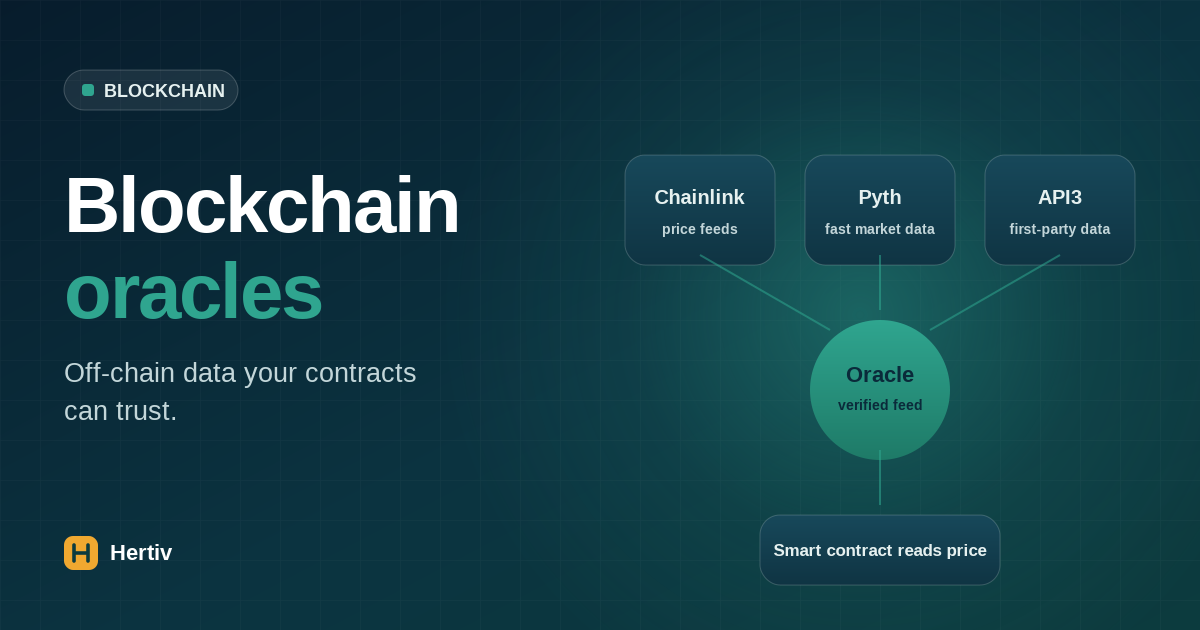
The best blockchain oracle for a startup depends on the data you need and the chain you build on. Chainlink suits price feeds across many chains, Pyth suits fast market data, API3 suits first-party data, Band suits multi-chain feeds, Chronicle suits stablecoin-grade data, and RedStone suits low-cost feeds on newer chains. Compare data freshness, cost and decentralisation before you commit.
Which blockchain oracles should a startup compare?
The oracles worth comparing first are the ones with live feeds on your chain, clear pricing and a simple integration path. An oracle is a service that brings off-chain data, such as prices or weather, into a smart contract, which cannot fetch data on its own.
Use this comparison to shortlist. Cost varies by feed and chain, so check the vendor site for current pricing rather than relying on a blog figure.
| Oracle | Best for | Data style | Chains |
|---|---|---|---|
| Chainlink | Price feeds on many chains | Decentralised feeds | Many |
| Pyth Network | Fast market data | Publisher feeds | Many |
| API3 | First-party data | Direct from source | Several |
| Band Protocol | Multi-chain feeds | Decentralised feeds | Several |
| Chronicle | Stablecoin-grade data | Verified feeds | Several |
| RedStone | Low-cost feeds | Pull and push models | Many |
Start with the data your contract actually needs, not the longest feature list. A lending app needs fresh prices; a weather insurance app needs verified weather data; a prediction market needs a trusted outcome feed.
Chainlink and Pyth Network
1. Chainlink: best for price feeds across many chains
Chainlink is the most widely used oracle network, with price feeds on many chains and a long record in lending and derivatives. Its feeds aggregate answers from many independent node operators, which makes a single bad report less likely to move a price.
Integration is well documented, with examples for the common chains and languages. The trade-off is cost and setup effort: feeds are priced per chain, and custom feeds take more work than reading a standard price feed.
- Pros: broad chain coverage, many live feeds, strong documentation
- Cons: higher cost on some chains, custom feeds need more setup
2. Pyth Network: best for fast market data
Pyth publishes price data from trading firms and exchanges, updating as often as every few hundred milliseconds on some chains. That speed suits trading, liquidations and any contract that needs a price close to the market.
Its pull model means your contract requests a price when it needs one, rather than paying for constant updates. The trade-off is that your team must handle the update step and its cost.
- Pros: very fast updates, wide asset coverage, pull model saves on idle cost
- Cons: fewer non-price feeds, update step adds integration work
API3 and Band Protocol
3. API3: best for first-party data
API3 lets data providers run their own oracle nodes, so the data comes straight from the source instead of through middlemen. That removes one layer of trust and can lower cost for feeds that do not need a large node set.
It suits teams that already have a trusted data provider and want that provider's numbers on-chain without re-aggregation. The trade-off is a smaller feed catalogue than the largest networks.
- Pros: data straight from the source, lower cost for simple feeds
- Cons: fewer ready-made feeds, smaller ecosystem
4. Band Protocol: best for multi-chain feeds
Band Protocol runs its own chain and serves data to many destination chains, with feeds for prices and other data types. Its design suits teams building across several chains that want one oracle relationship.
Setup is straightforward for standard feeds, and the network supports custom data requests. The trade-off is that feed coverage is narrower than the largest networks on some chains.
- Pros: one integration for many chains, custom data requests supported
- Cons: narrower feed coverage on some chains
Chronicle and RedStone
5. Chronicle: best for stablecoin-grade data
Chronicle focuses on verified, high-integrity price feeds, and it has a long record securing stablecoins and lending protocols. Its feeds are built for contracts where a wrong price would be expensive.
It suits teams that value auditability and a conservative design over the widest asset list. The trade-off is a smaller catalogue and fewer chains than the broadest networks.
- Pros: strong record with stablecoins, verified feed design
- Cons: smaller feed catalogue, fewer chains
6. RedStone: best for low-cost feeds on newer chains
RedStone offers both push feeds and pull feeds, so a team can choose between regular updates and on-demand prices. Its pull model keeps costs low on chains where a push feed would be expensive.
It has grown quickly on newer chains and layer-two networks, which suits startups building there. The trade-off is a shorter track record than the oldest networks.
- Pros: flexible push and pull models, low cost, strong newer-chain support
- Cons: shorter track record, fewer legacy integrations
How to choose a blockchain oracle
Choose an oracle by matching the feed to your contract's risk, not by brand alone. A wrong price in a lending contract can trigger liquidations, while a stale weather reading can pay the wrong claim.
- List the data you need. Write down each feed, how fresh it must be, and what happens if it is wrong or late.
- Check your chain. Confirm the oracle has a live feed on the chain you deploy to, not just on its homepage list.
- Test with a small contract. Read the feed on a test network, check update speed and failure behaviour, and measure gas cost.
- Compare total cost. Add feed fees, update transactions and any subscription, then check the vendor site for current pricing.
- Plan for failure. Add a fallback feed or a circuit breaker that pauses the contract when data looks wrong.
Before choosing, read what a blockchain oracle is if the concept is new to your team.
Also check smart contract development for how oracles fit into a contract's design.
What are the common mistakes?
The most common oracle mistakes are trusting a single source, ignoring update delays, and skipping a fallback plan.
- One feed, no backup. If the feed stops, your contract stops or acts on stale data. Keep a second source or a pause switch.
- Ignoring freshness. A price that updates hourly is fine for a weekly settlement and dangerous for a liquidation.
- No price sanity checks. Reject prices that move too far too fast before the contract acts on them.
- Testing only on one chain. Feed behaviour and cost differ by chain, so test where you deploy.
- Assuming the oracle is the whole risk. Contract bugs, key management and access control matter just as much.
Key takeaways
- The right oracle depends on your data, your chain and how fast the data must be
- Chainlink and Pyth cover most price-feed needs; API3 and RedStone suit cost-sensitive teams
- Always check that a feed is live on the chain you deploy to
- Add a fallback feed or a circuit breaker before mainnet
- Compare total cost on the vendor site, not just the headline feed price
Frequently asked questions
What is a blockchain oracle?
A blockchain oracle is a service that brings off-chain data into a smart contract, such as a token price, a weather reading or a sports result. Smart contracts cannot fetch data from the internet on their own, so oracles act as the bridge between the chain and the outside world.
Do oracles make a smart contract centralised?
They can add a trust point, which is why most oracle networks use many independent node operators and aggregate their answers. A single-source feed is simpler but riskier. Choose the level of decentralisation that matches how much money the contract controls.
How much does a blockchain oracle cost?
Costs vary by feed, chain and update model, and vendors price differently, so check the vendor site for current pricing. Push feeds charge for regular updates, while pull feeds charge when your contract requests a price.
Can a startup use more than one oracle?
Yes, and many do. A common pattern is one primary feed plus a second feed as a check, with the contract pausing if the two disagree by too much. The extra cost is usually small compared with the risk of a wrong price.
What data can oracles provide besides prices?
Oracles can provide weather data, sports results, random numbers, proof of reserves and event outcomes. The feed must exist for your chain and be maintained by a reliable source, so check availability before designing around it.
How do I test an oracle integration?
Deploy to a test network, read the feed over several days, and check update speed, failure behaviour and gas cost. Then simulate a stale feed and a wrong price to confirm your fallback and circuit breaker work before mainnet.


