Best Blockchain Bridges for Startups: 6 to Compare
Six bridges startups use to move tokens between chains, compared on design, coverage and security: Wormhole, LayerZero, Axelar, Across, Stargate and deBridge.
On this page
Short answer
The best blockchain bridges for startups are Wormhole, LayerZero, Axelar, Across, Stargate and deBridge. They differ in security design, chain coverage and speed, so the right choice depends on the exact route your users need and how much risk you are willing to accept.
Which blockchain bridges should startups compare first?
The bridges worth comparing first are the ones that already move real volume between the chains your users hold assets on, and that publish how their security works. A bridge is only as safe as its design, so start with the security model, not the fee page.
Use this comparison to shortlist. "Design" is how the bridge checks a transfer on the destination chain.
| Bridge | How it moves assets | Chains covered | Best for |
|---|---|---|---|
| Wormhole | Guardian network attests transfers | 30+ chains | Wide coverage, messaging |
| LayerZero | Oracle and relayer verify messages | 70+ chains | Omnichain apps, developers |
| Axelar | Validator set secures transfers | 60+ chains | Interchain apps, Cosmos links |
| Across | Relayers fill orders, settled later | Major EVM chains | Fast, low-cost transfers |
| Stargate | Unified liquidity pools | Major EVM chains | Stablecoin transfers |
| deBridge | Validator network, fast finality | 20+ chains | Cross-chain swaps, apps |
Pick two or three rows and test them with small transfers before you commit. A bridge that looks cheap on paper can be slow or limited on the exact route your users need.
Wormhole and LayerZero: the broadest coverage
1. Wormhole: best for wide coverage and messaging
Wormhole connects more than 30 chains through a network of guardians that attest to transfers. It moves tokens and also passes messages between chains, which is why many apps use it for cross-chain governance and NFT transfers as well as payments. Its scale makes it a common first choice for teams that need many chains at once.
The trade-off is trust in the guardian set. Wormhole has had a major security incident in the past and has since changed its design and review practices. Startups should read its current security documentation and check which chains and assets it supports for their exact route.
Pros
- Wide chain coverage and support for messages as well as tokens
- Large developer ecosystem and documentation
Cons
- Security depends on the guardian set, so read the current design before relying on it
- Fees vary by route; check the cost for your exact transfer, or see vendor site
2. LayerZero: best for omnichain apps
LayerZero is a messaging layer that lets an application on one chain read state and send instructions on another. Developers use it to build apps that exist on several chains at once, with a single interface. It connects more than 70 chains, which is the widest coverage in this list.
Its design separates the oracle that reports a block header from the relayer that supplies the proof. An app can pick its own oracle and relayer, which gives teams control over the trust assumptions. That flexibility is useful, but it also means the security of your app depends on the choices you make.
Pros
- Very wide chain coverage and a developer-first design
- Apps can choose their own oracle and relayer setup
Cons
- More configuration decisions than a simple token bridge
- Security depends on the oracle and relayer you pick
Axelar and Across: validators versus fast fills
3. Axelar: best for interchain apps and Cosmos links
Axelar is a network of validators that secures cross-chain transfers and general message passing. It connects more than 60 chains, including Cosmos chains, which many other bridges cover less well. Teams building apps that need to reach Cosmos and EVM chains from one place often start here.
Axelar also offers tools for developers to call contracts on another chain from their own app. That matters if your product needs more than a token transfer, such as triggering an action on the destination chain. Check the supported chains for your route, since coverage varies.
Pros
- Strong Cosmos coverage alongside EVM chains
- General message passing for cross-chain contract calls
Cons
- Security rests on the validator set, so review its current size and stake
- Some routes are slower than intent-based bridges
4. Across: best for fast, low-cost transfers
Across works differently from most bridges. Instead of locking tokens and minting a wrapped version, relayers fill your transfer from their own funds on the destination chain, and the protocol settles with them later. That design usually gives fast transfers and low fees on the routes it supports.
The trade-off is coverage. Across focuses on major EVM chains, so it may not cover a smaller chain your users need. It also relies on relayers having funds ready on the destination chain, which works well on busy routes and less well on quiet ones.
Pros
- Fast transfers with low fees on supported routes
- No wrapped tokens for the user to manage
Cons
- Narrower chain coverage than Wormhole or LayerZero
- Speed depends on relayer funds on the destination chain
Stargate and deBridge: liquidity pools versus swaps
5. Stargate: best for stablecoin transfers
Stargate moves assets through unified liquidity pools, so a transfer is settled from a pool on the destination chain rather than by minting a wrapped token. That design keeps the asset the user receives identical to the asset they sent, which matters for stablecoins where a wrapped version adds risk.
Stargate is built on LayerZero messaging, so it shares some of the same trust assumptions. Its strength is predictable settlement for stablecoin transfers between major EVM chains. Check the pool depth for your route, since a thin pool can mean a worse rate on larger transfers.
Pros
- Settles in the native asset, not a wrapped version
- Predictable behaviour for stablecoin routes
Cons
- Focused on major EVM chains, so coverage is narrower
- Large transfers depend on pool depth on the route
6. deBridge: best for cross-chain swaps
deBridge is a cross-chain protocol that lets users swap an asset on one chain for a different asset on another, in a single step. A validator network secures the transfers, and the protocol aims for fast finality. It covers more than 20 chains and is often used inside wallets and apps that want bridging as a feature.
For a startup, the appeal is that deBridge can be embedded as a widget or API, so users bridge without leaving your product. As with every bridge, read the current audit history and check which chains and assets it supports for your route before you build on it.
Pros
- One-step swaps across chains, easy to embed in a product
- Fast finality on supported routes
Cons
- Smaller chain coverage than the largest bridges
- Fees and rates vary by route; check the live quote, or see vendor site
How to choose a blockchain bridge
You choose a blockchain bridge by matching its security design and chain coverage to the exact route your users need, then testing it with small amounts before you build on it.
- List the routes that matter. Write down the chains and assets your users actually hold, and drop any bridge that does not cover them.
- Read the security design. A bridge secured by a large validator set, a multisignature group or an oracle pair carries different risks. A cross-chain bridge guide explains the main designs and where each can fail.
- Check the audit history. Look for recent third-party audits, a public bug bounty and a clear incident record. A bridge with no public audits is not a saving; it is a risk.
- Test the route with small amounts. Send a small transfer on the exact route, measure the time and the fee, and confirm the asset that arrives is the one you expected.
- Plan for failure. Decide what happens if the bridge pauses or a route is suspended, and keep a second route or a clear message for users.
If the bridge will sit inside your product, check the developer tools as well: an API or widget, clear documentation and support channels. A bridge that is hard to integrate will cost more than the fee difference you were chasing, so talk to a blockchain development team about the integration before you commit.
What are the common mistakes?
The most common bridge mistakes are picking on fees alone, trusting a bridge without reading its security design, and building on a route that has thin liquidity.
- Choosing on fees alone. The cheapest bridge on one route can be the slowest or least secure on another. Compare the full route, not the headline fee.
- Skipping the security design. Bridges hold real value in transit, so the validator set, oracle setup and audit history matter more than the brand name.
- Assuming wrapped tokens are identical. A wrapped asset is a claim on the bridge, not the asset itself, so check what backs it.
- Ignoring pool depth. A thin liquidity pool gives a worse rate on larger transfers, even when the fee looks low.
- No fallback route. Bridges pause. Keep a second route or a clear user message ready before you need it.
A bridge is infrastructure your users trust with their funds, so treat the choice like a vendor decision: check the design, test the route and keep a fallback. For the underlying concepts, what a blockchain is explains how chains record value in the first place.
Key takeaways
- Compare bridges on security design and chain coverage, not on fees alone
- Wormhole and LayerZero cover the most chains; Across and Stargate are faster on major EVM routes
- Wrapped tokens are claims on the bridge, not the asset itself
- Test every route with a small transfer before you build on it
- Keep a fallback route ready in case a bridge pauses
Frequently asked questions
What is a blockchain bridge?
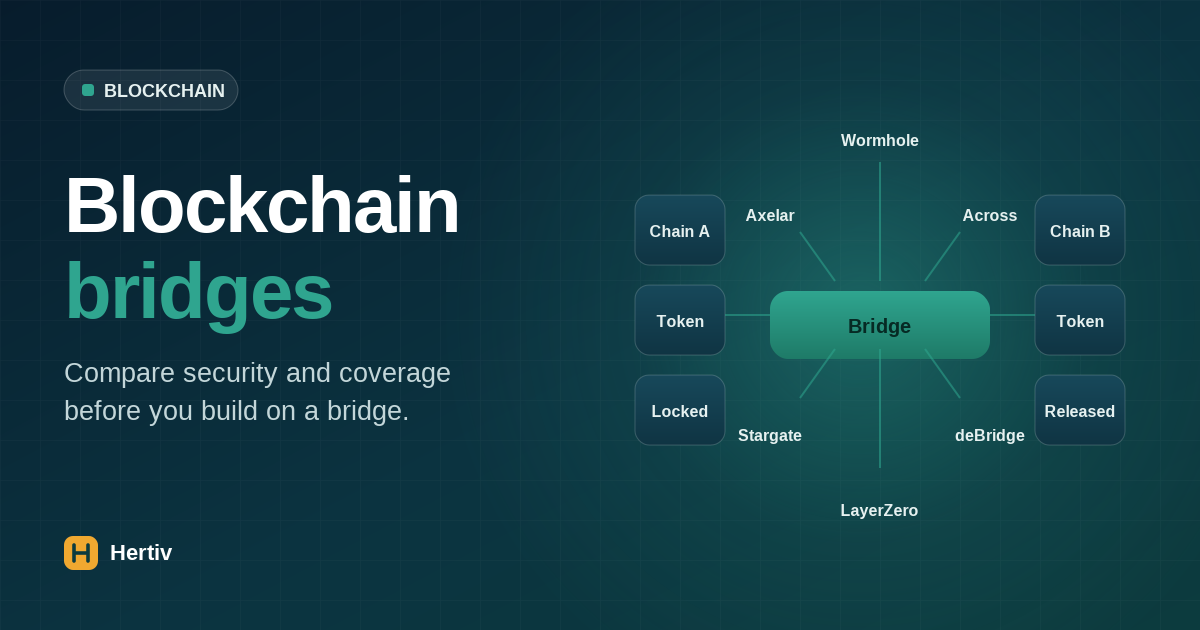
A blockchain bridge moves tokens or messages between two blockchains that cannot talk to each other directly. It locks or holds the asset on the source chain and releases the matching asset on the destination chain, so value can cross chains without a central exchange.
Are blockchain bridges safe?
Bridges carry real risk because they hold value in transit, and several have been attacked. Safety depends on the security design, the size of the validator or guardian set, recent audits and a public bug bounty. No bridge is risk-free, so test with small amounts first.
Which bridge is cheapest for startups?
Fees vary by route, asset and network congestion, so there is no single cheapest bridge. Compare live quotes for your exact route, and weigh the fee against speed and security. For current pricing, see vendor site rather than relying on a published fee table.
Do I need a bridge if my app is on one chain?
No. A bridge only matters when your users hold assets on a different chain from the one your app runs on. If your product and your users live on one chain, skip bridging and keep the product simple.
What is the difference between a bridge and a wrapped token?
A wrapped token is the asset a bridge issues on the destination chain to represent the locked original. The bridge is the system that moves value; the wrapped token is what the user holds afterwards. Some bridges avoid wrapped tokens by settling from liquidity pools.
Can a startup build its own bridge?
Building a bridge is a security project, not a feature. It needs audits, monitoring and a team that can respond to incidents around the clock. Most startups should use an established bridge and focus their effort on their own product.


