What Is an AWS Advanced Tier Partner?
An AWS Advanced Tier Partner has deeper AWS delivery experience than a Select partner: more references, more certified staff and bigger AWS programme access.
On this page
Short answer
An AWS Advanced Tier Partner is a consulting or software firm in the AWS Partner Network that has earned the Advanced tier, the level above Select and below Premier. It has delivered more AWS projects for real customers, holds more AWS certifications among its staff and can access greater funding, training and go-to-market support from AWS.
What is an AWS Advanced Tier Partner?
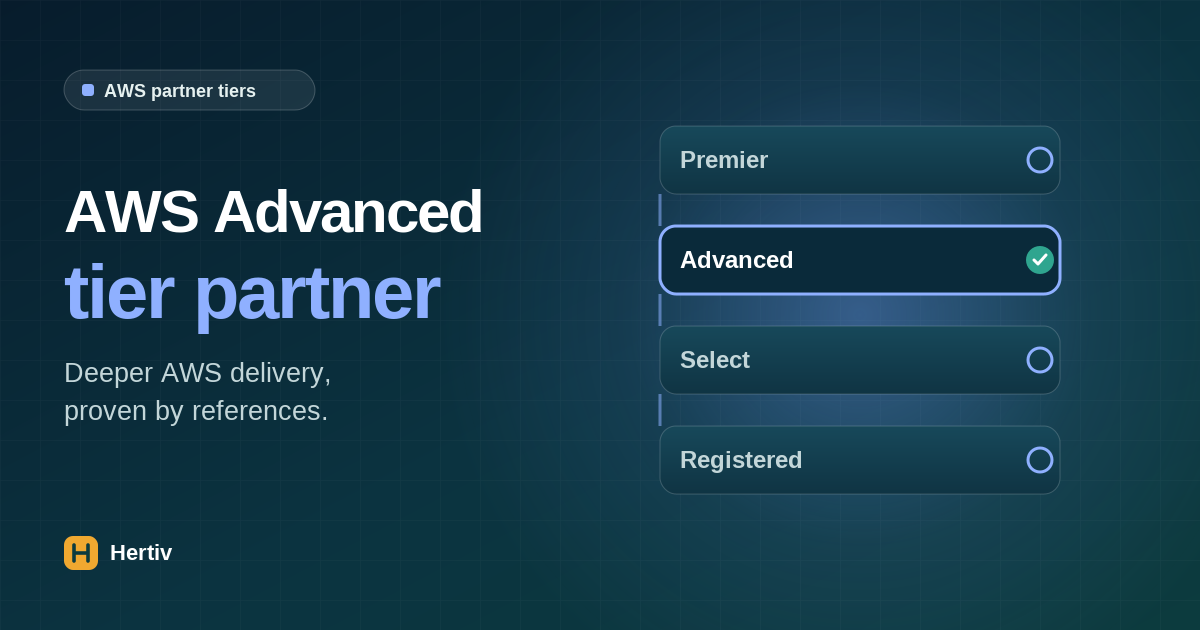
An AWS Advanced Tier Partner is a firm in the AWS Partner Network that has proven it can deliver substantial work on Amazon Web Services. The partner network is AWS's programme for consulting and software firms that build on its cloud, and Advanced is the tier above Select and below Premier.
Reaching Advanced means the firm has shown a larger body of real customer work on AWS than a Select partner, holds more AWS certifications among its staff, and can point to customers willing to confirm the work. It is a signal to buyers: this firm has done AWS projects repeatedly, and AWS has checked the evidence.
| Tier | What it signals | Typical evidence | Support from AWS |
|---|---|---|---|
| Registered | Entry level, firm is in the network | Partner profile | Basic training and resources |
| Select | Proven AWS delivery work | Customer references, certifications | Funding, training, co-selling |
| Advanced | Deeper AWS expertise | More references and certifications | Greater funding and go-to-market help |
| Premier | Top tier, deep and broad expertise | Extensive track record | Closest AWS engagement |
The tier matters because AWS work is easy to claim and hard to verify. An Advanced badge tells a buyer the firm has passed AWS's own checks at a higher bar than Select, even if it does not tell them how good the firm is at their specific problem. That is why AWS vs Azure comparisons rarely settle a vendor choice on their own: the partner matters as much as the cloud.
What does a firm need to reach Advanced?
A firm reaches Advanced by showing AWS more of the same evidence it showed for Select: customer references, certified staff and a track record of AWS work, at a larger scale. The references come from customers who confirm the firm delivered AWS projects for them, and AWS expects more of them than it did at Select.
Certifications are the second pillar. More staff need to hold AWS certifications, and in the areas the firm sells. A firm that sells migration work needs certified staff in migration and architecture, not just general cloud certifications held by people who never touch client work.
The track record is the hardest part. A firm needs completed AWS projects it can describe, with customers willing to be named, across more than one workload or industry. Firms that reach Advanced usually have a repeatable way of delivering AWS work, not just a few good projects.
The practical path is to plan the move as a project of its own. Pick the reference customers early, certify staff alongside live work, and keep a record of each project's scope and outcome so the evidence is ready when AWS asks for it.
What do Advanced partners get from AWS?
Advanced partners get more of the three kinds of support Select partners get: funding, training and help selling. Funding can cover larger parts of a proof of concept or a migration assessment, so the partner can show a customer the value of AWS before the customer commits. Buyers comparing providers can also look at cloud services offerings to see how a partner packages its AWS work.
Training gives staff access to AWS courses and exams at partner rates, and Advanced firms often get places on programmes that Select firms do not, such as competency validations in specific workloads like migration, security or data and analytics.
Go-to-market help is where the difference is most visible. AWS sales teams can bring an Advanced partner into bigger deals, and the partner gets more joint marketing support, including case studies and event presence. The partner is also listed more prominently in the AWS Partner directory.
None of this is free money. Funding is tied to specific activities and needs AWS approval, and co-selling depends on the partner having the skills for the deal. The value is access: an Advanced partner can reach AWS people and programmes that a Select firm cannot.
How do you check a partner's tier?
You check a partner's tier in the AWS Partner directory, where AWS lists the firm's tier, its competencies and its customer references. If the firm claims Advanced but the directory shows Select, trust the directory.
Then check the references. Ask the firm which customers it has done AWS work for, and ask those customers what the firm actually delivered. A tier tells you the firm passed AWS's checks; a reference tells you whether it can do your job.
Also check the certifications. Ask which staff hold AWS certifications, in which areas, and whether those people will work on your project. A firm can hold certifications on staff who never touch client work, so the names on the certificates matter less than the names on your project.
Finally, check competencies. An Advanced partner may hold a competency in migration but not in machine learning, and that matters if your project is a machine learning one. Match the competency to your workload, not just the tier.
Example (hypothetical): a consultancy moves from Select to Advanced
Example (hypothetical): a 40-person consultancy already holds Select and wants to reach Advanced. It has three customer references and four certified engineers, and it needs roughly double both: six references and eight certified engineers.
First, the references. It needs three more customers willing to be named. Each reference takes about 2 hours of preparation and a 2-hour call with the customer, so 3 references times 4 hours is 12 hours of work, plus the time to write up each project.
Second, the certifications. Four more engineers each study for about 15 hours, which is 4 times 15, or 60 hours. The firm also needs to document two more completed projects, which takes about 2 hours each, or 4 hours in total.
That is 12 plus 60 plus 4, or 76 hours in total, spread over 12 weeks, which is about 6 to 7 hours a week across the team. The firm blocks Friday afternoons for study and reference work, and reaches Advanced without stopping client work. The arithmetic is simple; the hard part is getting customers to agree to be named.
When does the Advanced tier matter most?
The Advanced tier matters most when the work is large, risky or regulated. A multi-account migration, a regulated workload, or a project where downtime costs real money is where a buyer wants evidence of repeated delivery, not just a badge.
It matters less for small, well-understood work. A single-account migration or a small proof of concept can be done well by a Select firm that has done it ten times. An Advanced firm with no experience in your workload can be worse than a Select firm that knows it inside out.
Competencies often matter more than the tier. A Select firm with a migration competency and five named references in your industry is a stronger choice than an Advanced firm whose experience is in a different workload. Ask for the competency and the references, not just the tier.
For buyers comparing clouds as well as partners, what an AWS Select Tier Partner is explains the tier below Advanced, and the differences between the two are mostly about scale of evidence rather than a different kind of work.
What are the common mistakes?
The most common mistakes around AWS Advanced Tier Partners are reading too much into the badge, skipping reference checks, and assuming the tier guarantees a good outcome.
- Treating Advanced as a quality guarantee. Advanced proves deeper AWS delivery experience, not that the firm fits your project, your budget or your timeline.
- Skipping reference calls. A tier is a checklist; a reference call tells you how the firm actually works with customers.
- Ignoring who does the work. The certified staff may not be the team on your project. Ask who will actually build it.
- Choosing on tier alone. An Advanced firm with no experience in your workload can be worse than a Select firm that has done it ten times.
- Not checking the directory. Tiers change. Verify the current tier in the AWS Partner directory before signing.
Key takeaways
- Advanced is the AWS Partner tier above Select and below Premier, earned with more references and certifications
- The jump from Select is about scale of evidence: more named customers and more certified staff
- Advanced partners get larger funding, competency programmes and stronger go-to-market help from AWS
- Always verify the tier in the AWS Partner directory and check references for your workload
- A tier is not a quality guarantee — a Select firm with the right experience can beat an Advanced firm without it
Frequently asked questions
How is an Advanced partner different from a Select partner?
Advanced is one tier above Select. The firm has shown more customer references, more certified staff and a larger track record of AWS work, and it gets greater funding and go-to-market support from AWS. The kind of work is the same; the scale of evidence is larger.
Does Advanced mean the firm is better at my project?
Not necessarily. Advanced proves deeper AWS delivery experience, but a Select firm with five named references in your workload can be a better fit than an Advanced firm with no experience in it. Check references and competencies for your specific job.
How long does it take a firm to reach Advanced?
It depends on the firm's existing work. A firm with several completed AWS projects and certified staff can usually gather the extra references and certifications in a few months. A firm starting from scratch needs the project history first, which takes longer.
What is a competency, and why does it matter?
A competency is an AWS validation that a partner has proven skill in a specific workload, such as migration, security or data and analytics. It matters because it shows the firm has done your kind of work, while the tier alone only shows it has done AWS work.
Can a firm lose its Advanced tier?
Yes. Tiers are reviewed, and a firm that stops meeting the requirements, such as losing certified staff or failing to renew references, can drop a tier. That is why buyers should check the current tier in the AWS Partner directory before signing.
Should a small business only hire Advanced partners?
No. For small, well-understood work, a Select firm with the right experience is often a better fit and may cost less. Advanced matters most for large, risky or regulated projects where repeated delivery at scale is what you are buying.


