AI Voice Agents in Telecom: What They Do and Where They Help
AI voice agents in telecom answer calls, sort billing questions and check network status around the clock. Here is where they help, where a human is still needed.
On this page
Short answer
AI voice agents in telecom are phone systems that understand spoken customer requests, look up account and network data, and answer or act without a human agent. They handle billing questions, plan changes, fault reports and appointment booking, and pass the call to a person when the problem needs judgement or a decision.
What are AI voice agents in telecom?
AI voice agents in telecom are phone systems that understand spoken customer requests, look up account and network data, and answer or act without a human agent. A customer calls, speaks naturally, and the agent works out what they want, checks the systems, and either resolves the request or passes it on.
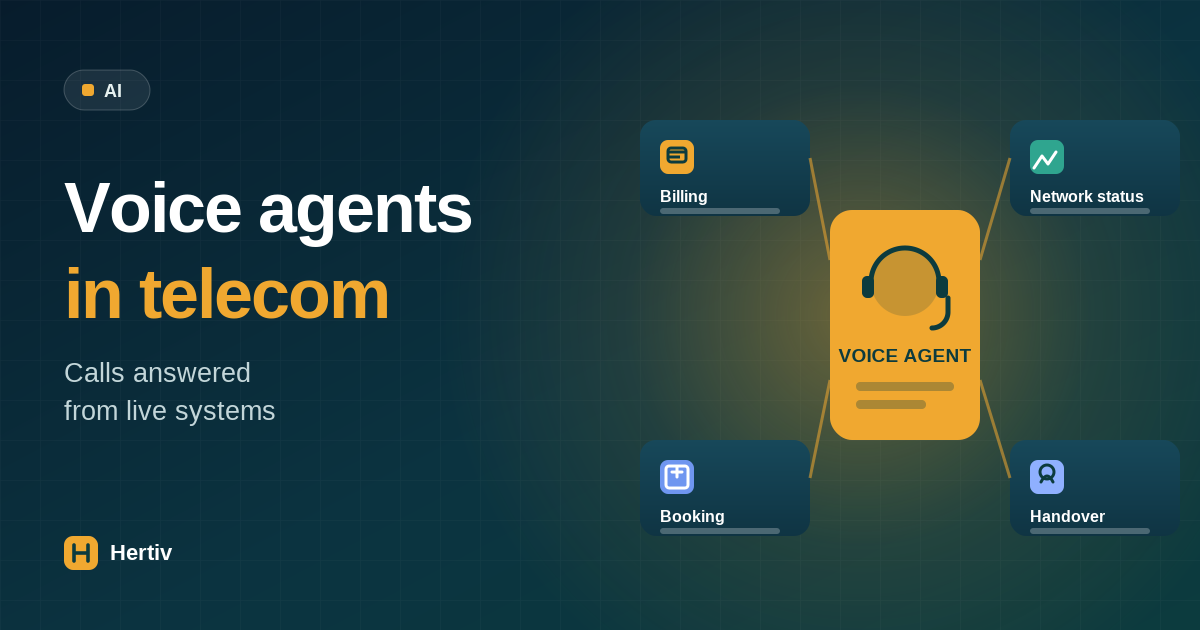
The agent is not a recorded menu. It listens to free speech, asks a follow-up question when the request is unclear, and keeps the context of the call as it goes. Behind it sit the same systems a human agent uses: billing, customer records, network status and appointment booking.
The table below shows where telecom voice agents are used most and what each one does.
| Use case | What the agent does | What it needs |
|---|---|---|
| Billing questions | Reads the bill and explains charges | Billing system access |
| Plan changes | Compares plans and applies the change | Product and pricing data |
| Fault reports | Logs the fault and checks the network | Network status data |
| Payment reminders | Reminds and takes a payment | Payment system access |
| Appointment booking | Books an engineer visit | Field scheduling system |
| New connections | Takes details and starts the order | Order and address checks |
The pattern is the same in every row: the agent answers from the carrier's own systems, not from general knowledge. A voice agent that guesses a bill amount or a network status will create complaints, so the answers must come from live data, and anything it cannot find should go to a human.
Where do AI voice agents help most?
AI voice agents help most where calls follow a pattern and the answer sits in a system the agent can read. Billing questions are the clearest case: most callers want to know what a charge is, when a payment is due, or why a bill changed, and all three answers come from the billing system.
Fault reporting is the second strong case. A customer who reports no service wants to know whether the network is down in their area and when it will be fixed. The agent can check the network status, confirm whether the fault is known, log the report and give a time window, all in one call.
Plan changes and appointment booking also work well, because they are structured: the agent asks a short set of questions, checks what is available, and applies the change or books the slot. The calls that do not fit are complaints, disputes and anything where the customer is upset: those need a person, because the value of the call is being heard, not just being answered.
For the wider picture of voice agents, see AI voice agent use cases.
How does a telecom voice agent work?
A telecom voice agent works by turning speech into text, working out what the caller wants, checking the carrier's systems, and speaking the answer back. Each step is a separate piece, and the quality of the whole call depends on the weakest one.
- Listen and transcribe. The caller's speech is turned into text in real time, including names, numbers and addresses.
- Work out the intent. The agent decides what the caller wants — a bill question, a fault report, a plan change — and what it still needs to know.
- Check identity. The agent verifies the caller with a code, a date of birth or a one-time passcode before reading account data.
- Look up the answer. It queries billing, network or scheduling systems and reads only what the caller is allowed to see.
- Act or answer. It speaks the answer, applies the change, books the slot or logs the fault, and confirms what it did.
- Hand over when needed. If the request is outside its scope, or the caller asks for a person, it passes the call with a summary of what happened so far.
The handover step is the one teams get wrong most often. A caller who has to repeat everything to the human agent will not call the voice agent again. The summary — who called, what was asked, what was checked — has to travel with the call.
What stays with a human agent?
Complaints, disputes and anything where the customer is upset stay with a human agent. A voice agent can apologise and log a complaint, but it cannot judge a goodwill payment, weigh a dispute or calm a customer who has been charged wrongly three times.
Complex sales also stay human. A customer choosing between plans for a family, a business or a move to a new address has trade-offs that depend on their situation, and a voice agent that pushes one plan will lose the sale. The agent can compare plans and take the details, but the recommendation needs a person.
Vulnerable customers need a human too. An elderly caller, a caller who does not speak the language well, or a caller in distress should reach a person quickly, and the voice agent should be designed to spot that and hand over without a fight. The test is simple: if the call needs judgement, empathy or a decision that cannot be reversed, a person should take it.
Example (hypothetical): a billing call pilot
Example (hypothetical): a telecom carrier takes 2,000 billing calls a week, and each call takes an agent about 6 minutes to handle. That is 2,000 x 6 = 12,000 minutes, or 200 hours, of agent time a week.
The carrier adds a voice agent that handles the simple billing questions — what a charge is, when a payment is due, how to set up a payment plan. In the pilot it resolves 60% of the calls, which is 1,200 calls x 6 minutes = 7,200 minutes, or 120 hours, saved a week.
The saving only holds if the answers are right. In the first month the team finds that 50 calls a week are handled wrongly and each one takes a human agent 12 minutes to fix, which is 600 minutes, or 10 hours, a week. The net saving is 120 - 10 = 110 hours a week, and the team uses the time to answer the complaints and disputes that the voice agent cannot handle.
The lesson is to measure the net saving, not the gross one. The review time and the fix time are part of the cost of using a voice agent, and a team that ignores them will think it saved more than it did.
What are the common mistakes?
The most common mistakes carriers make with AI voice agents are launching on every call type at once, letting the agent guess, and making handover hard.
- Launching too wide. Starting with billing, faults, sales and complaints at once means no call type works well. Start with one pattern, such as billing questions, and expand only when it works.
- Letting the agent guess. An agent that invents a bill amount or a fix time creates complaints that cost more than the time saved. If it cannot find the answer, it should say so and hand over.
- Bad handover. A caller who repeats everything to the human agent will not use the voice agent again. The summary must travel with the call.
- No identity check. Reading account data to an unverified caller is a privacy failure. Verify first, every time.
- Measuring calls, not outcomes. Counting how many calls the agent took says nothing about whether customers got the right answer. Measure resolution and complaints.
- Ignoring vulnerable callers. An agent that will not hand over to a person for a caller in distress will damage trust fast. Build the escape route first.
How to start with voice agents in telecom
You start with voice agents in telecom by picking one call pattern, wiring it to one live system, and running it as a pilot with a human safety net. The scope should be small enough to fix quickly when it goes wrong.
- Pick one call type. Billing questions are the usual first pick, because the answer sits in one system and the call follows a pattern.
- Wire it to live data. Connect the agent to the billing system so answers come from real records, and block it from guessing when data is missing.
- Build the handover. Make sure the call summary travels to the human agent, and that a caller can reach a person at any point.
- Pilot with a small share of calls. Route a tenth of billing calls to the agent, listen to the recordings, and fix the failure points before raising the share.
- Measure resolution and complaints. Track how many calls were resolved, how many needed a fix, and how many customers complained, then decide whether to expand.
For a related telecom use case, see document AI in telecom.
For another, see computer vision in telecom.
Key takeaways
- Billing calls follow a pattern, so they suit a voice agent first
- Answers must come from live systems, never from guessing
- Complaints, disputes and upset callers stay with a person
- The handover summary has to travel with the call
- Measure net hours saved, including review and fix time
Frequently asked questions
What is an AI voice agent in telecom?
It is a phone system that understands spoken customer requests, looks up account and network data, and answers or acts without a human agent. It handles billing questions, plan changes, fault reports and bookings, and passes the call to a person when judgement is needed.
What can a telecom voice agent do?
It can explain a bill, take a payment, compare plans, log a fault, check network status and book an engineer visit. All of these answers come from the carrier's own systems, which is what makes the agent useful instead of a recorded menu.
Can a voice agent replace human support agents?
No. It takes the routine calls so human agents can handle complaints, disputes and complex sales. A voice agent that tries to do everything will handle the hard calls badly, and customers who feel unheard will stop calling.
How do you keep customer data safe with a voice agent?
Verify the caller before reading any account data, using a code, a date of birth or a one-time passcode. Only read what the caller is allowed to see, log what the agent accessed, and never let it invent an answer.
How long does it take to launch a telecom voice agent?
A pilot for one call type usually takes a few months, including the system connection, the handover and the testing. Expanding to more call types takes longer, because each one needs its own data, checks and handover rules.
What should you measure after launch?
Track how many calls were resolved without a human, how many needed a fix, and how many customers complained. Those three numbers show whether the agent is helping; call volume alone says nothing about quality.


