AI Voice Agents in Banking: What Banks Use Them For
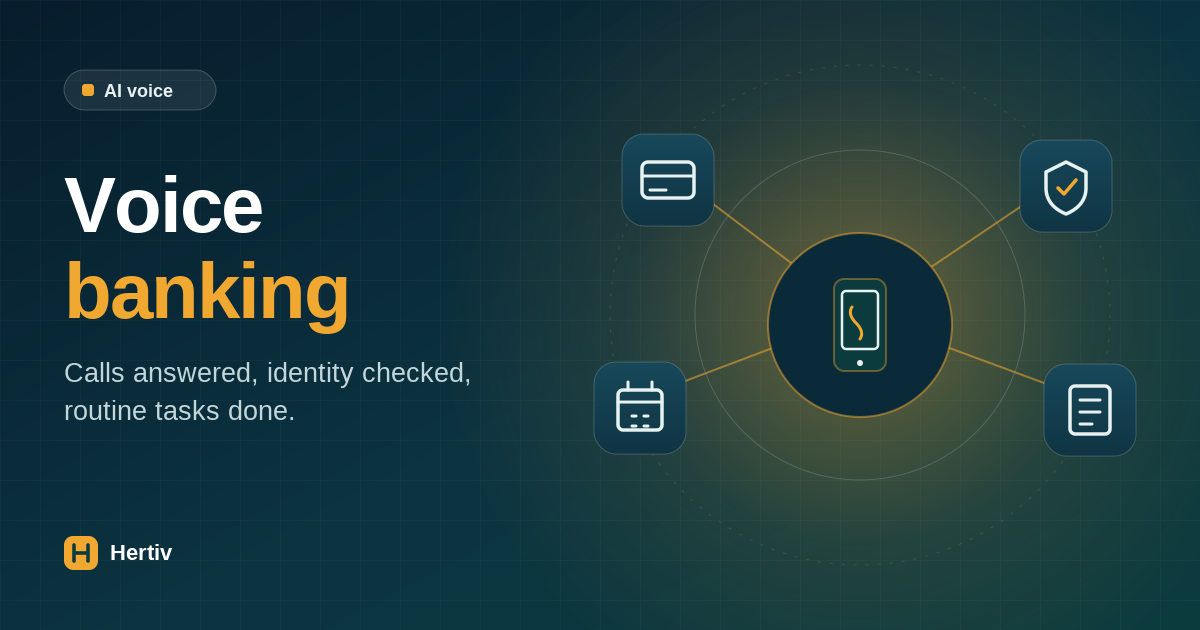
AI voice agents in banking answer customer calls, check identity, read live account data and complete routine tasks such as balance checks and card replacements.
On this page
Short answer
An AI voice agent in banking is a phone system that answers customer calls, checks identity, reads live account data and completes routine tasks such as balance checks, card replacements and loan updates. It handles the calls that follow a fixed pattern and passes the rest to a human adviser.
What is an AI voice agent in banking?
An AI voice agent in banking is a phone system that talks with customers in natural language, understands what they are asking for and acts on it using the bank's own systems. It can check a balance, report a lost card, confirm a payment or book an appointment, all in one call.
It is different from an old phone menu, which makes the caller press keys and follow a fixed path. A voice agent lets the caller speak freely, works out the intent and pulls the answer from live account data instead of a recorded script.
Banks use it because phone calls are still the channel customers trust most when money is involved. The agent answers at once, at any hour, and keeps the same tone and the same checks on every call, which is hard to do with a large human team alone.
What jobs do banking voice agents handle?
Most banking voice agents start with a short list of routine jobs and add more once the first ones work well. The list below covers the jobs that appear most often in retail banking, and each one follows a fixed pattern that the agent can check against live data.
| Job | What the agent does | Human step |
|---|---|---|
| Balance and transactions | Reads balances and recent payments | None for a routine check |
| Lost or stolen cards | Blocks the card and orders a new one | Fraud team if the loss is disputed |
| Payment and transfer help | Confirms, schedules or traces payments | Adviser for large or unusual transfers |
| Loan and mortgage updates | Reads status, balance and next payment | Adviser for a new application or change |
| Appointment booking | Books branch or adviser appointments | None for a standard booking |
| Password and access resets | Verifies identity and resets access | Security team if identity cannot be proven |
The pattern is the same across the industry, as the AI voice agents in finance overview shows, but banking adds its own rules around identity and fraud checks.
How do they handle account and card calls?
An account call starts with identity. The agent asks for the details the bank requires, checks them against its records and only then reads account data aloud. If the caller cannot pass the checks, the agent offers a safer route, such as a branch visit or a call-back, instead of guessing.
For a lost card, the agent blocks the card at once, confirms the block in plain words and orders a replacement to the address on file. It also asks whether any recent transactions look wrong, and if the caller says yes, it opens a dispute case and hands the call to the fraud team.
The agent never reads out full card numbers or passwords, and it does not change an address or a payment limit on a voice call alone. Those changes need a second check, which is a deliberate limit, not a missing feature. How an AI voice agent works explains the speech, intent and action steps behind these calls.
How do they help with fraud and security?
Voice agents help with fraud in two ways: they spot risky calls and they make the safe path easy. The system can flag a call that does not match the customer's usual pattern, such as a new number, an odd hour or a request that does not fit the account, and route it to a specialist.
When a customer reports a suspicious message or transaction, the agent records the details, checks whether the transaction is real and, if needed, freezes the card or the account while a human reviews it. Speed matters here, because a frozen card stops further loss while the case is checked.
The agent also warns callers about common scams in plain language, for example when someone asks for a one-time code or a transfer to a new account. It will never ask the caller to share a full password or a code, and it says so when the topic comes up.
Where do they fit in lending and onboarding?
In lending, a voice agent gives status updates and collects missing documents, but it does not approve loans. A customer can ask where an application stands, what the next payment is or which document is still missing, and the agent reads the answer from the loan system.
For onboarding, the agent can book an identity check, explain which documents to bring and remind the customer before the appointment. It can also answer the routine questions that come up after an account is opened, such as how to set up a payment or where to find a statement.
The line is clear: the agent handles information and scheduling, while a human adviser handles the decision, the advice and the exceptions. That split keeps the bank compliant and keeps the customer talking to a person when the stakes are high. The what is an AI voice agent explainer covers the same split in other industries.
What must stay with a human?
Anything that needs judgement stays with a human. That includes approving or refusing a loan, giving financial advice, handling a complaint, settling a disputed transaction and talking with a vulnerable customer who needs care rather than speed.
The agent should also hand over when the caller is upset, confused or repeating the same request. A good handover passes the call summary to the adviser, so the customer does not have to start again, and it says plainly that a person is joining the call.
Banks set these rules in writing before launch, and they test them with real calls. The test is not whether the agent can answer, but whether it knows when it should not, and whether the handover is fast enough that the customer does not hang up.
Example (hypothetical): a bank handles Monday morning calls
Example (hypothetical): a retail bank receives 1,000 calls on a Monday morning. Before the voice agent, 400 of those calls were routine balance and payment checks, each taking a human adviser 6 minutes, or 40 hours of adviser time in total.
After launch, the voice agent answers 320 of the 400 routine calls end to end, and 80 callers still ask for a person. The agent calls take 2 minutes each, or about 11 hours of system time, while the 80 handovers take 6 minutes each, or 8 hours of adviser time.
Adviser time on routine calls falls from 40 hours to 8 hours, a saving of 32 hours in one morning, and the saved time goes to loan calls and complaints. The bank keeps the human team the same size and measures success by shorter waits and fewer repeat calls, not by headcount.
Common mistakes
The first mistake is letting the agent guess when it does not know. A wrong balance or a wrong payment date damages trust fast, so the agent should say it cannot find the answer and hand over, rather than invent one.
The second mistake is weak identity checks. A friendly voice that hands out account details to the wrong person is a security failure, so the checks must be as strong as the ones a human adviser uses, even if that makes the call a little longer.
The third mistake is measuring only cost. A voice agent that cuts call time but pushes customers to call again has not helped anyone. Track repeat calls, handovers and customer satisfaction alongside cost, and fix the jobs that send people back. The AI chatbots in finance article covers the same measurement problem for text channels.
Key takeaways
- A banking voice agent answers calls, checks identity and completes routine tasks
- Balance checks, card blocks, payment help and appointment booking are the first jobs
- Fraud and security calls need fast freezing and a clear handover to specialists
- Lending decisions, advice and complaints must stay with a human adviser
- Measure repeat calls and handovers, not just cost, to judge whether it works
Frequently asked questions
Can a voice agent approve a loan?
No. It can give status updates, read the next payment and collect missing documents, but approval, refusal and advice stay with a human adviser. That split keeps the bank compliant.
How does a voice agent check my identity?
It asks for the details the bank requires, such as account details and a security answer, and checks them against its records before reading any account data. If the checks fail, it offers a safer route.
What happens if the agent cannot help?
It hands the call to a human adviser and passes on a summary, so the customer does not have to start again. A good handover says plainly that a person is joining.
Is it safe to report a lost card to a voice agent?
Yes, if the bank built it properly. The agent blocks the card at once, confirms the block and opens a dispute case if a transaction looks wrong. It never asks for a full password or code.
Do voice agents replace bank staff?
No. They take the routine calls so advisers have more time for lending, complaints and complex cases. Banks that do this well keep the same team and measure shorter waits.
Can I use a voice agent at night?
Usually yes. Voice agents answer at any hour, which is one reason banks use them. Routine jobs work the same at night, and urgent cases are routed to the on-call team.


