AI Strategy vs AI Implementation: What's the Difference?
AI strategy decides where AI will help your business and what it must prove. Implementation builds and runs the system that does the work.
On this page
Short answer
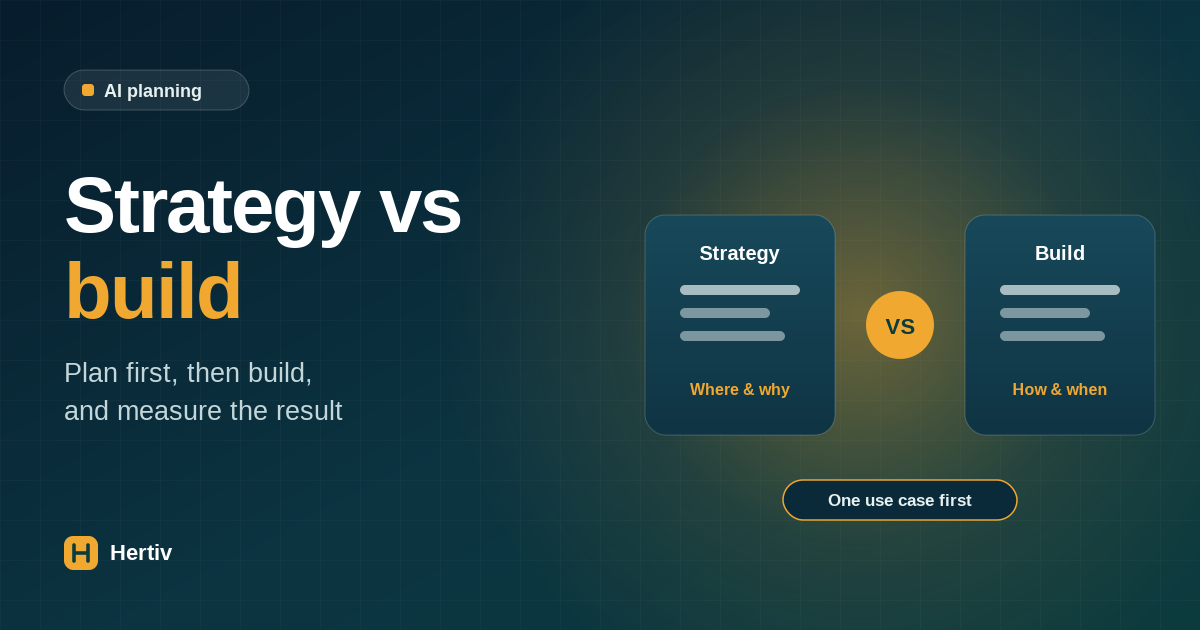
AI strategy is the plan for where artificial intelligence will help a business and what success looks like. AI implementation is the work of building, testing and running the system that delivers that plan. Strategy answers where and why; implementation answers how and when. Mixing them up is why many AI projects start fast and stall before they deliver value.
What is AI strategy?
AI strategy is a written plan that says where AI will help a business, which problems it will solve first, and how the business will know it worked. It starts from the business, not from the technology: which costs are too high, which work is too slow, and which customers are not served well enough.
A good strategy names three to five use cases, in order, with a clear owner and a clear measure for each one. For example, a support team might aim to answer routine questions faster, while a factory might aim to cut unplanned machine stops. Each use case gets a target, such as fewer hours spent or fewer errors made, and a date by which the result should show.
Strategy also decides what the business will not do. AI cannot fix bad data, unclear processes or a product nobody wants, and a strategy that admits that saves more money than one that promises everything. The plan should also say who owns the data, who checks the output, and what happens when the system is wrong. For a structured way to reach that plan, see an AI readiness assessment before you commit budget.
What is AI implementation?
AI implementation is the work of turning one use case from the strategy into a system people actually use. It covers the data, the model, the software around it, the tests and the rollout to real users. It starts small, with one use case and one team, and grows only when the first version proves its value.
Implementation has a clear order. First, the team collects and cleans the data the system needs, and checks that it is complete and lawful to use. Then it builds a first version, often a simple model or a test with an existing tool, and checks the output against real cases. Then it connects the model to the daily work, with a human check where mistakes are costly.
The last step is the one teams skip most often: watching the system after launch. Models drift as data changes, and a system that was right in January can be wrong by June. Implementation is not finished at launch; it includes the checks, the retraining and the fixes that keep the system useful.
AI strategy vs AI implementation compared
Strategy and implementation are two halves of the same job, and each one fails without the other. A strategy with no implementation is a document nobody uses. Implementation with no strategy is a tool looking for a problem, and it usually ends up solving the easiest problem instead of the most valuable one.
| Point | AI strategy | AI implementation |
|---|---|---|
| Main question | Where should AI help us? | How do we build it? |
| Output | A ranked list of use cases | A working system in daily use |
| Owner | Business leaders | Product and engineering teams |
| Timeframe | Months to years | Weeks to months per use case |
| Success measure | Value delivered per use case | Accuracy, uptime and adoption |
| Biggest risk | Picking the wrong problems | Shipping a system nobody trusts |
The two should run in a loop. Strategy picks the first use case, implementation builds it, and the result feeds back into the strategy: what worked, what the data showed, and what to build next. For the build itself, read how to build an AI proof of concept as the first implementation step.
How strategy and implementation connect
The connection is a single use case with a single owner. Strategy picks it, implementation builds it, and the owner is responsible for both the result and the rollout. Without an owner, the use case drifts: the strategy team moves on, the build team guesses, and nobody is responsible when users ignore the result.
A useful pattern is to run strategy and implementation in short cycles. Each cycle lasts a few weeks and covers one use case: agree the measure, build a first version, test it with real users, and decide whether to keep it, fix it or stop it. That cycle keeps strategy honest, because it must produce a use case that can be built, and it keeps implementation honest, because it must show a result.
Data is the shared ground between the two. Strategy must ask whether the data exists and is good enough, and implementation must say plainly when it is not. A strategy that assumes clean data will fail at the first build step, so the readiness check belongs in the strategy, not after it.
Example (hypothetical): a support team plans its first AI project
Example (hypothetical): a support team of 12 people handles 300 questions a day, and each one takes about 5 minutes, which is 25 hours a day of work. The strategy picks one use case: answer the 100 most common questions with an AI draft that a human checks before sending.
Implementation builds the draft system in four weeks. It uses past answers as the data, tests the drafts on 200 real questions, and finds that 160 drafts are good enough to send after a quick check. The human check takes about 1 minute per question, so the 100 common questions take about 1 hour 40 minutes a day instead of about 8 hours 20 minutes.
The team saves about 6 hours 40 minutes a day on those questions and uses the time for the harder cases. The result feeds back into the strategy: the next use case is the second most common group of questions, with the same owner and the same measure.
What to do first
Start with the strategy, but keep it short. Write down the three use cases that would help most, the measure for each one, and the owner. If you cannot name the measure, the use case is not ready, and no amount of building will fix that.
Then run a small implementation test on the first use case. A proof of concept that uses real data and real users for a few weeks tells you more than months of planning. It shows whether the data is good enough, whether users trust the output, and whether the saving is real.
Finally, decide in writing whether to keep going. A test that fails is useful, because it stops a bigger build that would also have failed. A test that works gives you the evidence to fund the next use case. For how to run that test, see how to test AI models before you scale.
Common mistakes
The most common mistake is starting to build before the strategy is written. A team that builds a chatbot because the technology is interesting, without asking which questions it should answer, ends up with a system that handles the wrong work and is ignored by the people it was meant to help.
The second mistake is treating strategy as a one-off document. A strategy written once and filed away does not survive contact with real data. It should be reviewed after each use case, with the results written in and the next use case chosen on evidence.
The third mistake is skipping the human check. A system that sends answers or makes decisions without a person in the loop will eventually make a costly mistake, and the business will lose trust in it. Build the check into the first version, not as an afterthought.
Key takeaways
- Strategy decides where AI helps; implementation builds the system.
- Each use case needs one owner and one clear measure.
- Start with one use case and a small test.
- Data quality decides whether implementation can succeed.
- Review the strategy after each use case, on evidence.
Frequently asked questions
Do I need a strategy before I build AI?
Yes, a short one. Without it you cannot tell whether the build is worth the money, because there is no measure to judge it against. A one-page plan with three use cases and a measure for each is enough to start.
How long does an AI strategy take?
A first strategy can take two to four weeks if the business knows its problems. It takes longer when the problems are unclear, and that is a sign to spend the time on the problems first.
Can implementation start before the strategy is finished?
A small test can run while the strategy is being written, as long as it uses one clear use case. A full build should wait until the strategy names the use case and its measure.
Who should own AI strategy?
A business leader who owns the problem the AI will solve, not the technology team alone. The technology team owns the build, and the two owners work together on each use case.
What if the first use case fails?
That is a useful result. Stop it, write down what the test showed, and pick the next use case. A failed test is far cheaper than a full build that fails the same way.
How do I know the strategy is working?
Each use case should show a measured result by its date, such as hours saved or errors cut. If no use case shows a result, the strategy needs to change.


