AI for Sales Closing and Order Entry: From Deal to Delivery
AI in sales closing and order entry checks contracts, approves discounts and turns a signed quote into an ERP order without retyping. Here is how the flow works.
On this page
Short answer
AI in sales closing and order entry is software that checks, drafts and moves the paperwork between a signed deal and a shipped order: it reviews contract terms, flags discount requests that need approval, and turns a signed quote into an order in the ERP without retyping.
What is AI in sales closing and order entry?
AI in sales closing and order entry is software that checks, drafts and moves the paperwork between a signed deal and a shipped order: it reviews contract terms, flags discount requests that need approval, and turns a signed quote into an order in the ERP without retyping.
Closing is the last stretch of a sale, where the rep agrees terms, gets the signature and hands the deal to operations. Order entry is what happens next: the order is created, validated against stock and price, and passed to fulfilment. AI helps in both places by reading documents, checking rules and catching mismatches early.
It does not replace the rep or the operations team. It removes the copy-and-paste work and the checks that are easy to miss when a deal closes late on a Friday. See AI in sales for where AI helps earlier in the pipeline.
How does AI help close a deal?
AI helps most in the review steps that slow a close down. It compares the draft contract against the standard terms and flags clauses that changed, checks that the discount fits the approval policy, and confirms the quote matches the price list before the customer signs.
It also keeps the close moving. It drafts the follow-up email from the call notes, reminds the rep when a signature is overdue, and summarises the agreed terms for the handover note. The rep still owns the negotiation and the relationship; the software handles the checks and the chasing.
The risk is letting the software approve what it should only flag. A discount above policy or a changed liability clause should go to a person, not through on a model score. The approval path is where AI agents for sales need a human in the loop.
How does AI handle order entry?
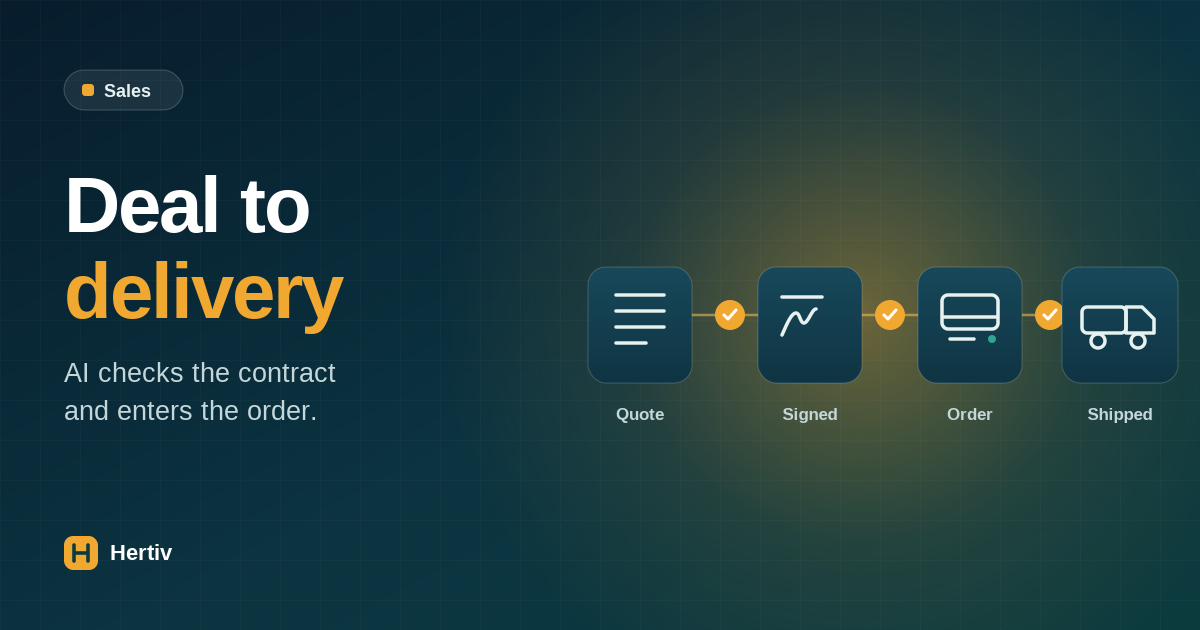
Order entry follows a fixed sequence, and AI can run most of it once the quote is signed. The table shows the steps and where a person still needs to look.
| Step | What AI does | What a person checks |
|---|---|---|
| Read the signed quote | Pulls items, prices and terms | Unusual terms or handwriting |
| Create the order | Builds the ERP order from the quote | Order number matches the quote |
| Validate price and stock | Checks price list and availability | Discounts above policy |
| Send to fulfilment | Passes the order with delivery date | Delivery date the customer agreed |
| Confirm with the customer | Drafts the confirmation email | Final wording before sending |
The biggest gain is accuracy. A mistyped quantity or an old price is caught at entry instead of at delivery, when fixing it costs a return or a credit note. The biggest risk is a silent failure: an order the system could not read that sits unprocessed, so every order needs a visible status and an owner.
What data and systems does it need?
The system needs the CRM record, the CPQ or quote tool, the e-signature record and the ERP, all joined on one order number. Without that link, the software cannot tell whether the signed quote and the created order are the same deal.
It also needs the rules written down: price lists, discount policy, tax rules and stock checks. A model that guesses prices from past orders will repeat past mistakes, so the rules come from the price list, not from history. That is the same discipline used in predictive analytics in sales, where the data must be clean before the model is trusted.
Start with one product line and one sales channel. A distributor with ten product lines and three channels should prove the flow on the simplest one, then add the rest once the error rate is measured.
Example (hypothetical): a distributor cuts order errors
Example (hypothetical): a distributor enters 400 orders a month by hand, and 24 of them (6%) contain an error: a wrong quantity, an old price or a missed delivery date. Fixing each error costs about 45 minutes of staff time and one delayed delivery.
The team adds AI order entry for its standard product line, which covers 300 of the 400 orders. Errors on those fall from 18 a month to 3, saving 15 errors times 45 minutes, which is 675 minutes, or 11 hours and 15 minutes a month, plus 15 fewer delayed deliveries. The remaining 100 orders stay manual until the flow is proven.
The pilot works because the team measures the error rate before and after. Without a baseline, nobody can tell whether the software helped or the team simply got more careful.
How do you start?
You start by mapping the current close-to-cash flow, counting the errors, and proving the flow on one product line before widening it. The steps below keep the pilot small enough to measure.
- Map the flow on one page. From signed quote to shipped order, write down every step, system and handover.
- Count the errors and rework. For one month, record how many orders contain an error and how long each fix takes, so the baseline is real.
- Pick one product line and one channel. Prove the flow on the simplest case before adding the rest.
- Connect the four systems. Join the CRM, quote tool, e-signature and ERP on one order number.
- Write the rules down. Price lists, discount policy, tax rules and stock checks go in one place the software checks against.
- Run the pilot for a month. A person reviews every order the software creates, then the team widens it once the error rate is measured.
What are the common mistakes?
The most common mistakes in AI sales closing and order entry are letting the software approve what it should only flag, and connecting only some of the systems.
- Letting the software approve discounts. A discount above policy or a changed liability clause should go to a person, not through on a model score.
- Connecting only some systems. If the order number does not match across CRM, quote tool and ERP, the team cannot tell which order belongs to which deal.
- No visible status for unreadable orders. An order the system could not read should appear in a queue with an owner, not sit silently unprocessed.
- Skipping the baseline. Without an error count from before the pilot, nobody can prove the software helped.
- Rolling out to every product line at once. One product line proves the flow; ten at once multiply the failure modes.
- Treating the handover note as optional. If operations has to guess at the agreed terms, the deal will be fulfilled wrong.
Key takeaways
- AI checks contracts, discounts and prices at closing, and catches errors before the customer signs
- Order entry runs quote to ERP order in fixed steps, with a person checking discounts and delivery dates
- CRM, quote tool, e-signature and ERP must share one order number or the flow breaks
- Measure the error rate before the pilot, or you cannot prove the software helped
- Discounts above policy and changed contract clauses always go to a person
Frequently asked questions
What does AI do in sales closing?
It reviews the draft contract against standard terms, checks the discount against approval policy, confirms the quote matches the price list, and drafts follow-ups and the handover note. The rep still owns the negotiation and the relationship.
Can AI sign contracts for you?
No. AI can prepare and check the contract, but the signature and the commercial decision stay with a person. E-signature tools record who signed and when, and the AI only checks that the signed terms match the agreed quote.
What systems does AI order entry need?
The CRM record, the CPQ or quote tool, the e-signature record and the ERP, all joined on one order number. It also needs the price list, discount policy, tax rules and stock checks written down in one place.
How do you measure whether it works?
Track the order error rate, the time spent fixing errors, and the share of orders created without retyping. Compare one month before the pilot with one month after, on the same product line.
Does AI replace the sales rep at closing?
No. It handles the checks and the paperwork: contract comparison, discount checks, order creation and confirmations. The rep still negotiates, judges the deal and owns the customer relationship from first call to signed order.
What goes wrong most often?
Order numbers that do not match across systems, discounts approved by software instead of a person, and orders the system could not read sitting unprocessed with no owner. All three are fixed by joining systems on one order number and giving every order a visible status.


