AI Roadmap for Food and Beverage Companies
An AI roadmap for food and beverage companies turns scattered ideas into a plan: pick one problem, fix the data, run a pilot, then scale what works.
On this page
Short answer
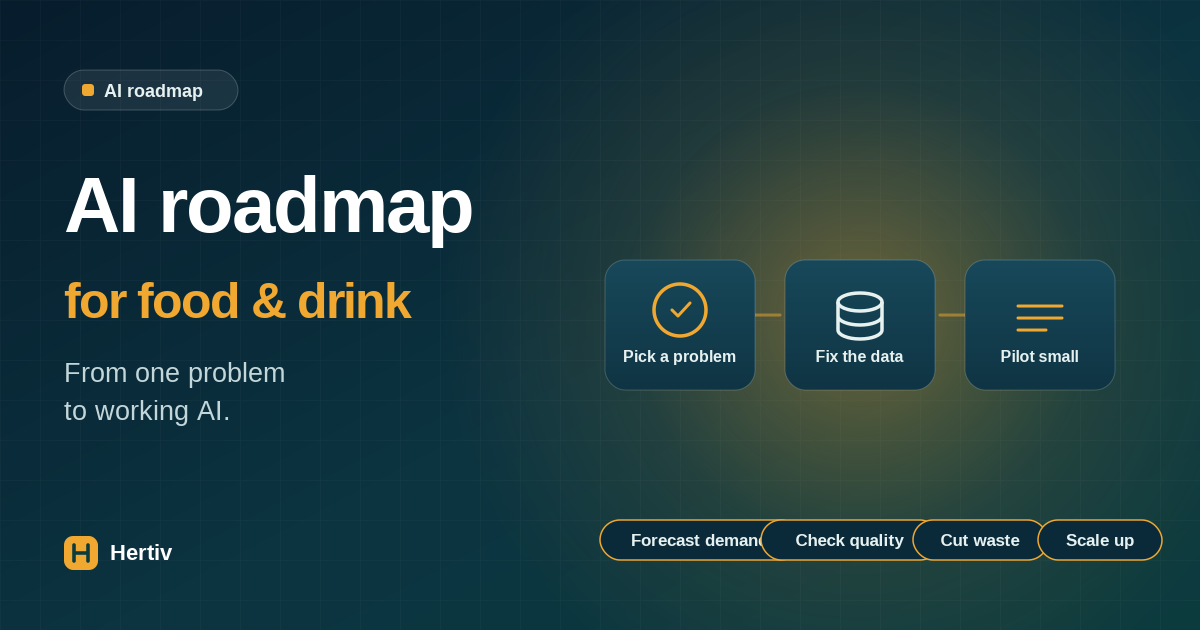
An AI roadmap for food and beverage companies is a plan that takes AI from scattered ideas to working systems, one step at a time. It starts with a single clear problem, fixes the data behind it, tests a small pilot, and only then scales. These eight steps give that plan its shape.
Eight steps of an AI roadmap at a glance
These eight steps take a food and beverage company from first idea to a working AI system. Each step builds on the one before it, so skipping ahead usually costs time later.
| Step | What you do | What it gives you | Timeframe |
|---|---|---|---|
| 1. Pick one problem | Choose a clear, costly problem | A goal everyone understands | Weeks 1-2 |
| 2. Fix the data | Clean and connect the data | Reliable inputs for any model | Weeks 2-6 |
| 3. Run a small pilot | Test AI on one line or site | Proof it works before you spend more | Weeks 6-12 |
| 4. Measure results | Compare pilot to the old way | A decision based on numbers | Weeks 12-14 |
| 5. Train the team | Teach staff to use and check it | People who trust the system | Weeks 12-16 |
| 6. Scale what works | Roll out to more lines or sites | Value across the business | Months 4-9 |
| 7. Add governance | Set rules for data, safety and review | AI you can defend | Months 6-12 |
| 8. Keep improving | Review, retrain and add new uses | AI that stays useful | Ongoing |
The roadmap is deliberately slow at the start. The first two steps, picking a problem and fixing the data, decide whether the rest works. A pilot built on messy data will fail, and the team will blame the AI instead of the data.
1. Pick one problem: best for getting a clear starting point
1. Pick one problem: best for getting a clear starting point
Pick one problem that costs real money or time, such as demand forecasting, quality checks or stock waste. The problem should be easy to describe and easy to measure, so you can tell whether the AI helped.
Avoid starting with a vague goal such as "use AI everywhere". A narrow problem gives the team a target, a budget and a way to judge the result. Good first problems in food and beverage include forecasting demand for a product line, spotting defects on a packing line, or cutting waste in a warehouse.
Pros:
- Clear goal the whole team understands
- Easy to measure success
- Small scope keeps the pilot cheap
Cons:
- Other teams may feel left out
- One problem may not show the full value
- Needs a sponsor who will defend the choice
2. Fix the data: best for making the pilot work
Fix the data before you build anything. That means finding where the data lives, cleaning it, and connecting it so the AI can use it. Most food and beverage companies hold data in several systems: sales, production, stock and suppliers.
The work is unglamorous but it decides the outcome. A model trained on missing or wrong data will give wrong answers, and no amount of tuning will fix that. Spend the time here and the pilot has a fair chance. See how to prepare data for AI for the detail.
Pros:
- Better data helps every later step
- Exposes problems you did not know about
- Cheap compared with rebuilding a failed pilot
Cons:
- Slow and hard to show off
- Needs access to several systems
- Data owners may resist sharing
3. Run a small pilot: best for proving value before spending more
3. Run a small pilot: best for proving value before spending more
Run a small pilot on one product line, one site or one process. The pilot should run for long enough to show a real result, usually a few weeks, and it should run alongside the old way so you can compare.
Keep the pilot narrow on purpose. A demand forecast for one product line is a good pilot; a forecast for the whole catalogue is not. The pilot's job is to prove the idea, not to transform the company.
Pros:
- Low cost and low risk
- Real numbers to decide with
- Team learns how AI behaves in practice
Cons:
- Small pilots can be dismissed as too small
- Needs staff time alongside daily work
- Results may not transfer to other lines
4. Measure results: best for deciding with numbers
Measure results by comparing the pilot with the old way on the same measure. For demand forecasting, compare forecast error. For quality checks, compare defects missed. For waste, compare stock thrown away.
Decide the measure before the pilot starts, not after. If you choose the measure after seeing the results, you will pick the one that looks best. A fair measure, agreed in advance, makes the decision easy: scale it, fix it, or stop it.
Pros:
- Decision based on numbers, not opinions
- Shows the value to people who fund the work
- Finds problems early, while they are cheap
Cons:
- Some benefits are hard to measure
- Needs clean before-and-after data
- Short pilots may miss seasonal effects
5. Train the team: best for getting people to trust the system
5. Train the team: best for getting people to trust the system
Train the team to use the AI system and to check its work. Staff need to know what the system does, when to trust it, and when to overrule it. A forecast that nobody trusts will be ignored, however good it is.
Training should include the limits. Show the team where the system makes mistakes, how to spot them, and who to tell. People who understand the limits use the system well; people who do not either trust it too much or not at all.
Pros:
- Staff use the system instead of working around it
- Mistakes get caught early
- Builds skills the company keeps
Cons:
- Takes time away from daily work
- Needs training materials and a trainer
- Some staff will resist the change
6. Scale what works: best for turning a pilot into value
Scale what works by rolling the pilot out to more lines, sites or products, one at a time. Each rollout should reuse the same data work, the same checks and the same training, so it gets faster each time.
Do not scale everything at once. Roll out to the next most similar line first, measure again, and then move on. Scaling too fast spreads the team thin and hides problems until they are expensive. For examples of what AI can do in this sector, see generative AI use cases in food and beverage.
Pros:
- Value grows with each rollout
- Each rollout is faster than the last
- Proven system, so less risk
Cons:
- Needs more staff and budget
- Different sites may need different data work
- Early wins can create pressure to rush
7. Add governance: best for AI you can defend
7. Add governance: best for AI you can defend
Add governance once AI is used beyond a single pilot. That means rules for who can see the data, how models are tested, who approves changes, and how mistakes are handled. Governance sounds heavy, but it is what lets you scale without losing control.
Keep it light at first: a named owner for each system, a log of changes, and a regular review of results. Add more as the number of systems grows. The goal is to know what each AI system does, what data it uses, and who is responsible for it.
Pros:
- Clear ownership for each system
- Easier to pass audits and customer checks
- Mistakes are caught and fixed faster
Cons:
- Can slow down new ideas if too heavy
- Needs someone to own it
- Rules must be updated as systems change
8. Keep improving: best for AI that stays useful
Keep improving by reviewing each system regularly, retraining models on new data, and adding new uses when the old ones work. Food and beverage data changes with seasons, suppliers and products, so a model left alone will slowly get worse.
Set a review rhythm: monthly checks on the key measures, and a deeper review each quarter. Use the review to decide what to retrain, what to retire, and what to try next. A roadmap that stops at launch is not a roadmap; it is a project that ends.
Pros:
- Systems stay accurate as data changes
- New uses build on proven work
- Team keeps learning
Cons:
- Needs ongoing time and budget
- Easy to neglect when the launch is over
- Retraining can introduce new errors
How to choose where to start your AI roadmap
Choose where to start by ranking problems on value, data readiness and ease of measurement, then picking the one that scores well on all three.
- List the problems. Ask operations, sales and quality teams where they lose time or money.
- Score each one. Rate value, data quality and how easy it is to measure the result.
- Pick the best first pilot. Choose the problem with good data and a clear measure, not the biggest one.
- Check the sponsor. Make sure one senior person will defend the pilot and its budget.
- Set the measure. Agree how you will judge success before the pilot starts.
If no problem has good data, fix the data first. A roadmap that starts with a data project is still a roadmap, and it is far cheaper than a pilot built on bad data. An AI readiness assessment can help score the options.
What are the common mistakes?
The most common AI roadmap mistakes are starting too big, skipping the data work, and measuring success after the fact.
- Starting with the biggest problem. Big problems have messy data and many owners. Start small and prove it.
- Skipping data work. A model on bad data gives bad answers, and the team blames the AI.
- No agreed measure. Without a measure set in advance, every result looks like success.
- Scaling a pilot that has not been measured. Roll out only what the numbers support.
- No owner after launch. A system with no owner slowly gets worse until nobody trusts it.
Key takeaways
- Start with one clear, measurable problem
- Fix the data before building anything
- Prove value with a small pilot, then scale
- Train the team so the system is trusted and checked
- Governance and regular review keep AI useful
Frequently asked questions
How long does an AI roadmap take in food and beverage?
A first pilot usually takes two to three months from problem selection to measured results. Scaling to more lines or sites takes longer, often six to twelve months, depending on how many sites there are and how ready the data is.
What is the best first AI use case for a food company?
Demand forecasting is a common first use, because the data usually exists and the result is easy to measure. Quality checks on a packing line and stock waste reduction are also good first pilots for the same reasons.
Do we need to hire AI experts to follow this roadmap?
Not at first. A pilot can be run with a small team and outside help for the technical build. What matters more is a sponsor inside the company, clean data and staff who will use the system. Hire specialists once the pilot proves the value.
How much does an AI roadmap cost?
The cost depends on the size of the pilot and how much data work is needed. A small pilot is far cheaper than a company-wide rollout, which is why the roadmap starts small. Ask vendors for current pricing before committing to a build.
What data do food and beverage companies need for AI?
The most useful data is sales history, production records, stock levels, supplier deliveries and quality results. The data needs to be clean, connected and labelled so the model can learn from it. Missing or inconsistent data is the most common blocker.
How do we handle food safety rules with AI?
AI should support food safety checks, not replace them. Keep a human in the loop for safety decisions, log what the system did, and make sure the system follows the same rules your team already follows. Governance covers this once AI moves beyond a pilot.


