AI Risk Scoring in Insurance: How It Works
AI risk scoring estimates how likely a policyholder is to claim and how large that claim may be, so underwriters can price risk and focus on the borderline cases.
On this page
Short answer
AI risk scoring uses machine learning to estimate the likelihood and size of future claims from applicant, asset, claims and external data. The score ranks applications so underwriters focus on borderline cases while low-risk ones move faster, with a human owning the final decision.
What is AI risk scoring in insurance?
AI risk scoring in insurance is the use of machine learning models to estimate how likely a policyholder is to make a claim, how large that claim may be, and how that risk should be priced. The model reads data about the applicant, the asset and past claims, then returns a score that underwriters use alongside their own judgement.
The score does not decide the policy on its own. It ranks applicants so underwriters spend their time on the borderline cases, while clear-cut low-risk cases move faster. That ranking is the main value: speed for straightforward applications and attention where it matters.
A typical score draws on application data, claims history, external data such as weather or crime records, and the behaviour of similar policies. The model learns patterns from past outcomes, then applies them to new applications. For the wider picture of how insurers use AI, see AI for insurance.
What goes into a risk score?
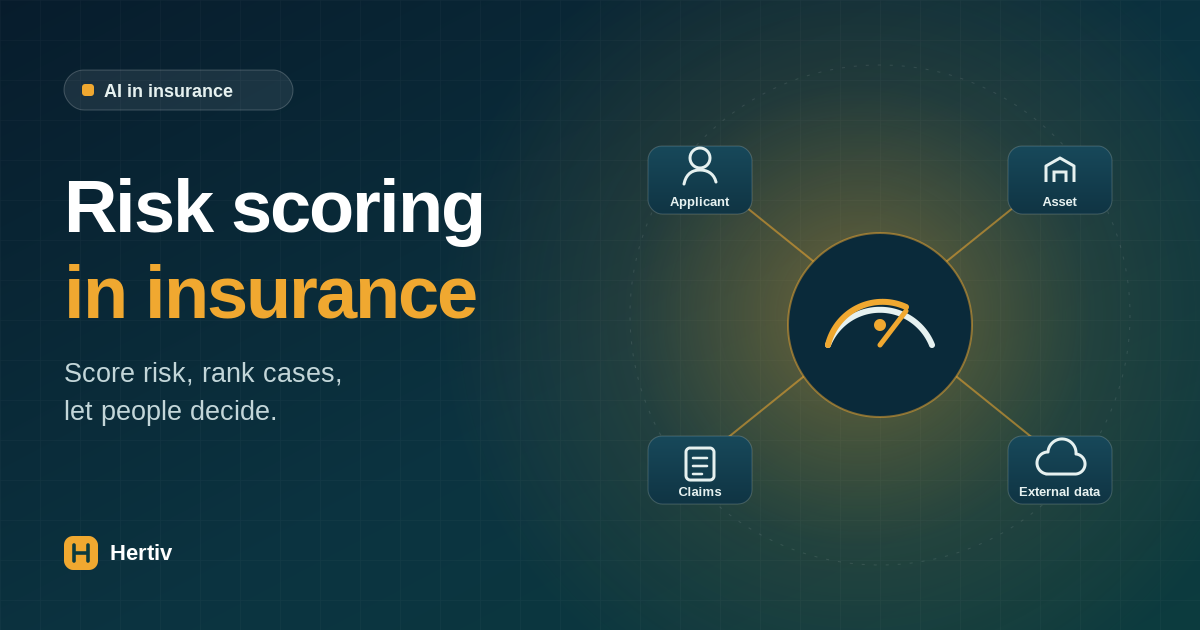
A risk score is only as good as the data behind it. The inputs fall into four groups, and each one needs to be accurate, current and lawful to use in the market where the policy is sold.
| Input group | Examples | What it tells the model |
|---|---|---|
| Applicant data | Age, location, occupation | Base risk profile |
| Asset data | Vehicle, property, health history | What is being insured |
| Claims history | Past claims, fraud flags | How this risk behaved before |
| External data | Weather, crime, traffic records | Risk in the surrounding area |
External data is where most projects go wrong. A dataset that looks useful can be stale, biased or restricted, and a model trained on it will repeat those problems at scale. Every input needs an owner, a refresh schedule and a check that its use is allowed.
How does risk scoring change underwriting?
Risk scoring changes underwriting by turning a manual queue into a sorted one. Instead of reviewing every application in arrival order, underwriters see the highest-risk and most uncertain cases first, while low-risk applications can be approved automatically within clear rules.
The usual setup has three bands. Low-risk applications pass straight through with a standard price. Mid-risk applications go to an underwriter with the model's reasons attached. High-risk applications get a deeper review, a higher price, or a decline. The bands are set by the insurer, not by the model, and they can be adjusted as results come in.
This only works if the model's reasons are visible. An underwriter who sees only a number cannot explain a decision to a customer or a regulator, so the score must come with the factors that drove it. That explanation is also what lets the team spot when a model starts drifting.
Where does risk scoring help beyond pricing?
Risk scoring helps beyond pricing in claims triage, fraud detection and renewals. The same patterns that predict a claim can also flag which claims need a closer look and which policyholders are likely to leave at renewal.
In claims, a score can route simple claims to fast settlement and send unusual ones to investigators. The key is that the score supports the handler, not replaces them: a high score means look closer, not assume fraud. False accusations cost more than the fraud they catch.
At renewal, scores can flag policies where the risk has changed, for example a property in an area with new flood exposure, so the price can be reviewed before renewal rather than after a claim. Teams that automate this work often pair scoring with workflow tools; see automation in insurance for how that fits together.
What data and governance do you need?
A risk scoring project needs clean historical data, a labelled outcome to learn from, and governance that covers fairness, privacy and audit. Without those, the model is a guess with good branding.
The minimum data set is several years of policies with their outcomes: who claimed, how much, and when. You also need the application data as it looked at the time, not as it looks now, or the model learns from information it would not have had. That point-in-time view is the most common data mistake in scoring projects.
Governance covers three checks. First, fairness: test whether the model treats similar applicants differently across groups it should not distinguish. Second, privacy: confirm every input is lawful to use in each market. Third, audit: log every score, its inputs and its version, so a decision can be explained months later. For the agent side of insurance AI, see building AI agents for insurance.
Example: a motor insurer triages 10,000 applications a month
Example (hypothetical): a motor insurer receives 10,000 applications a month. Manual review takes 30 minutes each, which is 300,000 minutes, or 5,000 hours of underwriter time every month.
The insurer adds a risk score with three bands. The model marks 7,000 applications as low risk, and those are approved automatically within set rules. The remaining 3,000 go to underwriters, taking 3,000 times 30 minutes, or 1,500 hours.
That frees 3,500 hours a month, which the team spends on the borderline cases, fraud review and pricing work. The saving is real, but only because the low-risk band was set conservatively and reviewed weekly for the first three months. A band set too wide would have approved risks the model did not understand.
What are the common mistakes?
The most common mistakes are training on the wrong data, trusting the score too far, and skipping the explanation layer.
- Training on current data instead of point-in-time data. The model learns from facts it would not have had at decision time.
- Letting the score decide alone. A score ranks risk; a person owns the decision, especially for declines.
- No fairness testing. A model can repeat historical patterns that no longer reflect policy or law.
- Stale external data. Weather, crime and traffic data go out of date fast and quietly.
- No monitoring after launch. Risk patterns shift, and a model that is not re-checked will drift.
- Starting with the riskiest product line. Pilot on a simple product where mistakes are cheap.
Key takeaways
- AI risk scoring ranks applicants by expected claim likelihood and size.
- Scores work best as a triage tool, not as a standalone decision maker.
- Point-in-time data matters: the model must learn from facts available at decision time.
- Every score needs an explanation an underwriter can defend.
- Fairness, privacy and audit checks belong in the design, not after launch.
Frequently asked questions
What is AI risk scoring in insurance?
It is the use of machine learning to estimate how likely a policyholder is to claim and how large the claim may be. The model reads applicant, asset, claims and external data, then returns a score that underwriters use to rank applications and price risk.
Does AI risk scoring replace underwriters?
No. The score ranks and triages applications, but a person owns the decision, especially for declines and borderline cases. Underwriters also set the risk bands, review the model's reasons and handle the cases the model cannot judge well.
What data does a risk scoring model need?
It needs several years of policies with their outcomes, application data as it looked at decision time, and lawful external data such as weather or traffic records. Every input needs an owner, a refresh schedule and a check that its use is allowed.
How do insurers check a scoring model for fairness?
They test whether similar applicants receive different scores for reasons that should not matter, and they review the factors driving the score. Fairness testing, privacy review and audit logging should be built into the project from the start.
Can risk scoring help with fraud?
Yes, in triage. A score can flag unusual claims for closer review by investigators. It should never be treated as proof of fraud on its own, because false accusations cost more than the fraud they catch.
How long does a risk scoring project take?
A pilot on a simple product line can run in a few months when historical data is clean. Production use takes longer, because it needs point-in-time data, explanation tooling, fairness testing and monitoring before the model touches real decisions.


