AI Quality Control in Manufacturing: How It Works
AI quality control in manufacturing uses cameras, sensors and models to check parts, spot drift and flag faults earlier than manual checks. Here is how it works.
On this page
Short answer
AI quality control in manufacturing is the use of cameras, sensors and machine learning models to inspect parts and processes, and to flag defects, drift and faults as they happen. It checks far more units than sampling can, catches small changes before they become scrap, and records every decision so teams can trace a fault back to its cause.
What is AI quality control in manufacturing?
AI quality control in manufacturing is the use of cameras, sensors and machine learning models to check products and processes against a quality standard, and to flag anything that does not match. It replaces or extends sampling, where a person checks a few units from each batch.
The key difference is coverage. A person can inspect a sample; a camera and a model can inspect every unit on the line, at line speed, without getting tired. That matters most where defects are rare but costly, or where a fault in one part affects the whole batch.
AI quality control covers four kinds of checks:
| Check | What AI looks at | Typical use |
|---|---|---|
| Incoming materials | Supplier parts and raw material | Wrong parts, damaged goods |
| In-process | Parts during production | Cracks, missing parts, wrong fit |
| Final inspection | Finished products | Cosmetic flaws, labelling, packing |
| Predictive | Machine and process data | Drift, wear, early failure signs |
Most plants start with one check, usually final or in-process inspection, and add the others once the first one is stable.
How does AI quality control work?
AI quality control works by comparing what a camera or sensor sees against what a good part looks like, and raising an alert when the difference is large enough. The model learns the difference from labelled examples of good and bad parts.
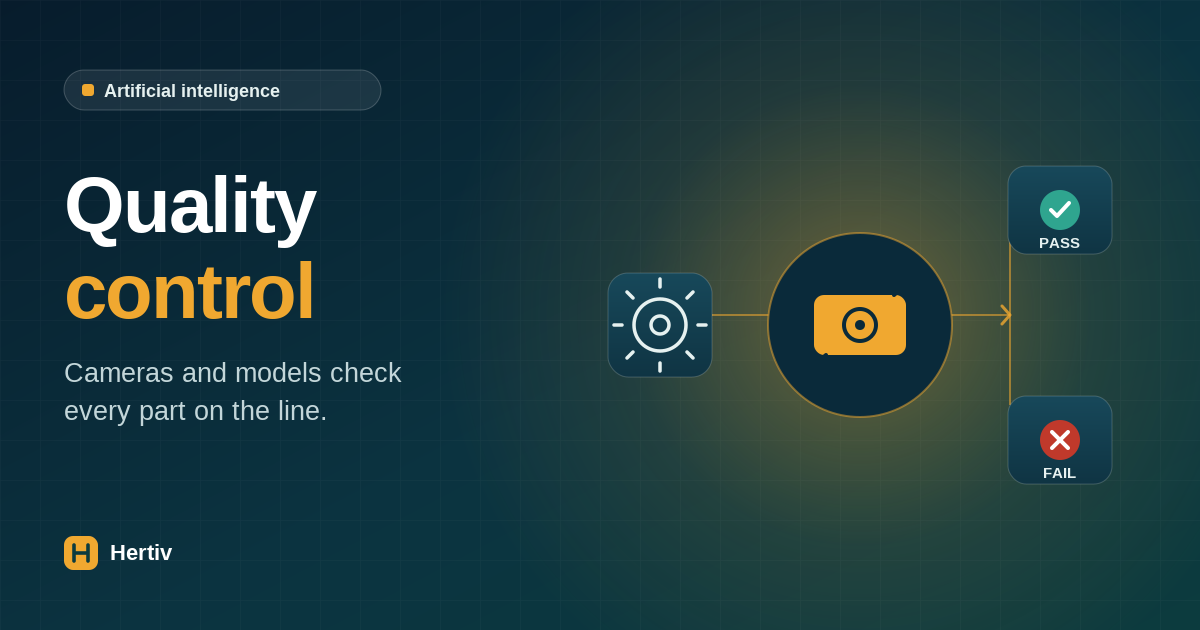
A typical setup has four parts. A camera or sensor captures the part. A model scores the image or reading. A rule decides pass, fail or send to a human. The result is logged with the image, so a rejected part can be reviewed later.
Vision models handle surface defects such as scratches, cracks and missing parts. Sensor models watch vibration, temperature and pressure for drift that a camera cannot see. The two are often combined: the camera checks the part, the sensors check the machine that made it.
For the inspection-agent pattern, where a software agent runs the checks and routes results, see quality control inspection AI agents.
Computer vision development covers building the vision side of the system.
Where does AI quality control fit best?
AI quality control fits best where volume is high, tolerances are tight, or a missed defect is expensive. Electronics, automotive parts, food packaging and pharmaceutical lines are common starting points.
It also fits where defects are hard for people to spot: tiny cracks, colour shifts, or faults that only appear under certain light. A camera with the right lighting sees these consistently, while a person checking hundreds of parts an hour will miss some.
It fits less well where quality is a matter of taste, such as the feel of a fabric or the finish of a handmade product. It also struggles where good examples are rare, because the model needs enough labelled images of both good and bad parts to learn from.
What data and setup does it need?
AI quality control needs labelled examples, stable lighting and a way to act on the result. The data side is usually the hardest part of the project.
- Labelled images or readings. Examples of good parts and of each defect type, labelled by someone who knows the product. A few hundred examples per defect type is a common starting point.
- Stable capture conditions. Fixed camera position, consistent lighting and a clean background, so the model learns the part and not the shadows.
- A decision rule. What happens on a fail: stop the line, divert the part, or send it to a human? The rule must be agreed before the model goes live.
- Integration with the line. A way to trigger the camera, read the result and log it against the batch or serial number.
Models also need retraining when the product changes. A new part design, a new supplier or a different material can all shift what a good part looks like, so plan for regular updates rather than a one-off build.
How do you start with AI quality control?
You start with AI quality control by picking one defect on one line, proving the model catches it, and then expanding. A narrow first project teaches the team what good data looks like.
- Pick the defect. Choose the fault that costs the most when it escapes, and where you already have examples.
- Collect and label data. Gather images of good and bad parts from the real line, labelled by your quality team.
- Build a small pilot. Run the model beside the existing checks for a few weeks and compare its calls with human decisions.
- Set the decision rule. Agree what happens on pass, fail and uncertain, and who reviews the uncertain cases.
- Go live on one line. Run it in production, log every decision, and review the misses weekly.
- Expand step by step. Add defect types and lines only after the first one is stable and trusted.
Keep a human in the loop for uncertain cases. A model that sends its unsure calls to a person is more useful than one that guesses, and the reviewed cases become training data for the next version.
Example: a parts line checks every unit
Example (hypothetical): a factory makes 8,000 metal brackets a week. Manual sampling checks 400 of them, which is 5% of output, and the defect rate is 1.5%, so about 120 defective brackets leave the line each week.
Sampling catches about 5% of those defects, roughly 6 brackets, and the other 114 reach customers or the next assembly step. The team installs a camera and a vision model that checks all 8,000 brackets and catches 90% of defects, which is 108 of the 120.
Escaped defects fall from 114 a week to 12. The 12 uncertain cases go to a human reviewer, who also labels them for the next training round. The line keeps its speed, and the quality team spends its time on real faults instead of random samples. For the scrap-reduction angle, see how AI cuts manufacturing errors and scrap.
What are the common mistakes?
The most common mistakes are training on clean lab images, skipping the decision rule, and trusting the model without a review loop.
- Training on perfect images. A model trained on clean studio photos fails on a real line with dust, glare and vibration. Train on images from the actual line.
- No decision rule. A model that flags defects but has no agreed action just creates a pile of alerts nobody owns.
- Ignoring false alarms. If the model rejects too many good parts, operators start ignoring it. Track the false alarm rate weekly.
- Forgetting retraining. Products change, and a model that is never updated slowly drifts away from what a good part looks like.
- Measuring the wrong thing. Accuracy on a test set is not the goal; escaped defects and false alarms in production are.
Key takeaways
- AI quality control checks every unit, not a sample, so rare defects get caught
- Vision models handle surface defects; sensor models catch drift a camera cannot see
- Start with the most expensive defect on one line, not with every check at once
- Labelled images from the real line matter more than model choice
- Keep a human review path for uncertain cases and retrain when the product changes
Frequently asked questions
What is the difference between AI quality control and automated inspection?
Automated inspection uses fixed rules, such as a sensor that rejects parts over a size limit. AI quality control uses a model that learns what good and bad parts look like, so it can catch defects that are hard to describe as a fixed rule.
How much labelled data does AI quality control need?
It depends on the defect. A few hundred labelled examples per defect type is a common starting point for vision models. Rare defects take longer to collect, which is why teams often start with the most common fault.
Can AI quality control replace human inspectors?
No. It replaces repetitive sampling, not judgement. Humans still handle uncertain cases, new defect types and the final call on borderline parts. The model lets them spend time on real faults instead of random samples.
Does AI quality control slow the production line?
It should not, if the camera and model are matched to line speed. Most vision checks run in well under a second per part. The pilot phase should measure cycle time before going live.
What happens when the product design changes?
The model needs new labelled examples of the changed part, because what a good part looks like has shifted. Plan for retraining as part of normal product change, not as a separate project.
Is AI quality control only for large factories?
No. Small lines benefit too, especially where one defect type is costly. A single camera station on one line is a common starting point for smaller manufacturers, and it can pay for itself by catching the expensive fault early.