AI Property Appraisal: How Automated Valuations Work
AI property appraisal estimates a home's value from recent sales, property features and market data. Learn how automated valuations work and when to trust them.
On this page
Short answer
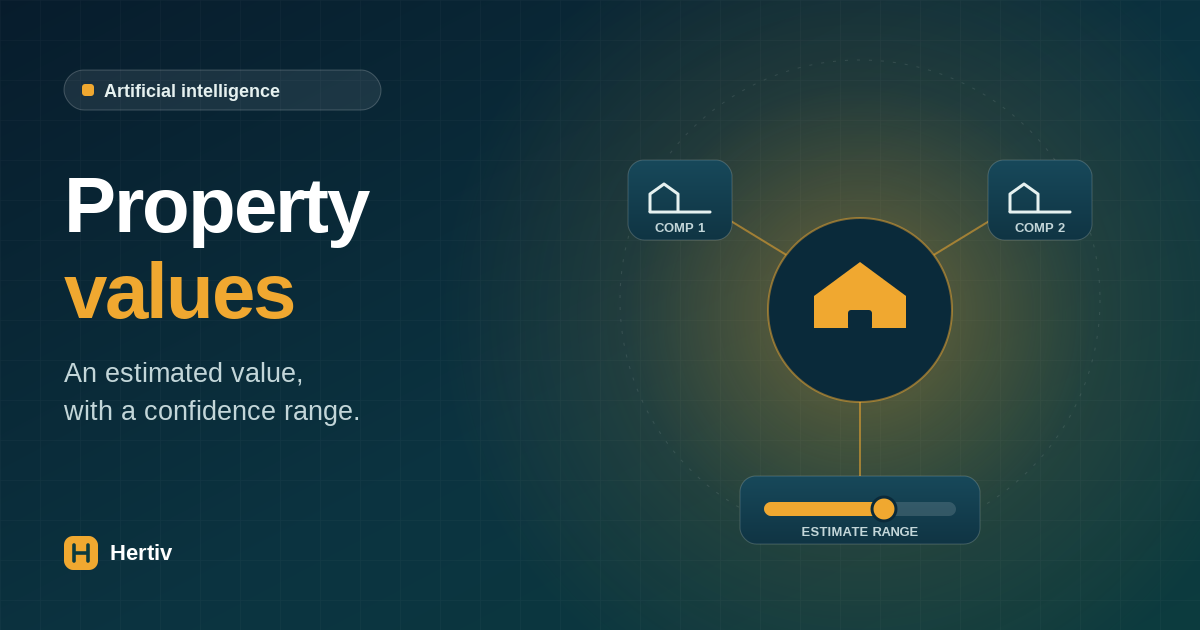
AI property appraisal is an automated valuation that estimates what a property is worth using recent comparable sales, property features and market trends. A model weighs factors such as size, condition, location and sale prices of similar homes, then returns an estimated value with a confidence range. It is fast and cheap, but it cannot see inside the property.
What is AI property appraisal?
AI property appraisal is an automated valuation model, often called an AVM, that estimates a property's value without a person visiting it. It takes the property's facts, finds similar homes that sold recently, and calculates a likely price from those sales.
It is not a full appraisal. A human appraiser visits the property, checks its condition and notes features a database cannot see, such as a new kitchen or a damp wall. An AI appraisal is a fast estimate built from data; a human appraisal is a judgement built from a visit.
The main approaches are:
| Method | What it uses | Best for |
|---|---|---|
| Comparable sales | Recent sales of similar homes | Standard homes in active markets |
| Feature models | Size, rooms, age, condition flags | Adjusting for differences |
| Market trends | Price movement by area | Updating older sales |
| Hybrid review | Model plus human check | Lending decisions |
Most serious uses are hybrid: the model produces the estimate, and a person reviews it before anyone relies on it.
How does an AI appraisal work?
An AI appraisal works in four steps. First it gathers the property's facts: size, rooms, age, plot and any recorded upgrades. Then it finds comparable sales, usually homes of similar size and type that sold nearby in the last few months.
Next the model adjusts for differences. A larger home, an extra bedroom or a recent renovation moves the estimate up; a smaller plot or an older roof moves it down. Finally it applies market trends, so a sale from six months ago is adjusted for price movement since then.
The result is an estimated value plus a confidence range, such as an estimate of 420,000 with a range of 395,000 to 445,000. A narrow range means the model found many close comparables; a wide range means it did not, and the estimate is less certain.
Predictive analytics covers the modelling approach behind these estimates.
Data engineering covers the sales and property data they depend on.
How accurate is AI property appraisal?
Accuracy depends on the property and the market. Standard homes in areas with many recent sales get the most reliable estimates, because the model has plenty of close comparables to work from.
Accuracy falls where sales are rare, properties are unusual, or the data is stale. A unique house, a rural property or a home with a major renovation the database does not record will all produce a wider confidence range and a less reliable estimate.
The confidence range is the honest signal. An estimate with a narrow range is useful for screening; an estimate with a wide range is a warning that a human should look at the property. Treat a single number without a range with suspicion.
Where is AI property appraisal used?
AI property appraisal is used where speed and scale matter more than a single precise value. Lenders use it to screen applications before ordering a full appraisal, so appraiser time goes to the cases that need it. Portfolio owners use it to value many properties at once for reporting, which would take weeks by hand.
It is also used by buyers and sellers for a first sense of price, and by insurers and tax authorities for broad valuations. In each case the estimate is a starting point, not the final word, and the confidence range tells the user how much weight to give it.
It is not used, on its own, for final lending decisions on unusual or high-value properties. Those still need a human appraiser who visits the property and signs off on the value.
How do you use an AI appraisal responsibly?
You use an AI appraisal responsibly by treating it as a screen, checking its range, and ordering a human appraisal whenever the stakes or the uncertainty are high.
- Check the confidence range. A wide range means the estimate is weak; do not rely on it alone.
- Look at the comparables. Are the similar sales really similar, recent and nearby? If not, the estimate is shaky.
- Note what the model cannot see. Condition, renovations and defects are invisible to the model unless recorded.
- Set a threshold for human review. Decide in advance which cases go to a human appraiser, such as wide ranges or high values.
- Keep records. Log the estimate, the range and the comparables, so the decision can be reviewed later.
Document the review step. If a lending decision is ever questioned, the record of what was checked matters as much as the estimate itself.
Example: a lender screens 120 homes
Example (hypothetical): a lender receives 120 mortgage applications in a week. A full human appraisal takes about 3 hours per home, so appraising all 120 would take 360 hours of appraiser time.
Instead, the lender runs an AI appraisal on each home, which takes about 5 minutes each, or 10 hours for all 120. The model flags 18 homes with wide confidence ranges, and those 18 get a full human appraisal at 3 hours each, which is 54 hours.
Total time is 10 hours of AI screening plus 54 hours of human appraisal, which is 64 hours instead of 360. The 102 homes with narrow ranges are approved for the next step, and the 18 uncertain ones get the human attention they need. For a related property-data use, see property tokenization versus traditional investment.
What are the common mistakes?
The most common mistakes are trusting a single number, ignoring the confidence range, and using an automated value where a human visit is required.
- Trusting the headline value. An estimate without its range is half the information. Always read both.
- Ignoring stale data. A model trained on old sales misses a fast-moving market. Check how recent the comparables are.
- Skipping the human review. Unusual properties need a visit. An automated value cannot see a new kitchen or a damp wall.
- Using it for the wrong decision. A screening estimate is fine for a first filter, but not for a final lending decision on a high-value home.
- No audit trail. If nobody logs the estimate and its basis, the decision cannot be defended later.
Key takeaways
- An AI appraisal is a fast estimate from data, not a judgement from a visit
- The confidence range matters more than the headline value
- Standard homes in active markets get the most reliable estimates
- Use automated values to screen; send uncertain cases to a human appraiser
- Always log the estimate, its range and its comparables
Frequently asked questions
What is the difference between an AI appraisal and a human appraisal?
An AI appraisal estimates value from data: recent sales, property features and market trends. A human appraiser visits the property, checks its condition and notes features a database cannot see. AI is faster and cheaper; a human visit is more reliable for unusual homes.
Can a lender rely on an AI appraisal alone?
Usually not for a final decision. Lenders use automated values to screen applications and order a full human appraisal where the range is wide, the value is high or the property is unusual. Rules vary by country and lender.
How long does an AI property appraisal take?
Seconds to a few minutes per property, once the data is in place. That is why lenders and portfolio owners use it to screen many properties at once before spending human time on the uncertain ones.
What makes an AI appraisal inaccurate?
Few recent comparable sales, unusual properties, stale data and unrecorded renovations all reduce accuracy. The confidence range usually shows this: a wide range means the model found little to work with.
Do AI appraisals work for commercial property?
Less well than for homes. Commercial properties vary more, sell less often and depend on rental income, so the model has fewer close comparables. They usually need a human appraiser.
Should a buyer trust an AI valuation when making an offer?
Use it as a starting point, not a final price. Check the comparables and the confidence range, and get a human appraisal or a surveyor's view before committing to a large purchase.