AI Predictive Analytics in Insurance: How It Works
Insurers use AI predictive analytics to price risk, spot fraud and triage claims early. Here is how the models work, what data they need and where the limits are.
On this page
Short answer
AI predictive analytics in insurance is the use of machine learning models to forecast what is likely to happen next: which policies will claim, which claims look unusual, and which customers may leave. The model learns from past policies, claims and customer records, then scores each new case so underwriters and claims teams can act earlier and with a clearer view of risk.
What is AI predictive analytics in insurance?
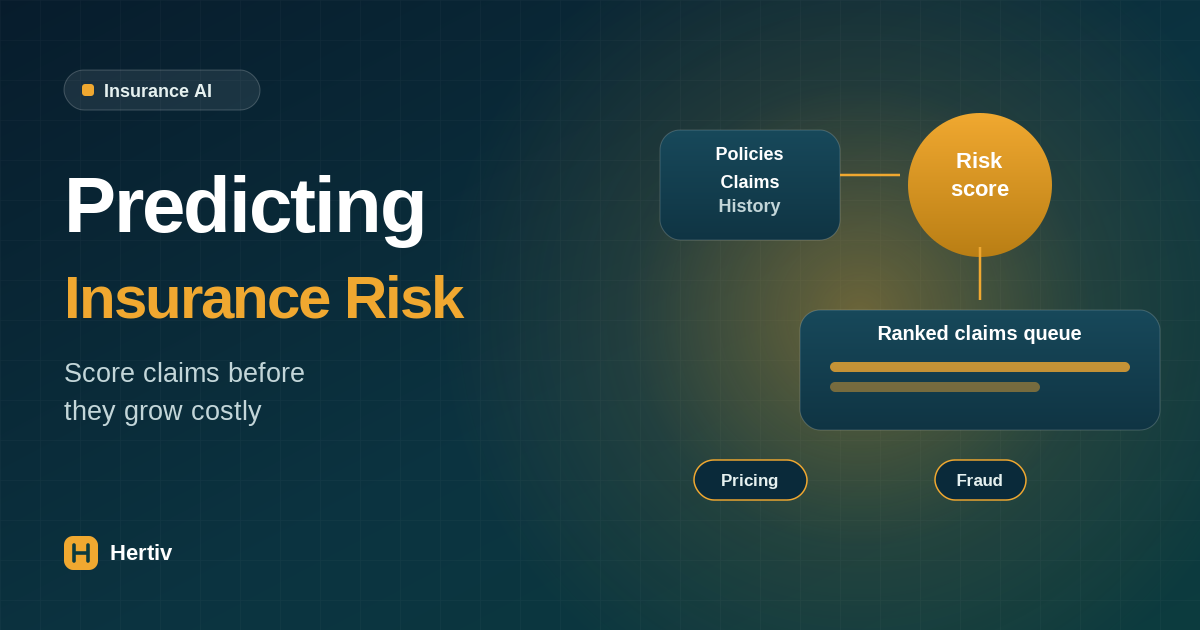
AI predictive analytics in insurance is the use of machine learning models to score the future likelihood of an event, such as a claim, a fraud signal or a customer leaving, based on patterns in past data. The model does not decide anything on its own; it gives people a ranked list so they can focus first on the cases that matter most.
It differs from traditional actuarial tables in speed and detail. A table groups customers into broad bands, while a model can weigh many signals at once, such as claim history, policy type, location and payment behaviour, and update its score as new data arrives.
The result is a number, often called a risk score, attached to each policy or claim. A high score means the model sees a pattern that, in the past, was linked to a claim or a problem. What the team does with that score is a business decision, not a model decision. The basics of the method are covered in the guide to what predictive analytics is.
Where do insurers use predictive analytics?
Insurers use predictive analytics across the whole policy lifecycle, from pricing a new policy to settling the last claim. The table below shows the five most common uses.
| Area | What the model predicts | Who uses it |
|---|---|---|
| Underwriting | How likely a policy is to claim, and how large the claim may be | Underwriters |
| Pricing | A fair premium for a given risk profile | Actuaries and pricing teams |
| Claims triage | Which claims need fast review and which can settle normally | Claims handlers |
| Fraud | Which claims look unusual compared with past patterns | Investigators |
| Retention | Which customers may leave at renewal | Service and sales teams |
Underwriting and pricing were the first areas to adopt it, because they already worked with large sets of past claims. Claims and fraud followed, because a ranked queue lets a small team handle the riskiest cases first instead of working through files in the order they arrived.
Retention is the newest use. A model that spots customers likely to leave at renewal lets the service team call them early, when a conversation can still change the outcome. The same pattern appears in other industries, as shown in the guide to predictive analytics in finance.
What data feeds the models?
The models feed on data the insurer already holds: policy details, past claims, payment history, customer contact records and, where the rules allow, external data such as weather or vehicle records. The quality of that data matters more than the choice of model.
Three data problems appear in almost every project:
- Missing history. Claims from old systems may lack the fields the model needs, so the team must clean or rebuild them first.
- Inconsistent labels. If two teams record the same outcome in different ways, the model learns the wrong pattern.
- Stale data. A model trained on five-year-old claims may miss how risks have changed since then.
Insurance data is also sensitive, so access rules matter. Teams usually work with masked or aggregated data during development, and only the live system sees full customer records. That is a legal and practical requirement, not an optional step.
How does an insurer build a predictive model?
An insurer builds a predictive model by defining the question, preparing the data, training and testing the model, and then putting it into daily use with monitoring. The work is mostly data preparation, not modelling.
- Define the question. Pick one outcome to predict, such as 'will this policy claim in the next year', and agree on how success will be measured.
- Gather and clean the data. Pull policy, claim and customer records, fix missing values and agree on consistent labels.
- Train on past data. Fit the model on older cases, holding back the most recent ones for testing.
- Test on unseen cases. Check how well the model scores the held-back cases, and compare it with the current method.
- Run a small pilot. Let one team use the scores alongside their normal work and compare the results.
- Monitor in production. Track whether the scores stay accurate as new data arrives, and retrain when they drift.
A pilot matters because a model that looks good in testing can still fail in daily use, for example when handlers do not trust the scores or when the data feed changes. The pilot is where those problems surface while they are still cheap to fix.
Example: a motor insurer triaging claims
Example (hypothetical): a motor insurer receives 1,000 claims a month. Handlers used to work through them in the order they arrived, so an urgent claim could wait days behind routine ones.
The team builds a model that scores each claim for the chance it needs a closer look. The top 15% of scores, or 1,000 x 15% = 150 claims, go to a same-day review queue. Of those 150, about 30% need extra checks, or 150 x 30% = 45 claims, and the team catches them on day one instead of day five.
The other 850 claims stay in the normal queue and settle on the usual timetable. Nothing is auto-denied: the score only changes the order of work. After three months, the team compares the pilot group with the old queue and finds that the flagged claims are resolved about four days faster on average.
The numbers are small on purpose. A triage model does not need to be perfect to help; it only needs to rank the risky cases above the routine ones. That is the test a team should run before spending more on the project.
What are the limits and risks?
The limits of predictive analytics in insurance are data quality, fairness and the fact that the future is not a copy of the past. A model trained on old patterns can miss a new kind of risk, such as a new fraud pattern or a change in driving habits.
Fairness is the sharpest risk. If the training data reflects past decisions that treated some groups unfairly, the model can repeat that pattern at scale. Insurers must check scores across customer groups and be able to explain why a score is high, especially where regulators ask for it.
There is also a limit on what the model can know. It sees the data it was given, not the full story of a customer. A claim that looks unusual on paper may have a simple explanation, which is why a person should still make the final call. For teams building the underlying software, the guide to how to build an insurance app covers the systems these models plug into.
What are the common mistakes?
The most common mistakes are starting with too many use cases, trusting the model without a pilot, and forgetting that the data, not the model, decides the result.
- Too many questions at once. Pick one outcome, prove it works, then add the next.
- No pilot. A model that is never tested beside real work usually fails when it meets it.
- Dirty data. Missing fields and inconsistent labels will quietly ruin the scores.
- No fairness checks. Scores should be checked across customer groups before they are used.
- Auto-deciding on scores. A score is a ranking, not a verdict; a person should make the final call.
Key takeaways
- A predictive model ranks cases by risk; people still make the final call
- The biggest uses are underwriting, pricing, claims triage, fraud and retention
- Data quality decides the result far more than the choice of model
- Run a small pilot beside normal work before rolling the scores out
- Check scores for fairness across customer groups and keep them explainable
Frequently asked questions
What data do insurers need for predictive analytics?
The core inputs are policy records, past claims, payment history and customer contact records. External data such as weather or vehicle records can help where the rules allow it, but the project should start with the data the insurer already holds and trusts.
Is predictive analytics the same as AI underwriting?
No. Predictive analytics is one tool that underwriting can use. AI underwriting is the wider process of using models and rules to assess risk, and it may include document reading, data checks and pricing as well as prediction.
How accurate are insurance predictive models?
It depends on the question and the data. A model that ranks claims for triage only needs to put the risky cases near the top, while a pricing model needs tighter accuracy. Teams should measure accuracy on recent, unseen cases rather than on the data the model was trained on.
Can a model deny a claim?
It should not, on its own. A score can rank a claim for faster review, but the decision to pay or deny should come from a person who can see the full file. Regulators in many markets expect a human to be responsible for that decision.
How long does a first project take?
A narrow pilot, such as claims triage for one product line, often takes a few months, with most of the time spent on data cleaning and agreeing on labels. A wider rollout across products takes longer, because each product brings its own data and rules.
What should a small insurer do first?
Start with one question that has clear data and a clear owner, such as which claims need fast review. Clean that data, run a pilot with one team, and measure the result before spending on more models.


